
Who tames power?
In the last part I left Magdeburg lying as a field of ash. In 1631 Tilly’s troops had wiped out the richest city of the German interior, twenty-five thousand dead, the town burned down to the cathedral.
Out of that ash something grew. It still decides why a German and an American say the word “state” with different feelings. The one thinks of protection, order; the other of an overbearing state.
The bill from Augsburg
Where did this war come from?
Cuius regio, eius religio, the formula of Augsburg in 1555: whose the realm, his the faith. It sounded like a solution. But it was only a ceasefire. What happened when a prince changed his confession? What of the Calvinists, who were not even provided for at Augsburg? What of the towns where both creeds lived door to door? These open questions came back, for two generations, in one country after another. In France the Huguenot wars raged from 1562, eight of them. Their low point was the St Bartholomew’s Day Massacre of 1572, when thousands of Protestants were cut down in Paris within days. Only Henri IV ended the killing — himself a Huguenot, who converted to Catholicism because “Paris is worth a Mass”, and who in 1598 granted his old co-religionists protection with the Edict of Nantes. Remember this edict. It will die later in this part. In the Netherlands the Protestant northern provinces rose from 1568 against Catholic Spain, a war that would last eighty years and give birth to a new, mercantile republic. Remember it too. It sends a king to England in 1688. And then, in 1618, the spark. In Prague, Protestant nobles threw two imperial governors out of a castle window. The two survived because they landed, depending on the source, in a dung heap or in the grace of God; history has settled on the dung heap. More important than their fall was what it set off. The confessional fault line that Luther had torn open and Augsburg had hastily plastered over now ripped along its whole length.
The school of terror
The war that grew out of it lasted thirty years. It was a permanent condition that devoured a generation. Mercenary armies marched through the land and had to feed themselves, because no one paid them. Bellum se ipsum alet, war feeds itself, ran the principle, and in practice every village paid twice, to friend and foe. Wallenstein’s army was a wandering economic system with pikes. In some districts of central Germany a third of the people died, of violence, and more of hunger and plague.
Whoever survived that drew a lesson from it. It was not the lesson of liberty. Between you and the next Magdeburg stands only one thing: a power strong enough to enforce the peace. An army of your own, standing, paid, always ready. An administration that gathers taxes without long questions. A state that commands from above, because the chaos from below has just killed everyone you knew. Perhaps that is the birth of the Continental reflex, born of experience.
Westphalia 1648 — the peace of the princes
The Peace of Westphalia, negotiated in Münster and Osnabrück, ended the dying and answered the question of power in the Continental manner: from above. Around three hundred imperial territories were recognised as practically sovereign, with the right to make alliances and wage war. The Emperor remained as a roof, but the roof carried nothing. People celebrated this at the time as “German liberty”. And so it was, only not for those one means today. It was the liberty of the princes, not of their subjects. Cuius regio, eius religio was extended and widened to include the Calvinists. Whose the realm, his the faith, and now also: his the army, his the tax, his the last word. So the Empire did not splinter into freedom but into a host of small powers. Every prince now wanted his own Versailles, even a Versailles of brick.
The army that built itself a state
Brandenburg-Prussia in 1648 was rather a bad idea on the map: a few scattered patches in the north German sand, with no natural borders, bled white by the war. Frederick William, the Great Elector, reigned from 1640 to 1688 and drew an iron conclusion from his weakness. A land without borders can protect itself by one thing only: a standing army. So he built one, miles perpetuus, permanently under arms, even in peace. That was new, and expensive.
Expensive means taxes. Taxes until now were granted by the Estates, the diets of nobles and towns. But they did not want to. So the Elector broke them by buying them. The deal ran: let me levy taxes for my army and keep out of it, and in return I shall let you do as you please on your own estates. Above all with the peasants.
The result was a fusion of crown and Junker that would shape Germany for two centuries. The nobility became the officer corps and the estate-management of the state; the state left the nobility its serfs. And so, east of the Elbe, exactly the opposite happened to what happened west of it. Remember Magdeburg on the Elbe, “town air makes you free”, the serf who became free behind the town wall? West of the river, bondage loosened. East of it, in Brandenburg, Pomerania, East Prussia, it grew tighter in precisely these decades. Historians call it the “second serfdom”. The same river, two directions. On the one side the free town, on the other the manorial estate.
The state that arose this way had a peculiar tilt. In it the army did not come to the state; rather the state came to the army. The administration grew to supply the army; the tax flowed to pay the army; the official existed so that the soldier could exist. A century later a French observer would scoff about the Prussia of Frederick the Great that it was not a state with an army but an army with a state. The sentence was framed out by 1688. In 1701 the Great Elector’s son set the royal crown on his own head.
Versailles, or the taming of the nobility
France answered the same question more grandly, more brilliantly, and with better food. The road there was paved by no king but by a cardinal. Henri IV had fallen in 1610 to a fanatic’s dagger. Then came Richelieu. As chief minister to Louis XIII he did three things with cold method: he shattered the political and military power of the Huguenots, whose fortress of La Rochelle fell in 1628 after months of siege. He tamed the nobility, banned duels, and had defiant castles razed. And he made the king’s will the single axis around which everything turned.
Hume, looking at this from the distance of a century, balanced it soberly. Richelieu, he writes, held his own sovereign in subjection while he exalted the throne. “The people, while they lost their liberties, acquired, by means of his administration, learning, order, discipline, and renown.” He had taken the confused and inaccurate genius of government that France shared with the other European kingdoms and “changed [it] into a simple monarchy — at the very time when the incapacity of Buckingham encouraged the free spirit of the commons to establish in England a regular system of liberty.”
There is the whole fork in a single sentence, and a Scotsman of all people wrote it. At the same time, with the same printing press, the same wars, the same Roman inheritance: here the simple monarchy, there the system of liberty. And Hume did not prettify it. Absolutism took the liberties and gave order, discipline, renown. For people who carried Magdeburg in their memory, that was no bad bargain.
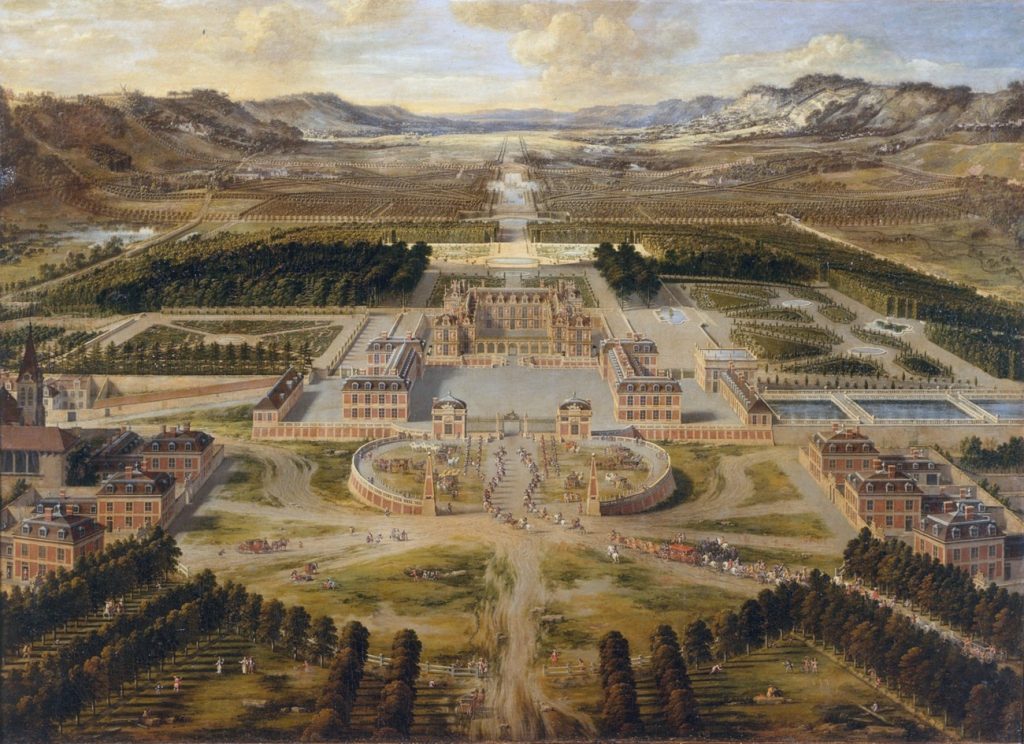
France got its own test of the matter. In 1648, the same year as the Peace of Westphalia, the Paris law courts and part of the nobility rose against the crown, the Fronde. The one moment when France did what England did: elites rebelled against the king. It failed, because the rebellious courts and the rebellious princes never found their way to a common front, and because the country, sick of chaos, wanted the strong king back in the end. The young Louis XIV fled the rebellious Paris one night as a child, and he never forgot it. The lesson he drew was the exact reverse of England’s. Never again must Paris have power, never again the nobility. From 1661 he ruled himself, without a chief minister, and from 1682 from a place built for the purpose: Versailles.
The trick was brilliant and a little ridiculous at once. Louis invited the high nobility to live with him, and there turned them into court extras competing over who might hand the king his shirt in the morning. Whoever stayed on his country estate was cut off from the source of all favour. Whoever came surrendered his independence at the cloakroom. A nobility that scuffles over the privilege of holding a candlestick plans no more Frondes. It was a gilded cage, and they crowded into it.
In the engine room Colbert built the rest: a mercantilist steering of the economy, royal manufactures, a navy, intendants as the crown’s governors in the provinces, the largest army in Europe. The state could now do anything. And to prove it could do anything, in 1685 it did something stupid. Louis revoked the Edict of Nantes and banned Protestantism. Around two hundred thousand Huguenots fled, and they were not just anyone, but craftsmen, merchants, skilled men. They went to the Netherlands, to England, and, received with open arms, to Brandenburg-Prussia, which positively invited them with the Edict of Potsdam. France gave away its own skill to precisely the rivals it had most reason to fear. The strength of the absolutist state was that no one could say no. Its undoing was the same.
Leviathan — the theory from above
While the Continent built the state from above, an Englishman of all people wrote its clearest justification yet. Thomas Hobbes sat in Parisian exile while at home the civil war raged, and in 1651 his Leviathan appeared. Hobbes asked one simple, terrible question: what would life be without a state? His answer was the state of nature, the war of all against all, in which life is “solitary, poor, nasty, brutish, and short”. Out of fear of that condition, men make a contract: they hand their rights to a sovereign, the Leviathan, and get in return the only thing that counts. Security. This sovereign must be absolute and undivided, for a divided power is a half power, and a half power is the door to civil war. One can dismiss Hobbes as a courtly flatterer, but that would be false. He flattered no king; he argued out of horror. He had the English civil war before his eyes and had heard of the German one. His logic: better one Leviathan than a thousand knives. And half the Continent lived exactly that without ever having read Hobbes. Versailles was the Leviathan in silk.
England’s other road — the king under the axe
The Stuarts wanted what Louis had. That was their good right and their undoing. James I, who came from Scotland to the English throne in 1603, was a theorist of the divine right of kings; he wrote books arguing that kings were set up by God and accountable to none but him. His son Charles I meant it in earnest. For eleven years, from 1629 to 1640, he ruled without parliament and raised money by means that lay hard on the edge of the law. He wanted his England from above. Only he lacked both things Louis had: no Versailles and no standing army. And when he needed money for a war, the Scots had risen against his church policy, he sat in the trap. For new taxes he needed Parliament. And Parliament, once summoned, made demands. Whoever holds the purse holds, in the end, the king. In 1640 Charles had to call it back, and this Long Parliament had not come to obey. In 1642 the civil war broke out. Parliament against crown, Roundheads against Cavaliers, and out of the chaos rose a man who was the first to run war like a modern craft: Oliver Cromwell, with his disciplined New Model Army. Charles lost, was captured, put on trial, and on 30 January 1649 the thing happened that was literally unthinkable on the Continent. Hume describes it without a gram of pathos. “At one blow was his head severed from his body.” A masked man held it up and cried: “This is the head of a traitor!” A nation had put its king before a court and beheaded him by sentence.
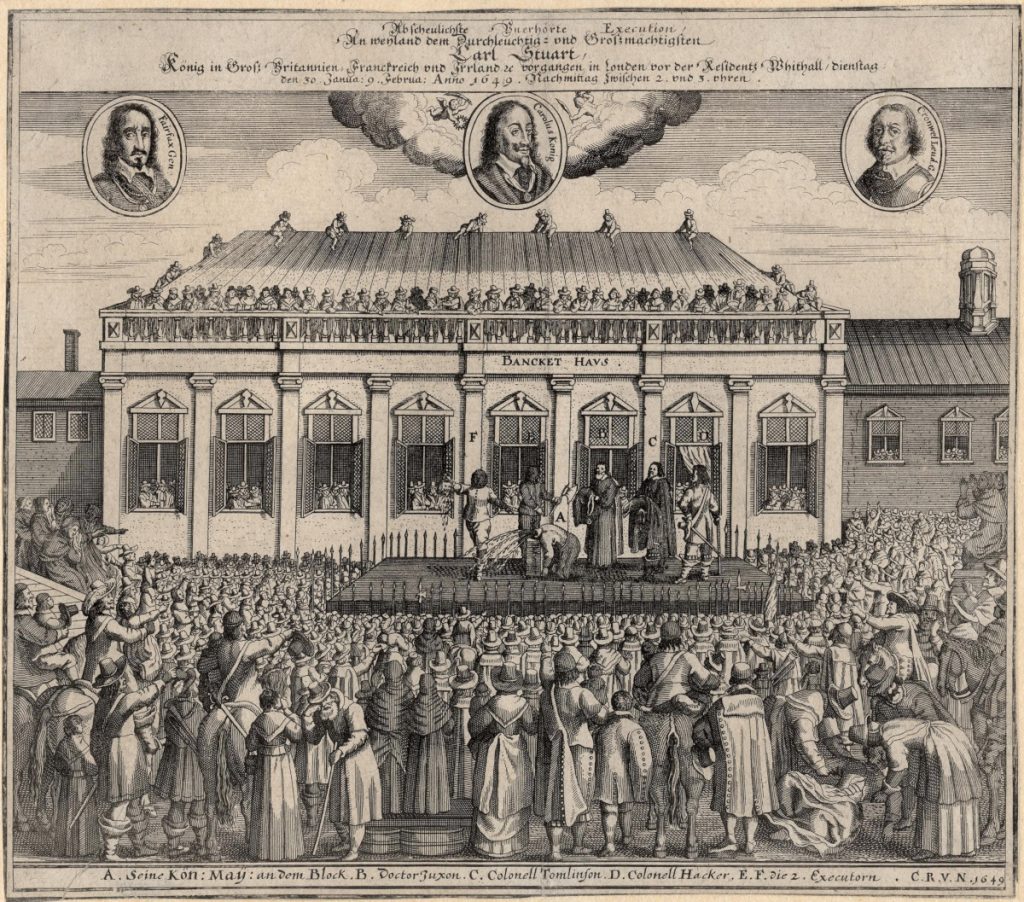
Here one must take care not to fall into the Whig trap and transfigure the “from below” into a choir of angels. The same Parliament had earlier disposed of two men by judicial murder, the minister Strafford and the aged Archbishop Laud, against all due process. Hume, the sceptic, drew the lesson coolly: popular assemblies are by their very number largely exempt from the restraint of shame, and “when they also overleap the bounds of law, they naturally break out into acts of the greatest tyranny and injustice”. The “from below” could itself become tyranny. And it did. The republic tipped within a few years into a military dictatorship. Cromwell ruled as Lord Protector, had the land administered by generals, closed the theatres, and the zealots who had marched into war with God’s word now hoped, as Hume notes with a dry edge, “by the terror of the sword, to impose a more perfect system of liberty on the reluctant nation”. Liberty by the sword, decreed from above. The English road to liberty ran first through a regicide and a junta. In 1660 the exhausted nation called the beheaded king’s son back.
1688 — the balance holds
It could have ended here, with a restoration and an England that swung onto the Continental track after all. It went otherwise. Charles II ruled cleverly and in secret league with Louis XIV. His brother James II, from 1685, was openly Catholic and clumsy with it. He tried, by royal fiat, to suspend laws and bring Catholics into office. As long as he seemed childless, men gritted their teeth and waited for his Protestant daughter. When a Catholic son was born to him in June 1688, the mood turned. What the English elite then did was cool and unprecedented. It invited itself a new king. William of Orange, stadtholder of the Netherlands, a Protestant, married to Mary, James’s Protestant daughter, received a formal invitation from leading men of both parties. Here a circle closes: the Dutch Republic, that mercantile, federal, comparatively tolerant counter-model to Versailles, supplied England its rescuer. William landed in November 1688 with an army, and James lost his nerve. He fled to France and on the way, so a pretty anecdote runs, threw the Great Seal of state into the Thames, as if the state could be switched off by drowning its stamp. In England barely a shot was fired. (In Scotland and Ireland it looked bloodier; the Irish are still paying for 1688.) In the spring of 1689 an assembly met, declared the throne vacant, and offered it to William and Mary, but on conditions. These conditions, the Bill of Rights of 1689, are the real monument. No standing army in peacetime without the consent of Parliament. No tax without Parliament. Free elections, free speech in Parliament, frequent parliaments, no royal suspending of the laws. Alongside it the Toleration Act of 1689, which allowed Protestant dissenters their worship. Not the Catholics, let us stay honest. The crown sat from now on under the law, not above it. The same year a philosopher supplied the justification. John Locke published his Two Treatises of Government. They are the exact counter-speech to Hobbes. Where Hobbes gave power upward, Locke derives it from below: government rests on the consent of the governed, man has natural rights to life, liberty, and property, and a ruler who breaks the trust may be removed. The same question as Hobbes, the opposite answer. England did not skip the question but fought it out, Hobbes against Locke, and chose Locke in the end. The Continent lived Hobbes without choosing. Why did England succeed where Charles I had failed and what the Fronde in France had not managed? Not because the English were freer by nature. But because they had what the Continent had lost: one national parliament with its hand on the purse and one national common law. France and Prussia tamed their nobility, the one at Versailles, the other with the bargain over the peasants. England’s landed gentry, though, sat together in a single chamber that could not be bought castle by castle. The Continent’s splintered liberties could be rolled over one after another. England’s bundled liberty held.
Not better, but different
Hume’s History of England ends in 1688, with the expulsion of James II. The aftermath we write ourselves, but Hume lays down his pen here. He was no Whig cheerleader. His Charles I is neither tyrant nor martyr but a tragedy of timing. Charles, Hume writes, was “a good, rather than a great man”, “more fitted to rule in a regular established government, than either to give way to the encroachments of a popular assembly, or finally to subdue their pretensions”. And then the sentence that carries the whole series: “Had he been born an absolute prince, his humanity and good sense had rendered his reign happy, and his memory precious; had the limitations on prerogative been in his time quite fixed and certain, his integrity had made him regard as sacred the boundaries of the constitution. Unhappily his fate threw him into a period” when none of that stood firm. A decent man, ground between an old order and a new one. Liberty, Hume saw, did not arise from any noble design.
Versailles gave France a century of brilliance, a rational, central state, a language and a taste that all Europe imitated. Absolutism brought order after the horror. England’s road was bloodier: a beheaded king, a military dictatorship, in the end an imported prince. Its liberty was for the propertied, shut out the Catholics, and was just then preparing to build itself a slave empire whose moral shadow this series has still to settle.
Not better. Different. The Continent had learned in the great war that order must come from above, or chaos returns. England learned at its Stuarts the opposite, just as bitterly: a power that no one binds from below sooner or later turns to tyranny. Both were right, each with its half of the truth, and the century made each side pay the price for it.
On the Continent the state won, and would spend the next century perfecting itself. On the island the state was put into harness, and it would spend the next century arguing about how tight to pull it. That argument, conducted by Hume’s own generation, in coffee houses and lecture halls from Edinburgh to Philadelphia, is the next part.
Sources and references
Primary sources – David Hume, The History of England, the volume on the reign of Charles I (1625–1649), first published 1754 — all Hume quotations in this part are from it (the Richelieu sketch; the character of Charles I; the execution; Strafford and Laud; the enthusiasm of the assembly) – Thomas Hobbes, Leviathan (1651) – John Locke, Two Treatises of Government (1689) – Bill of Rights (1689); Toleration Act (1689)
Secondary literature and references – On the wars of religion 1555–1618: the French Huguenot wars (St Bartholomew’s Day Massacre 1572; Edict of Nantes 1598), the Dutch Revolt (from 1568), the Defenestration of Prague (1618) – On the Thirty Years’ War and the Peace of Westphalia 1648: Peter H. Wilson, Europe’s Tragedy (2009) – On Brandenburg-Prussia, the Great Elector, and the manorial serfdom east of the Elbe (the “second serfdom”): Christopher Clark, Iron Kingdom (2006); the dictum attributed to Mirabeau (“an army with a state”) refers to the Prussia of Frederick the Great, c. 1788 – On Richelieu, the Fronde, Louis XIV, and Versailles; the revocation of the Edict of Nantes (1685) and the Huguenot emigration (Edict of Potsdam, 1685) – On the English Civil War, the regicide (30 January 1649), Cromwell’s Protectorate, the Restoration of 1660, and the Glorious Revolution of 1688/89
Schreibe einen Kommentar