
From the Big Bang to the Digital Primordial Soup.
Why, of all things, should a cow tell you the story of the world?
Because Audhumbla is a very special cow. She has been alive since the Big Bang — perhaps even before that; who knows for sure? Sometimes she lives on a farm, in a barn, or in a pasture; sometimes she lives in Ginnungagap — that special realm that lies beyond our real world. When she dwells in Ginnungagap, she knows everything. But when she lives on Earth, she forgets all these things and knows no more than any other cow.
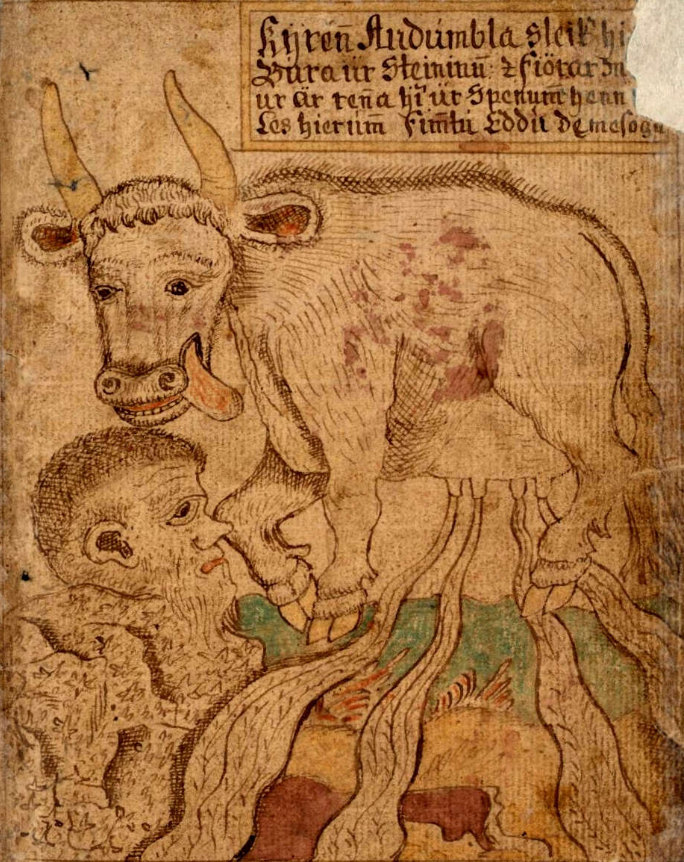
From an 18th-century Icelandic manuscript.
It is a curious arrangement, this double existence, and it is precisely what makes her the right narrator for a book that has no business being told by any single human voice. No biologist can speak about the Big Bang with the authority of the cosmologist; no cosmologist will have much to say about the rumen microbiome of a Holstein-Friesian; no animal scientist will know much about the Thirty Years’ War or about Renaissance cattle painters in the Dutch Lowlands; and none of them, perhaps, will be especially well placed to explain what the world will look like once artificial intelligence has finished its first proper pass through agriculture. But Audhumbla, the primal cow of Norse mythology — the one who licked the first god from the salt of the ice, according to the Edda — Audhumbla can do it. She remembers all of it. She has been there for all of it. And when she is in Ginnungagap, that timeless space, she can tell us the whole thing in one continuous breath.
This is the conceit of Audhumbla Remembers — An Odyssey of Rebirth from the Big Bang to the Digital Primordial Soup, the new English edition of my book. It is, on the face of it, a book about cattle. But anyone who picks it up expecting the usual narrow tract on dairy farming will be in for a surprise, because the cow’s lineage — once you start pulling on the thread — turns out to be the lineage of everything. Trace it back far enough and you arrive at LUCA, the Last Universal Common Ancestor, the single cell from which every living thing on Earth descends. Trace it forward and you arrive in a milking-robot metropolis in Iowa, where 30,000 cows are managed by algorithms that know each individual animal’s body temperature, fertility cycle, milk yield and even her gait pattern in real time. Between those two points lies thirteen and a half billion years of history, which is rather more than most cattle books attempt.
What this book is, and what it is not
It is not an academic monograph, although it draws on a good deal of academic literature and the bibliography runs to several pages. It is not a polemic, although it has opinions — about the methane debate, about industrial-scale dairying, about the curious way in which a single American bull line (“Carlin-M Ivanhoe Bell”) came to dominate the genome of nearly every milk cow on the planet. It is not a children’s book, although Audhumbla’s voice is warm enough that you could, if you wished, read passages of it aloud. And it is not the kind of farming memoir that explains how to muck out a barn or how to handle a calving.
What it is, more than anything else, is a long and very deliberately broad story. The book has thirty-one chapters and an introduction, and the chapters move forward in time. They begin before time begins (“Ginnungagap, the Beginning?”), then proceed to the formation of the eukaryotes, the rise of the vertebrates, the appearance of the mammalian line, the bovids, the aurochs — and only at chapter six do we reach domestication itself, ten thousand years ago in the Fertile Crescent. From there the narrative moves through Rome and the early Middle Ages, the High Middle Ages, the Thirty Years’ War, the Peace of Westphalia, the nineteenth century, the two World Wars, the post-war “butter mountains” of West Germany, the data-cloud cow of the present day, and on into the speculations of the next twenty-five years.
About a third of the way through, the book pauses. There is an interlude — “Beyond Chronology and Causality” — in which Audhumbla, back in Ginnungagap, reflects on the strangeness of telling a story in a single direction when, from where she sits, all directions are equally available. After that the chapters fan out: ration calculation, milking-robot farms, the questions of whether large dairies, small dairies, mother-bonded calf-rearing, American-scale operations, and species-appropriate husbandry can all be reconciled. Then a sequence of three chapters tackles the climate-and-environment trinity head-on: methane, water consumption, and nitrate. These are not gentle chapters. They engage with the literature, but they also push back, sometimes hard, against the simplifications that have become standard fare in newspaper columns.
Toward the end of the book the story turns to breeding history proper — the aurochs, the breeds, the Holstein, the genetic revolution, the question of what farmers know that city-dwellers have forgotten. The final chapter, “The AI Revolution — Return to the Digital Primal Soup, 2025–2050,” takes the conceit full circle: the digital soup of trained models, sensor networks and autonomous milking systems is not, in the end, so very different from the primal chemical soup in which life first organised itself. Order from chaos, and back again.
Who it is for
The book is written for an unusually broad audience, and that has been a deliberate choice. It is for the dairy farmer who wants to see her own daily work set in a cosmic frame. It is for the city-dweller who has never thought twice about the cheese in his supermarket basket but suspects, faintly, that there is more to the story. It is for the student of biology or veterinary medicine, who will find the evolutionary and genetic chapters considerably more detailed than the breezy tone might initially suggest. It is for the historian who is interested in how a single domesticated animal interacted with European agriculture across two thousand years of war, plague and recovery. It is for the climate-curious reader who would like to engage with the methane question without being shouted at from either side. And it is, frankly, for the curious person who simply enjoys an essayistic, opinionated, occasionally meandering book that takes its time and trusts the reader to follow.
Some chapters are denser than others. Chapter 28, on the Holstein-Friesian breed, runs to nearly a hundred pages on its own and is essentially a small monograph on the most successful rebranding campaign in agricultural history — how a chaotic, centuries-long cattle trade between Danish, German, Dutch and Frisian farmers eventually produced a “global monoculture” with the Holstein name attached to it, even though only a fraction of the underlying genetics ever came from Holstein proper. Other chapters are short, lyrical, even fragmentary. The interlude at chapter fifteen is barely an essay; the closing chapter on AI in agriculture is more a long thought experiment than a survey. The tone shifts with the material, and that is part of the design.
A few threads, to give a flavour
The opening introduction begins, of all places, in a German supermarket, where the author is hunting for a Camembert and finds himself transfixed by the scale of the global dairy economy: 978.5 million tonnes of milk a year, a Coke-can’s worth for every human being on Earth every single day. From there it slides backwards in time, past the Eliava Institute in Tbilisi, where bacteriophages were cultivated as alternatives to Western antibiotics during the Cold War, past the four-stomach digestive system of the cow — that “decentralised, cooperative” factory in which bacteria do most of the actual work — and back, eventually, to LUCA.
In the chapters on the Thirty Years’ War, the cow becomes, briefly, a survivor of plague and reconstruction. In the chapters on Renaissance painting, art-historical evidence is marshalled to establish what colour the cows of the Dutch lowlands actually were before the eighteenth century (mostly red, as it happens; black-and-white pied cattle only began to dominate around 1750). In the chapter on the breeding revolution, you will meet Carlin-M Ivanhoe Bell — born 1974, died 1978, sire of millions — and learn how his line came to constitute one of the most concentrated genetic bottlenecks in the history of any livestock species. In the chapter on the methane question, you will find a real attempt to wrestle with the carbon-cycle accounting and the difference between biogenic and fossil methane, rather than the usual one-line slogans. In the chapter on the future, you will find Audhumbla wondering, half-amused, what it means to be a cow whose every twitch is recorded by a sensor and analysed by a neural network.
Throughout all of this, the cow herself speaks. Sometimes from a pasture, sometimes from Ginnungagap, sometimes from a milking robot’s database. When she is in Ginnungagap she remembers everything; when she is on Earth she remembers nothing more than the next mouthful of grass. The book moves between those two registers, and the reader is invited to do the same.
A note on the edition
The English text is a British-English edition, prepared from the original German manuscript with care taken to preserve the author’s voice, his occasional irony, his fondness for the long sentence, and the small libertarian asides that surface here and there throughout the book. The book contains more than 180 figures — paintings, photographs, charts, schematic diagrams — and the EPUB and PDF editions reproduce them in full.
The original German edition is Audhumbla erinnert sich — Eine Odyssee der Wiedergeburt vom Urknall zur digitalen Ursuppe, and remains available for German-speaking readers.
Where to find it
Book excerpt:
Audhumbla Remembers is published by books.andreas-john.net and is available as an EPUB for e-readers and as a PDF for screen and print. A free chapter excerpt (Chapter 28, on the Holstein-Friesian) is available for download from the publisher’s website, so that prospective readers can get a proper feel for the voice, the breadth and the level of detail before committing to the full volume.
Come — let us travel, from the singularity to the meadow.
— Andreas John
Available for purchase in the shop, together with the audiobook, 22h, 2 Parts, for €9.99.
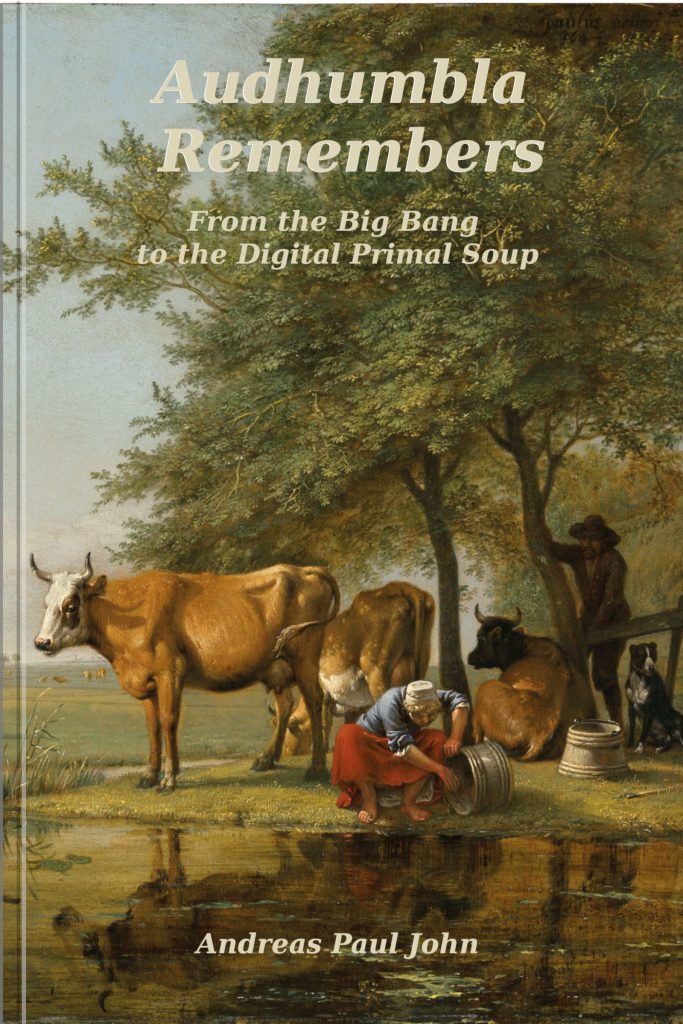
„Landscape with Cattle“ (c. 1650), Public Domain
„Landscape with Cattle“ (c. 1650), Public Domain
Schreibe einen Kommentar