
A man Germany does not know — and who, on April 1, 1789, opened the House of Representatives of the United States and First Speaker.
On July 4, 2026, the American Declaration of Independence turns 250 years old.
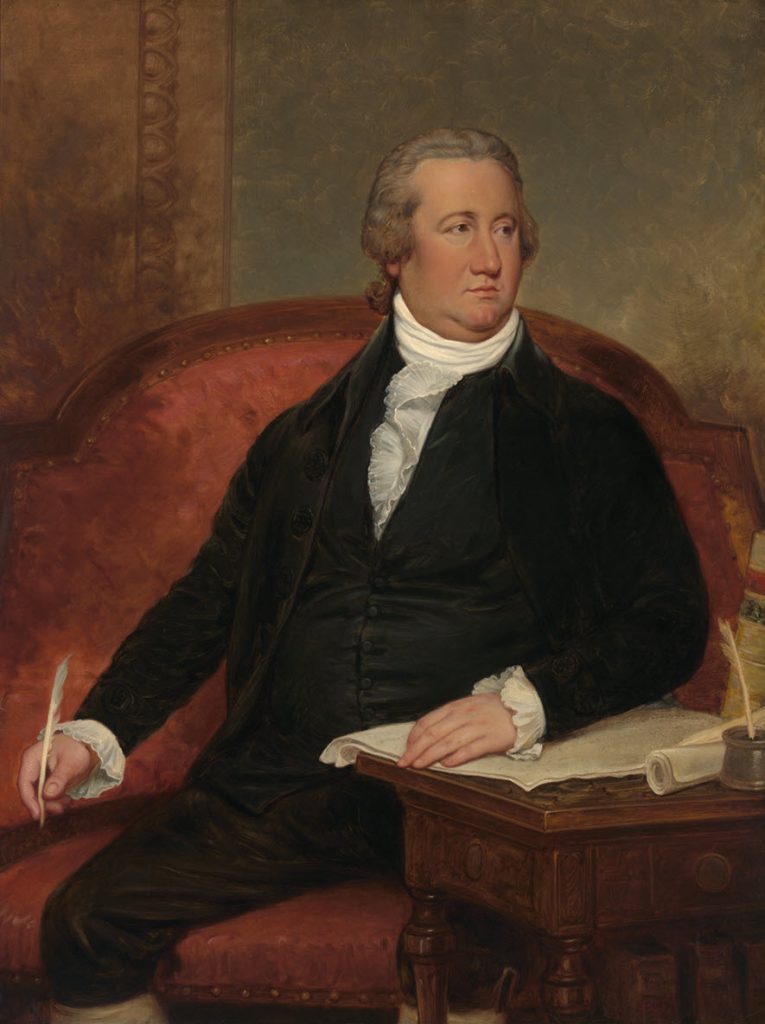
The Declaration of 1776 was a manifesto — a text, not a state. What happened between 1776 and 1789 was the slow labor of turning a manifesto into a constitution, a constitution into a Congress, a Congress into a working government. That labor did not fall to the signers of the Declaration. It fell to the next generation — those who in 1776 were still too young to sign, and in 1789 old enough to write the standing orders.
Frederick Muhlenberg was one of them. On April 1, 1789, thirteen years after the Declaration, he stepped before the House of Representatives of the United States as its first Speaker and opened the session. The Bill of Rights passed through his hands in the months that followed.
He is a footnote of the founding era in America — his portrait hangs in the Capitol, his name appears in every account of the First Congress. In Germany he is unknown. Yet he was the German voice at the moment the thirteen colonies became a state.
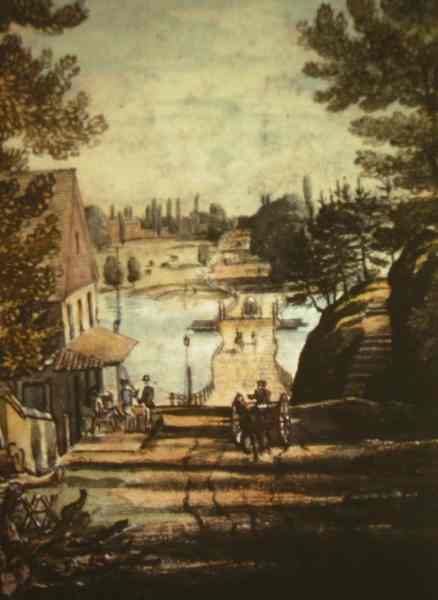
He was baptized on January 15, 1750, in a parsonage north of Philadelphia. His father was Henry Melchior Muhlenberg, the most influential Lutheran pastor in North America. His grandfather was Conrad Weiser — the Württemberg Schultheiß who had grown up among the Mohawk and spent thirty years mediating between the Iroquois and the British Crown. Three generations, three languages, one country in the making. That is where this book begins, continuing the story told in Between Two Worlds: First Speaker — Frederick Muhlenberg, the German Voice in the First Congress.
Three generations, one country becoming itself
Readers of Between Two Worlds know the grandfather. Frederick is the third generation. His father Henry Melchior Muhlenberg had come from Halle to Pennsylvania in 1742 to bring order to the scattered Lutheran congregations — and did so with such thoroughness that his Kirchenordnung, his church order, produced a structure with more in common with republican self-government than with European state churches: pastors elected by their congregations, lay elders sharing in decisions, a synod that worked through consultation rather than command.
It is a thesis seldom argued in Germany and only at the edges in America — but it follows from the sources: the German immigrants brought more than plows and pastors with them. They brought an order that anticipated, in decisive points, the later constitution. Frederick Muhlenberg lived inside that order before he translated it into politics.
Halle, 1763
In 1763 Henry Melchior sent his three sons to Halle, to the school of the Francke Foundations — the school where he himself had studied. Frederick was thirteen. His Latin was not yet what it needed to be. Halle in those years was a city of roughly 18,000 — larger than Philadelphia at the time, far larger than Princeton with its thirty students. The Francke Foundations were an educational complex without equivalent in the colonies.
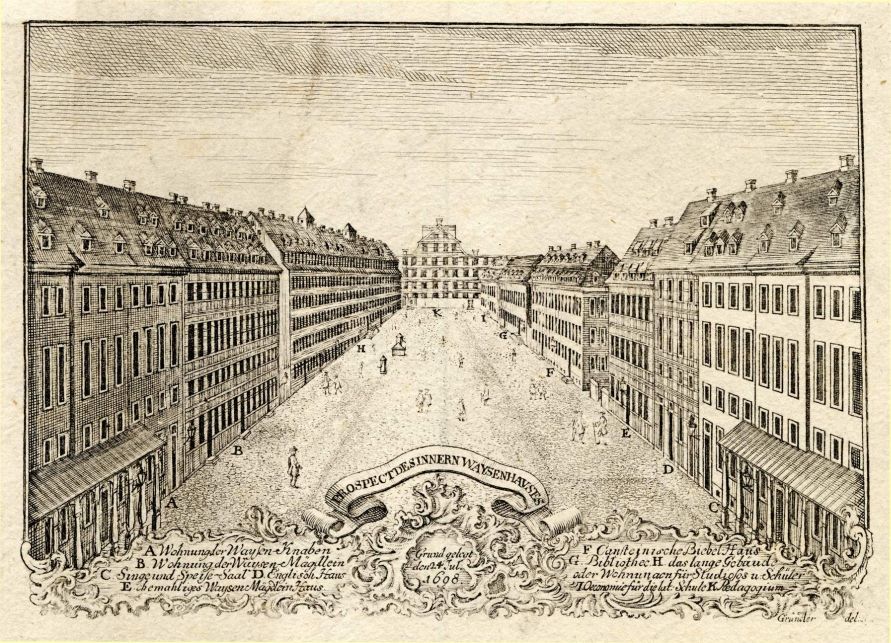
He stayed seven years. He learned Latin, Greek, Hebrew, theology. He was ordained. He married in Germany. In 1770 he returned to Pennsylvania — to a country that had waited ten years and would not wait longer.
The Revolution: a brother in robes, a brother with a sword
When the war came, Frederick had a parish in New York. His older brother Peter, also a pastor, preached a farewell sermon in his Virginia congregation in 1776, removed his robe — beneath it he wore the uniform of the Continental Army — and walked out. He rose to general.
Frederick stayed longer in his pulpit. He was not a man of large gestures. But when the British occupied New York, he fled to Pennsylvania, entered politics, served in the Continental Congress in 1779, then became Speaker of the Pennsylvania Assembly, then president of Pennsylvania’s constitutional ratifying convention in 1787.
In 1789 the new House of Representatives elected him its first Speaker. On April 1 he took the chair and opened the session. The Bill of Rights passed through his hands in the months that followed.
The myth of German as the official language
There is a story that still circulates online: that in 1794 Congress voted by a single vote — Muhlenberg’s — on whether German should become the official language of the United States. Muhlenberg, the story goes, voted against his own people. The story is false. There was no such vote. What happened in 1794 was a procedural question about translating laws into German. Muhlenberg was not even Speaker at that time. The myth is tenacious nonetheless, and the book takes time to take it apart — not from pedantry, but because false history makes false memory.
1796: one vote, one brother-in-law, one end
What did happen was something else. In 1796 the Jay Treaty with Great Britain hung in the balance — a treaty securing peace between the young United States and the former colonial power, but regarded among the Republicans as betrayal. The vote in the House came out tied. Muhlenberg, by then Speaker again, cast the decisive vote for the treaty. His brother-in-law, a Federalist who felt Muhlenberg had betrayed the cause, stabbed him with a knife a few days later. Muhlenberg survived. His career did not. At the next election he was not renominated.
He died on June 4, 1801, in Lancaster, Pennsylvania, fifty-six years old.
Why in English now
There is an English literature on Frederick Muhlenberg — scattered, not large, mostly in Pennsylvania-German regional publications. There is a recent academic biography. But there has not been, until now, a single narrative life of Muhlenberg that places him where he belongs: in the long arc that runs from his grandfather’s Mohawk longhouse to the Speaker’s chair of the First Congress.
This book is that life. It is the companion volume to Between Two Worlds — Conrad Weiser 1696–1760. Together they tell the story of three generations of one German-American family across the long American eighteenth century.
Written in the same form as the Weiser book: short sentences, close to the sources, no invented dialogue, no interior monologue, no pathos. Where something is not recorded, it is marked so. Where it is recorded, it stands as it was recorded.
Publication date: July 4, 2026 — the 250th anniversary of the Declaration of Independence. The date is not incidental. Frederick Muhlenberg belonged to the generation that did not found the young country but made it work. Without that second generation, the Declaration of 1776 could have remained a manifesto. It became a state because men like Frederick called the sessions to order, wrote the rules, counted the votes, and at the decisive moment cast one of their own.
The book has 18 chapters and an appendix on the Francke Foundations, approximately 220 pages.
The eBook is available in my shop.
Schreibe einen Kommentar