
Philosophy for the citizen, not for the guild.
In 1739 a twenty-eight-year-old Scot published a book that set out to place the whole of philosophy on a new foundation: A Treatise of Human Nature, three volumes. Today it counts as one of the most important philosophical works in history. At the time, almost no one noticed.
David Hume himself later described the failure with the cruellest sentence an author can find for his own book. It had, he wrote, “fallen dead-born from the press, without reaching such distinction, as even to excite a murmur among the zealots”.
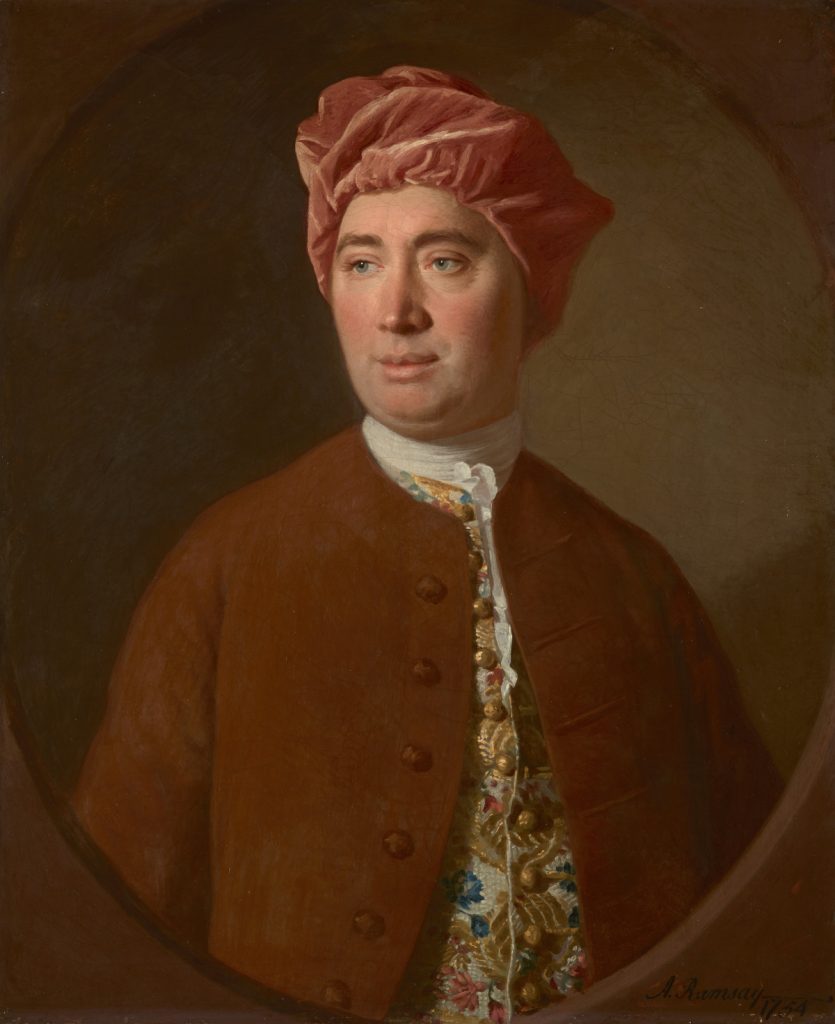
Someone else would have grown bitter. Hume drew a lesson. The ideas had not been wrong. The form was wrong. Whoever wants to be heard must write so that one likes to read him. Hume stopped writing for the guild and began writing for the citizen, in the essay. It is exactly what one does today in writing a blog or a Substack, to reach the reader directly, past the jargon of the university. Hume invented that move two hundred and eighty years ago.
Cicero’s pupil
He found his model in antiquity. As a youth Hume had read Cicero’s De Officiis with a devotion that never left him. Cicero had been the man who translated Greek philosophy for the educated Romans, not in the language of the school but in that of a statesman who writes well. That is exactly what Hume wanted to become in English.
So he stopped composing treatises and began writing essays. From 1741 they appeared, on politics, trade, taste, morals, the freedom of the press, the arts, of measured length, with a clear main thesis, readable in a single sitting. He called his public the “conversible world”, the world of those who converse, as against the “learned world”, the scholar’s study. He saw himself, he wrote, as an ambassador between the two. Philosophy was to come out of the seminar, to the coffee-house table — in Glasgow also to the taverns, oyster cellars, and clubs.
Whoever writes for the citizen asserts something by it: that the most important questions belong to everyone, not to a guild. Clarity, for Hume, was a form of democracy.
The history that conquered
The proof came in his greatest work, and it was, as hardly anyone would expect of philosophy’s greatest sceptic, a history book. Hume’s The History of England, six volumes between 1754 and 1761, became the bestseller of the century.
He wrote it backwards. First the Stuarts, because their constitutional quarrel was still politically alive; then back across the Tudors to Caesar’s landing. And he wrote it narratively, with balance, for the reader, not for the specialist. The work made him rich and independent, something no chair had ever given him. For a century it was the history of England, in every educated household, from Paris to Philadelphia.
And it was impartial in a way that annoyed both sides. Hume refused to write along with the Whig hero-legend, by which 1688 had been the foreseeable victory of liberty. He treated Charles I as a human being (Part 6), distrusted the Puritan enthusiasm, and saw in history not the march of a plan but chance, character, and slowly grown manners. The Whigs scolded him as a Tory, the Tories did not trust the atheist. Precisely in between is where he wanted to stand.
Why he could
Here comes the uncomfortable question. Hume was an open religious sceptic in a pious century. Why did he not fall silent? Why did he not end in exile or in prison?
Because no one could force him. The Church of Scotland tried; it denied him a chair twice, at Edinburgh in 1745 and at Glasgow in 1751, and nearly had him excommunicated. But that was all it could do. There was no longer any prior censorship; the English Licensing Act had lapsed in 1695. There was no state power that forbade a private man his pen. Hume lost a few posts and simply wrote on, became famous and well-off, without ever having held an academic position.
Set beside it what would have happened to the same man on the Continent, and one need not speculate, for the counter-example sits in Königsberg. Immanuel Kant, perhaps the greatest philosopher Germany produced, never left his home town his whole life long. In 1794 he received from King Frederick William II an official reprimand for his writings on religion, and had to promise in writing to keep silent on the subject. He kept to it until the king was dead. The free spirit of the Continent worked under supervision.
Hume reached every citizen not only because he wrote well, but because a society let him. The accessible essay needs the free press.
The man who woke Kant
And yet the Scot reached all the way to Königsberg. Kant admitted it himself, in one of the most famous sentences in the history of philosophy: it was the remembrance of David Hume that “first interrupted my dogmatic slumber many years ago”. Hume’s sober question, whether reason can really prove what it claims to prove, would not let Kant go.
Here lies a small comedy of the two traditions. Hume put the question on a few clear pages that anyone could read. Kant answered with the Critique of Pure Reason, eight hundred pages over which doctoral students have toiled for two hundred years, an edifice of such depth and such impenetrability that Kant himself had to follow it with a shorter, “easier” version, which did not help either. The same thought, two styles. The one writes for the citizen, the other for the seminar. Prose from below, prose from above.
In Kant’s cathedral there are passages that Hume’s bright essay never enters. But the question of this series is whose thoughts reached the citizens’ hands. Hume’s arrived. He was read, in the carriage, in the club, in the colonies.
Le bon David
In Paris, where Hume sat from 1763 to 1766 at the British embassy, he was the darling of the salons; the Frenchwomen, who ought really to have found his heavy Scottish accent and his bulky frame comical, called him fondly le bon David, the good David. He was cheerful, sociable, without bitterness, a man whose humour was never spoiled by the chairs denied him or the charge of atheism.
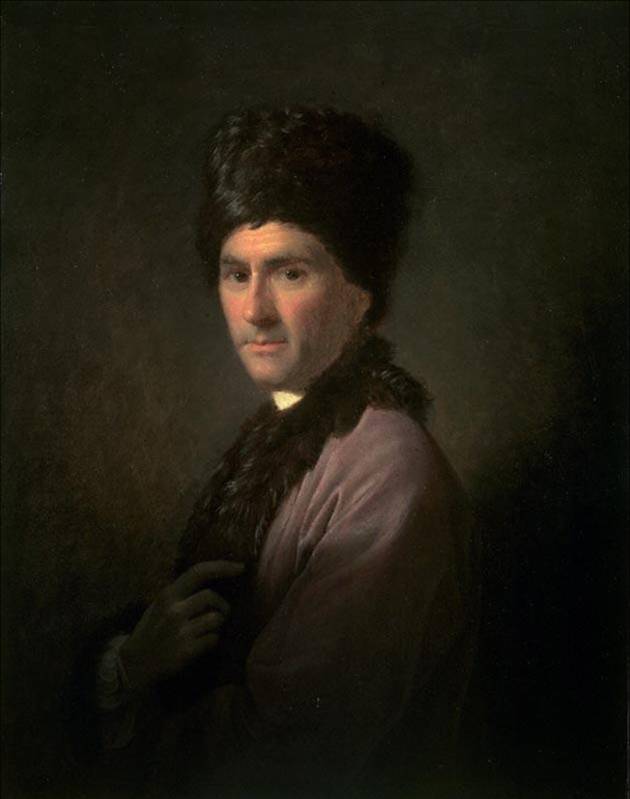
One episode shows his stature against the light. In 1766 Hume took in the homeless Jean-Jacques Rousseau, who, driven out of France and out of Geneva, was wandering through Europe. Hume brought him to England, found him a house and a royal pension. Within months Rousseau convinced himself that the whole asylum was a conspiracy, Hume a traitor out to ruin him, and showered him with accusations. Hume, dumbfounded, held the Genevan to be a far greater writer than thinker; the one was made of feeling and suspicion, the other of composure and measure. Two temperaments that did not find each other, long before their ideas would end in two different revolutions, 1776 and 1789.
Most striking of all was his end. Hume died in 1776 calm, cheerful, joking, entirely without the consolations of religion, which he had never needed. His friend Adam Smith described this godless, composed death in a public letter and concluded that he had always considered Hume a man who came “as nearly to the idea of a perfectly wise and virtuous man, as perhaps the nature of human frailty will permit”. That was almost a scandal. That a man could live well and die well without faith offended the pious more than any argument. Smith said later that this one letter brought him more hostility than all the rest of his work.
Not better, but different?
The Continental tradition honoured the heavy, the systematic, the professorial book; depth was measured by the effort it cost. The Anglo-Scottish one honoured clarity, the essay, the reader who is no specialist. Kant built the system, Hume wrote the essay.
For a free society the difference is not small. An order from below lives by its citizens holding in their hands the ideas that govern them. Hume put them there. He is the patron saint of every writer who would rather be understood than admired.
And his ideas did not die with him. They crossed the Atlantic, in the trunks of young Scots, into the library of a college in New Jersey, to the table of an assembly that wrote a constitution in 1787. How the Scottish sceptic became an American founding text — the bridge to Princeton — is the next part.
Sources and references
Primary sources – David Hume, My Own Life (1777) — “It fell dead-born from the press”; the Cicero influence; the History as bestseller – David Hume, A Treatise of Human Nature (1739/40); Essays, Moral and Political (from 1741); An Enquiry Concerning the Principles of Morals (1751, the quotation in the portrait caption); The History of England (1754–1761) – Adam Smith, Letter to William Strahan (1776) — Hume came “as nearly to the idea of a perfectly wise and virtuous man, as perhaps the nature of human frailty will permit” – Immanuel Kant, Prolegomena to Any Future Metaphysics (1783) — the remembrance of Hume had “interrupted my dogmatic slumber”
Secondary literature and references – On Hume’s denied chairs (Edinburgh 1745, Glasgow 1751) and the lapse of prior censorship in England (the Licensing Act, 1695) – On Kant’s official reprimand by Frederick William II (1794) and his silence on religion until the king’s death (1797) – On the Cicero influence (De Officiis; De Natura Deorum as the model for the posthumously published Dialogues Concerning Natural Religion, 1779) – On Paris, “le bon David”, and the Rousseau episode of 1766 (Hume held Rousseau to be the greater writer, not thinker) – On the impartiality of the History (criticism from Whigs and Tories alike)
Schreibe einen Kommentar