
The Channel was never a wall.
In this part I must add a fact that for seven parts we have all but kept quiet.
All this time we talk of two worlds, the island and the Continent, as if more than thirty kilometres of water divided them. And then this: for a hundred and twenty-three years, from 1714 to 1837, Great Britain and a German state had the same king. Whoever sat on the throne in London was at the same time Elector of Hanover. George I spoke barely any English and preferred to rule from the Leine rather than the Thames; his court composer, a certain Handel, had followed him from Hanover to London. A whole dynasty of British kings with a German seat, a German accent, German relations.
Today we ask why the cleverest Europeans move to Boston and Silicon Valley, why the talent runs west. There was a time when it ran the other way. In the eighteenth century the most modern piece of university on the Continent lay in a British-German joint venture, and the traffic of ideas ran, for a few decades, from the island into the Reich.
Göttingen, the twin of Edinburgh
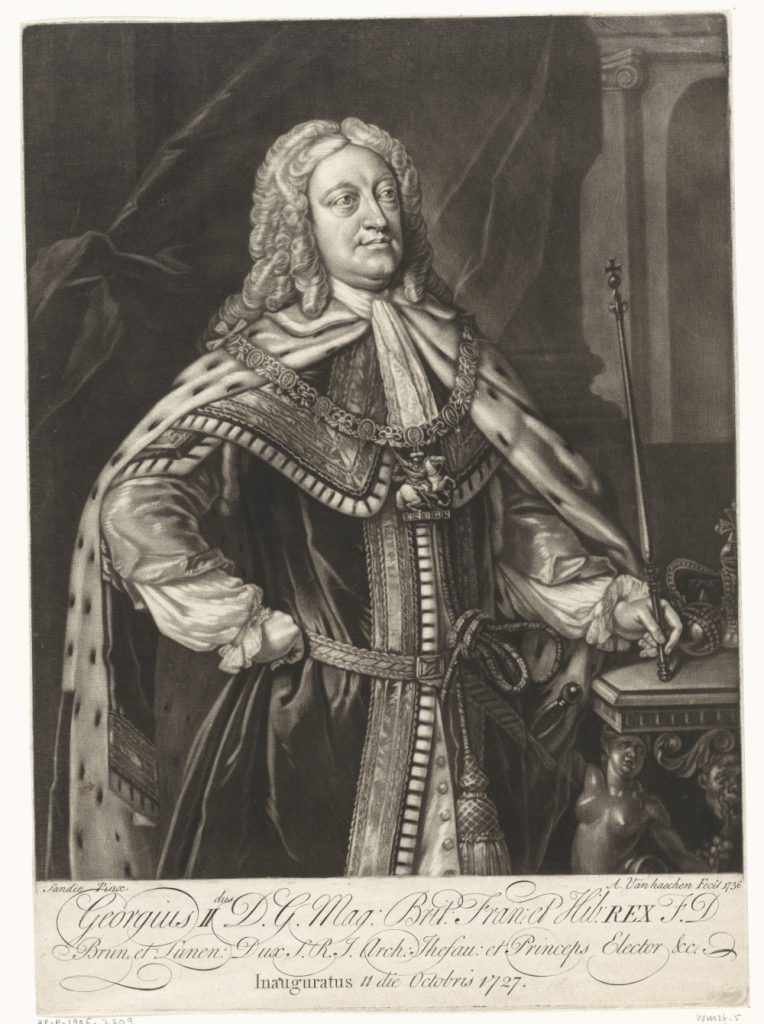
In 1737 a university began work in the small Guelph town of Göttingen. It had been founded by George II, in his capacity as Elector of Hanover — that is, the same man who was king in London. It was set up by his minister Gerlach Adolph von Münchhausen, a sober administrative head, not to be confused with the lying baron of the same name who, from the same family, was inventing his tales at about the same time.
Göttingen broke with everything a German university had been until then. The theological faculty lost its veto. The professors no longer had to swear to a religious confession, which made it possible to recruit the best minds, of whatever colour. They largely governed themselves. And Münchhausen introduced a criterion for advancement that seems obvious to us today and was new then: what counted was what a man had researched and published, not how long he had served. The research university, at its core, begins here.
Above all, Göttingen breathed English air. Through the Personal Union, British constitutional thought seeped into the lecture halls; the English model of government was admired and seriously studied. Here grew a school of history and of political science that looked to London and to the world rather than only to its own principality.
So the Reich suddenly had a twin to Edinburgh. A free, urban, research-minded university that looked forward. And the traffic between the two was real. Göttingen’s star was the physiologist Albrecht von Haller, the founder of modern experimental physiology; his works were translated and reprinted in Edinburgh. The two new lighthouses of the north shone to one another.
One must be careful and not claim that Göttingen simply copied Edinburgh. That is the comfortable legend, and it is not quite true. Rather, they drank from the same source.
The Dutch root
The source was Leiden, in South Holland, and it had a name: Herman Boerhaave. The Leiden physician was the most famous teacher in Europe in the early eighteenth century; students streamed to him from half the Continent. His pupils carried the new, empirical knowledge, tested at the bedside, in every direction.
They founded the medical faculty of Edinburgh, which within a generation became the best in the Western world. They shaped medicine in Göttingen, where Haller himself had studied under Boerhaave. And one of them, Gerard van Swieten, went to Vienna.
Here it gets interesting. The same seed, scattered in Edinburgh, Göttingen, and Vienna.
In Edinburgh and Göttingen it grew free. Self-governing faculties, research, autonomy. In Vienna it grew fenced in by the state. Van Swieten, now Maria Theresa’s personal physician, reformed the Habsburg universities from above. Modern it certainly was: he took them out of the hands of the Jesuits, admitted non-Catholics, brought in law and the secular subjects, pushed theology back. But he did it by drawing the state’s fence tighter. Prescribed textbooks. The sovereign’s veto over the heads of the faculties. Curricula cut to the needs of the state. The professor became an instrument of the crown.
So the same Dutch knowledge produced, in the north, the autonomous research university, and in the south, the state university. Modernisation from below and modernisation from above. The fault line this series follows runs not only through the Channel. It runs through the middle of the Continent, between a freer Protestant north and a state-bound Catholic south.
Halle and the Pietists
Before Göttingen there was Halle, and Halle had two souls. One was early reason: here a man could lecture in German instead of Latin, and philosophy began to pull free of dogma. The other was the heart.
August Hermann Francke was a Pietist, and that meant he distrusted the cold orthodoxy of the official church and wanted a religion of the heart, lived and active. From 1695 he built in Halle, out of almost nothing, something astonishing: a school for the poor, an orphanage, schools for boys and girls, a teacher-training, a printing house that turned out cheap Bibles by the cartload, even a mission as far as India. The German school system and the trained, professional teacher begin in Francke’s courtyard. From below, out of faith and stubbornness.
And then the pattern repeats that we know from Müntzer and from Luther’s princes, gentler this time. The official church eyed Francke with suspicion. But the King of Prussia, Frederick William I, the soldier-king, visited the institutions, was impressed, and took the Pietists under his wing. He saw what a state can do with people trained to discipline, duty, and reading. Francke’s schools became a model for Prussia, and Pietist values went into the making of the Prussian official and the Prussian officer.
Thaer, the revolution in the field
The transfer was not only ideas and faith. It reached the dung heap.
Albrecht Daniel Thaer was a physician in Celle, a town in the Electorate of Hanover — that is, in the German land of the British king. He never set foot in England. He did not need to. He read English, and he read everything the British agricultural revolution was printing. From 1798 he brought out his Introduction to the Knowledge of English Agriculture, written, as the title page says, “for thinking farmers and cameralists”. By that last word are meant state servants, administrators, and economists.
What he imported changed how Germany ate, what came to the table. The Norfolk crop rotation, which did away with the wasteful fallow field and grew clover instead, feeding the soil and the cattle at once. Stall-feeding, which gave more manure, which gave more grain. The better English plough. Thaer became the father of rational, scientific agriculture in Germany, and he became it by sitting in a Hanoverian town, at the seam of the Personal Union, reading British books. The same useful, practical, workbench spirit that in Glasgow fed James Watt’s engine now had a Celle doctor reinventing the German farm.
Not better, but different
The picture of two sealed worlds was thus always too simple. The Continent did not lack the energy from below. It had Göttingen, free and modern; it had Halle, building schools out of faith; it had Thaer, importing the future through a book. The model crossed the Channel and took root.
The difference was never whether the Continent had the seed. It was how much room the state left it to grow wild. In the Protestant north, around the Hanover seam, it grew freer. In the Habsburg south it grew within the state’s fence. And even in Prussia the freest energies were drawn again and again into the service of the throne — Francke’s schoolrooms into the making of officials, as Luther’s Reformation had once propped up the princes.
The same Enlightenment, under a different hand.
Of all these places, Göttingen grew tallest. The little university the British crown had planted became, around 1900, the brain of the scientific world, a magnet for the best minds on earth. What a state does to such a place when it loses its mind, and where those minds then flee, is a story for a later part. For now, hold only this image: the talent, this time, did not flow west.
But the next part first: a Scot who reached every citizen and, in passing, woke a German named Kant from his slumber. David Hume.
Sources and references
Primary sources and works – Albrecht Daniel Thaer, Einleitung zur Kenntniß der englischen Landwirthschaft (from 1798, Hanover: Hahn) – August Hermann Francke and the Francke Foundations at Halle (from 1695)
Secondary literature and references – On the Personal Union of Great Britain and Hanover (1714–1837) and the cultural transfer across that seam – On the Georg-August University of Göttingen (founded 1734, teaching from 1737): foundation by George II as Elector; Gerlach Adolph von Münchhausen as curator; academic freedom, exemption from the Lutheran confessional oath, advancement by publication; Anglophile orientation – On Albrecht von Haller (Göttingen, experimental physiology; trained under Boerhaave at Leiden; reception in Edinburgh) – On the Leiden root: Herman Boerhaave and his pupils in Edinburgh, Göttingen, and Vienna – On the Habsburg university reform “from above”: Gerard van Swieten under Maria Theresa and Joseph II (state control, textbooks, curricula to the state’s needs, pushing back the Jesuits/theology) – On Halle Pietism: A. H. Francke; adoption and support by Frederick William I of Prussia; significance for the Prussian school, civil-service, and officer systems – On Albrecht Thaer and “rational agriculture”: import of the British agricultural revolution (Norfolk crop rotation, stall-feeding) through the literature; Celle (Electorate of Hanover)
Schreibe einen Kommentar