
From Below or From Above.
In Kyiv, on the slope above the Dnipro, stands a slender white column. It is one of the oldest monuments in the city, raised between 1802 and 1808, and it commemorates neither a battle nor a saint. It commemorates a German town law: the Magdeburg Law.

That sounds like a footnote. It is a front line. Anyone who asks today how European Ukraine is gets, from this column, an answer in stone. Kyiv lived for some three hundred and forty years under Magdeburg law — its own court, its own aldermen, its own self-government. That is the Western European world of the free town, not the Muscovite world of the autocrat, where law came down from above. The fault line this whole series follows — order from below against command from above — runs straight through the east of Europe. And the Tsar’s empire knew it: it abolished Magdeburg law in Kyiv in 1834. The monument already stood; the freedom it recalled was cancelled a generation later.
But before we return to this column, I have to admit something. In the last part I drew the law too cleanly.
A confession
Part Four set two worlds against each other: the Continent, which set law from above, and England, which found it from below. As a final picture that is right. As a picture of the Middle Ages it is too smooth.
For the Continent was a patchwork. A single uniform code for all of France or Germany did not exist at all — that comes only with the Code Napoléon of 1804, half a millennium later. The Roman law of the Bologna jurists was, in the Middle Ages, a learned common law that stood beside a hundred local laws, filled gaps, supplied a shared language — but nowhere did it sweep away local custom at a stroke. And in many places law did grow from below, in the very middle of the Continent.
The best example is that same Magdeburg law. It was no code decreed by a prince but a movable body of norms, grown out of merchant custom and only confirmed from above. A town that adopted it governed itself: a bench of about eleven lay judges spoke the law, elected for life, choosing their own successors. In case of doubt one wrote to Magdeburg and asked. The law abolished trial by ordeal and replaced it with witness evidence; it ended kin-liability. And it knew the sentence that changed whole lives: town air makes you free. Whoever lived a year and a day within the walls was a serf no longer.
From Magdeburg this law travelled east, across hundreds of towns — Kraków in 1257, Vilnius in 1387, Lviv, and Kyiv itself towards the end of the fifteenth century. That is Western European self-government, grown deep inside what we wrongly take for the eternal periphery.
A word about the city itself, because outside Germany hardly anyone has heard of it. Magdeburg sits on the river Elbe — the great water road that runs from the Bohemian mountains down through the German plain to Hamburg and the North Sea; on the modern map it lies roughly midway between Berlin and Hanover. Until the seventeenth century it was a metropolis — a trading hub on the river, an archbishop’s seat, one of the largest and richest cities of the Empire. A kind of New York, only inland: the gate through which law, goods and people moved east.
What happened to this city belongs, properly, to a later part, but the shadow falls here already. In 1631, during the Thirty Years’ War, the troops of the Catholic League under the commander Tilly took Magdeburg and wiped it out. Of some twenty-five thousand people only a few thousand survived; the city burned down to the cathedral and a handful of houses. The shock ran so deep that “to magdeburgise” became, for a while, a word for total destruction, and the “Magdeburg Wedding” a bitter joke for the massacre. The metropolis that had handed half of Eastern Europe the freedom of self-government was, overnight, a field of ash. But that is another story.
Back to the point: the Continent even had parliaments earlier than England. The Cortes of León met in 1188 — more than a hundred years before the English Model Parliament. Spain, Poland, the imperial free cities: everywhere local liberties, estates, assemblies.
Where, then, lay the real difference? Not in “statute versus case” from the year 1100. It lay in scale and in duration. England unified early a single, national common law and kept a single, national parliament with its hand on the purse — and both held. On the Continent the liberties stayed local and splintered, town by town, region by region. And precisely because they were splintered, they could later be rolled over one at a time: by absolutism, by the thorough reception of Roman law, in the end by the Code Napoléon. The freedom from below existed on the Continent. It was simply never bundled nationally — and so it was devoured.
What happened to the serf
One question brings all this down to earth: what happened when a serf felt unjustly treated?
Little. The everyday life of the common man ran not before the proud royal court but before the court of his lord, by the “custom of the manor”, recorded on rolls, spoken by his own neighbours — but tilted towards the lord. In England a serf could not sue his own lord before the royal common law at all. He counted as the lord’s property; the vaunted law reached, precisely, not that far down. Hume noted drily in Part Two that the common people were for the most part unfree.
On the Continent the same basic picture — with one emergency exit. Whoever made it into a town under Magdeburg law and survived there a year and a day became free. For the serf, “law from below” was not Magna Carta. It was the custom of the manor — and, with luck, a town wall within sight.
The southern exception: al-Andalus
There is a second gap. When we say “the Continent”, we think of a Christian Europe that developed out of the Roman inheritance. For a large part of the Iberian Peninsula that is untrue for eight hundred years.
In 711 a Muslim army crossed the Strait of Gibraltar and shattered the Visigothic kingdom in a single battle. What followed was al-Andalus — an Islamic rule that for centuries covered most of the peninsula and ended only in 1492 with the fall of Granada. That was no passing episode. That was, in the south, more centuries under the crescent than Anglo-Saxon England had ever stood under any crown.
One should not prettify it, in either direction. Córdoba in the tenth century was perhaps the largest and most learned city in Western Europe, with libraries, medicine, mathematics, a culture of translation through which a good deal of ancient knowledge later flowed north. That is the one truth. The other is that al-Andalus was a conquest empire like others, with tribute from the subjected and with slavery. The Islamic slave trade was vast and long-lived — the saqaliba, Slavic slaves, through whose traffic the word “slave” first took on its meaning; the stream of black African slaves across the Sahara; later the Barbary corsairs, who carried off more than a million Europeans from the coasts, and that well into the nineteenth century. This rarely stands in the schoolbook, for reasons that have little to do with history and much with the present. This series will, in a later part, hold the Anglo-American inheritance to its own moral shadow — the dispossession of the first peoples of North America. Empire and slavery were neither a European invention nor a European monopoly.
And the remarkable thing: it was precisely the Christian kingdoms of the Reconquista, working their way south century by century, that developed a dense net of local liberties — the fueros, town and regional charters with which kings had to lure settlers to the dangerous frontier. Whoever is to settle a border gets privileges. So medieval Spain was full of self-government from below — until the absolutism of the Catholic Monarchs and their Habsburg heirs rolled it over, exactly as in the east. Iberia, then, fits the corrected picture: living liberties, later cancelled from above. Only it carries a whole non-Roman, non-Christian layer on top.
Ad fontes — back to the sources
In the early sixteenth century a movement of scholars did something new with old texts. Instead of simply passing on the inherited school Latin and the medieval commentaries, they went back to the originals, read them philologically, critically, aware that over the centuries errors and layers had crept in. In jurisprudence this humanist turn was called the mos gallicus, the “French manner” — men like Budé, Alciato, later Cujas, who no longer merely applied Roman law in practice, as the old mos italicus of the Bologna commentators had, but studied it as a historical text of antiquity, with all its breaks and contradictions.
The same thing was done, in the same decade, by a man with the New Testament. His name was Erasmus.
Erasmus of Rotterdam
Erasmus was the prince of the humanists, perhaps the most learned man in Europe, a cosmopolitan with no fixed ground — born in Rotterdam, at home in Basel, Paris, Leuven, and for a time in Cambridge. He wrote a Latin of such elegance that half of Europe read him, and he mocked the corruption of the Church more sharply than most — his Praise of Folly of 1509 is a reckoning with bloated theologians, idle monks and pomp-loving popes.
His real work was quieter, but more dangerous. In 1516 he brought out the New Testament in the Greek original, with a new Latin translation beside it. For the first time a scholar could test the Vulgate, the Church’s official Bible, against the source — and find errors. That was the same method as the mos gallicus: back to the text, against the authority of tradition. Erasmus once said he wished the farmer at the plough and the weaver at the loom would sing snatches of Scripture to themselves. A pious hope, a little naïve perhaps, for: if everyone can read the source himself, what need is there of priests as the sole interpreters?
Erasmus wanted to heal the Church from within, through learning, in moderation, without schism. He was not a man of the break. That, precisely, became his fate. When the break came, he stood between the lines, abused from both sides. It has been said that Erasmus laid the egg that Luther hatched. Erasmus replied that he had laid a hen’s egg, and Luther had hatched a fighting cock.
Erasmus against Luther
For the break had another man. In 1517, a year after Erasmus’s Greek Testament, an Augustinian monk in Wittenberg nailed up ninety-five theses against the trade in indulgences — or posted them off; the nailing to the door is half legend. Martin Luther.
Hume, the sceptic, draws him without a halo. Luther, he writes, was “a man naturally inflexible, vehement, opinionative”, become incapable of relinquishing a sect of which he was himself the founder, and which brought him a glory above all others — “the glory of dictating the religious faith and principles of multitudes”. That is no praise. But it names the force.
Erasmus and Luther both wanted reform. Temperament and method divided them. Why did Luther prevail and Erasmus not? The answer is that Luther’s infrastructure was superior.
Four things came together. First, a concrete scandal: the indulgence-preacher Tetzel was collecting money for the rebuilding of St Peter’s in Rome, and the Germans watched their money flow to Italy. “As soon as the coin in the coffer rings, the soul from purgatory springs” — against so palpable a sales pitch, outrage could be organised. Erasmus had no such story.
Second, and this is the heart of it, the printing press. Gutenberg’s invention was, by 1517, up to full speed. Luther wrote in German, short, blunt, for everyman; his September Testament of 1522 went out three thousand copies in two months and then through twelve reprints. Erasmus wrote Latin for a small learned circle. The one had mastered the old medium, the other the new. Hume saw it with a sober eye: “the art of printing, invented about that time, extremely facilitated the progress” of all these upheavals, and so “a general revolution was made in human affairs throughout this part of the world”. And he names, too, why the reformers won: the clergy, untrained in every kind of controversy, were “unable to defend themselves against men armed with authorities, quotations, and popular topics”. One might think Hume had been writing about the internet of the year 2026.
Third, princely protection. Frederick the Wise of Saxony hid Luther in the Wartburg when the imperial ban made him an outlaw. A whole generation of German princes saw in the break with Rome the chance to seize Church property and escape the papal tax burden. Erasmus had no such patrons.
Fourth, a political identity. Luther’s tract “To the Christian Nobility of the German Nation” of 1520 was the first mass-capable, proto-national text in German history. Erasmus, the European without a fatherland, had nothing to set against it, and did not want to.
The direct exchange between the two — Erasmus’s essay on free will of 1524, Luther’s massive reply on the bondage of the will of 1525 — ended philosophically in a draw. Culturally it ended plainly. Erasmus was right in much and lost all the same. He was out-printed.
Why Hus burned and Luther survived
That it was the infrastructure and not the doctrine is proved by a control case. A hundred years before Luther, a Bohemian theologian said almost the same thing. Jan Hus attacked the indulgences, the worldliness of the Church, the sole authority of the clergy. In 1415 he was summoned before the Council of Constance, under the Emperor Sigismund’s safe-conduct. They burned him anyway.
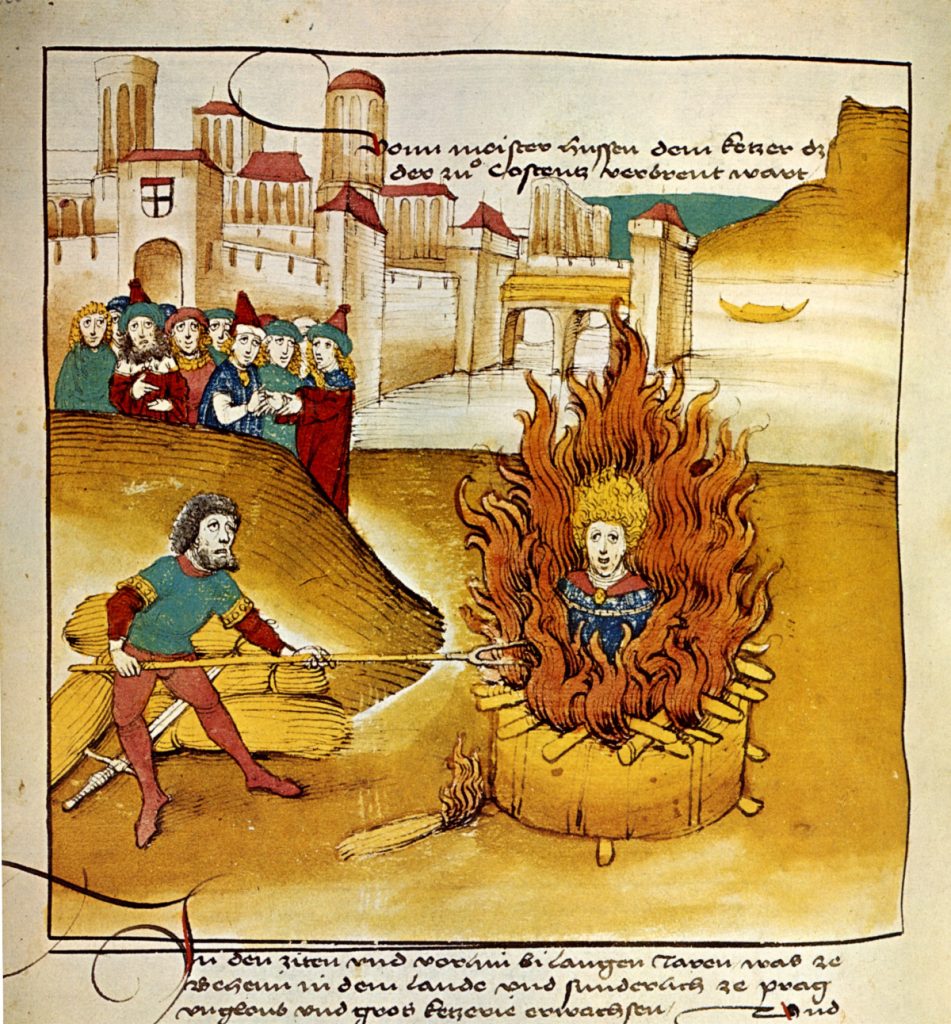
Three differences decided between the stake and success. First: in 1415 there was no printing press. Gutenberg’s invention lay thirty years in the future. Hus’s ideas stayed in manuscript, confined to Bohemia; Luther was present across all Europe within months. Second, the political moment: the Council of Constance was just then resolving the Western Schism — three popes at once — and needed a victory over a heretic to display its restored authority. Charles V, by contrast, was distracted in 1521 — war with France, the Turks at the door. Third, the backing: Hus had the Bohemian nobility, but not the emperor. Luther had an Elector too politically important to drop.
The Reformation did not win because its theology was better in 1517 than in 1415. It won because in 1517 the press was running, the princes caught the scent, and the emperor was busy elsewhere. The same idea, a century earlier: ash.
The Reformation that England got
But here a German self-deception has to be set aside. Luther conquered Germany and gave the Reformation its mass form — that remains his work. His direct reach, however, did not go much further. The image of Luther as the father of modern Europe is, to a good part, a German story, born in the nineteenth century when a national hero was wanted. The ideas that shaped England and the Netherlands did not come from Wittenberg.
England even fought Luther from the throne; Lutheran writings were burned, their readers persecuted. What formed English Protestantism came from three other sources.
The first we already know: Erasmus. He had lived in England, taught Greek at Cambridge, was close friends with Thomas More, the author of Utopia, and with the whole circle of English humanism. His programme — reform from within, learning instead of dogma, the source legible to all — lay nearer the English temperament than Luther’s all-or-nothing. The man who was out-printed in Germany shaped England precisely through what Luther lacked: measure.
The second source was William Tyndale, who translated the Bible into English — the New Testament in 1526, against the crown’s express prohibition, printed in exile and smuggled into England. Tyndale took Erasmus at his word, that the ploughman should know Scripture. He had read Luther, had even been to Wittenberg; a Lutheran thread ran along with it. But the English Church did not become Lutheran on that account. Tyndale paid in 1536 with his life, strangled and burned — and his translation became, almost word for word, the foundation of the King James Bible, and shaped the sound of the English language for four hundred years.
The third came a little later, and from Geneva: John Calvin, not Luther. His strict, closely worked theology formed English Puritanism, and in Scotland John Knox made a whole nation Presbyterian. The Netherlands, too, became Calvinist, not Lutheran.
England, then, got a different Reformation: humanist in spirit, Reformed in doctrine, parliamentary in form. It had little to do with Wittenberg.
The fork — to whom does conscience belong?
The Reformation freed Europe from Rome. But it raised at once the next question: if the pope no longer decides the faith — then who? And to this question Continent and island again gave opposite answers.
On the Continent the prince answered. The Peace of Augsburg of 1555 cast it into a formula: cuius regio, eius religio — whose the realm, his the religion. The prince determined the confession of his subjects. That was no freedom of belief. It was a new power of disposal over souls, exchanged for the old one of the pope. The Reformation had freed the princes from Rome and made them, in their own land, lords over conscience. It fed, in other words, straight into the absolutism that is the theme of the next part.
That the Above won there was no foregone conclusion; the Continent had its Below too. Thomas Müntzer, once Luther’s comrade, drew the most radical conclusion of the whole movement: not the pope, not the prince, but the common people themselves possess conscience, directly from God. In 1525 he carried it into the Peasants’ War. Luther answered with a pamphlet whose title says everything — “Against the Murderous, Thieving Hordes of Peasants” — and called on the princes to strike without mercy. At Frankenhausen the peasants were cut down, Müntzer tortured and beheaded. The German Reformation from below ended where Hus had ended. Luther stayed with the princes — and the princes stayed with Luther.
In England it ran, as almost everything there does, through Parliament. And the beginning, according to Hume, is anything but edifying. Henry VIII began not as a Protestant but as its opponent: he wrote, with his own hand, a book against Luther, for which the pope conferred on him the title “Defender of the Faith” — an appellation still retained by the kings of England, the “F.D.” on the coins. Only when Rome refused him the divorce from Catherine, and Anne Boleyn pressed at court, did he break. But, Hume stresses, Henry “abhorred all connections with the Lutherans” even as he broke with Rome. England’s Reformation began not from Protestant conviction but from the passion of a king.
What is decisive is how he broke. Henry could not simply declare himself head of the Church. He had to have Parliament do it. The Reformation Parliament of 1529 to 1536 passed law upon law, up to the Act of Supremacy of 1534, which made the king the head of the English Church. Even the dissolution of the monasteries, the greatest seizure of property in English history, ran by statute. Faith in England did not become a prince’s to dispose of, but a matter of law — negotiated, resolved, codified in the institution with its hand on the purse.
England in the sixteenth century was no haven of tolerance. Henry had heads struck off, his daughter Mary burned Protestants, Elizabeth persecuted Catholics. England had its own state church, and here too the crown decided in the end. The difference in 1530 was not freedom, but form — by Parliament and statute rather than by a prince’s whim — and the direction in which that form pointed. For a faith that passes through a contested, parliamentary assembly cannot be frozen as easily as one a single prince decrees. From the English form grew, over a century and a half, the toleration of 1689. From the Continental cuius regio grew the confessional subject.
Hume named the deeper mechanism, in his essay on superstition and enthusiasm. Superstition — fear, ritual, priestly power — favours tyranny. Enthusiasm, by contrast, the direct inspiration of the individual, is at first wild and dangerous, but in the end friendly to civil liberty, because it rejects all priestly authority. The Protestant zeal was often ugly. But whoever puts the Bible into the individual conscience’s hands and strikes out the priest between God and man has opened a door.
Where it leads
It is the same fault line, again and again, in a new layer. In law: common law from below against code from above. In faith: the conscience that passes through a parliament, against the prince who decrees the confession. And on the map: the free town with its bench of aldermen, against the autocrat who hands the law down.
That is exactly why the monument on the Dnipro stands where it does, not by chance, and why it is no museum piece even today. It marks which side of the fault line a city once stood on, before an empire moved the line. The question of how European Kyiv is, is at bottom the same as the one Henry VIII forced through Parliament and the one the Augsburg prince answered with cuius regio: does order come from below or from above?
On the Continent, for now, the Above won. How the prince who disposed of souls became the state that disposed of everything — that is the next part.
Sources and references
Primary sources – David Hume, The History of England (Tudor volume, Henry VIII), 1759 — all Hume quotations in this part are from it; also Hume’s essay Of Superstition and Enthusiasm (1741) – Erasmus of Rotterdam, Novum Instrumentum omne (1516), The Praise of Folly (1509), De libero arbitrio (1524) – Martin Luther, Ninety-Five Theses (1517), To the Christian Nobility of the German Nation (1520), De servo arbitrio (1525), September Testament (1522), Against the Murderous, Thieving Hordes of Peasants (1525)
Secondary literature and references – Andrew Pettegree, Brand Luther (2015) — the Reformation as a media and print phenomenon – Heinz Schilling, Martin Luther: A Rebel in an Age of Upheaval (2012); Lyndal Roper, Martin Luther: Renegade and Prophet (2016) – On the non-Lutheran shaping of English and Scottish Protestantism: William Tyndale (English New Testament, 1526); John Calvin, Institutio Christianae Religionis (1536); John Knox and the Scottish Reformation (1560); the English Erasmus circle (Thomas More, John Colet, Cambridge) – On the Magdeburg Law and the Kyiv monument: granted to Kyiv at the end of the 15th c.; column by Andrei Melensky (1802–1808); abolished by the Russian Empire in 1834 – On the destruction of Magdeburg by the troops of the Catholic League under Tilly (the Sack of Magdeburg / “Magdeburg Wedding”, May 1631) — anticipating a later part – On the German Peasants’ War and Thomas Müntzer (the Battle of Frankenhausen, 1525); Luther’s siding with the princes – On the mos gallicus / mos italicus, on cuius regio, eius religio (Augsburg 1555), and on the Reformation Parliament (1529–1536)
Image credits – Monument to the Magdeburg Rights in Kyiv: photograph by Wikimedia user IgorT, own work, used under attribution – Jan Hus at the stake: Spiez Chronicle (1485), public domain
Schreibe einen Kommentar