
The King under the Law.
Ask a German and an American lawyer the same question, and you get two reflexes. The German asks: where is it written? The American asks: what did the courts decide before? The one looks in the statute book, the other in the precedent. To this day the world’s legal systems fall, broadly, into two camps — the codified civil law that runs from France through Germany to Latin America and Japan, and the common law of the Anglosphere. Some hundred and fifty countries live under the one reflex, the anglophone world under the other.
Both were cast in the twelfth century, and both hang on a single university town in northern Italy.
The conquest that destroyed nothing
The third part ended on a battlefield. In 1066 William, Duke of Normandy, crossed the Channel, killed the last Anglo-Saxon king at Hastings, and within twenty years replaced almost the entire English upper class with Normans. It looked like the end. A foreign conqueror, a foreign tongue — the court now spoke French — foreign castles at every crossroads.
And yet the opposite of erasure happened. William came not as a mere conqueror but as the supposedly lawful heir. Edward the Confessor, he claimed, had promised him the throne; Harold had sworn it on relics and then broken the oath. The Pope blessed the enterprise, and on Christmas Day 1066 William had himself crowned king at Westminster with the full rite. But a man who arrives as the legitimate successor cannot smash the realm he finds — he must carry it on, or he exposes himself as something less. So William confirmed “the law of Edward” and left the Anglo-Saxon administration standing: the shires, the hundred courts, the system of royal writs, those short written orders, and above all the oral practice of justice with juries drawn from the neighbourhood.
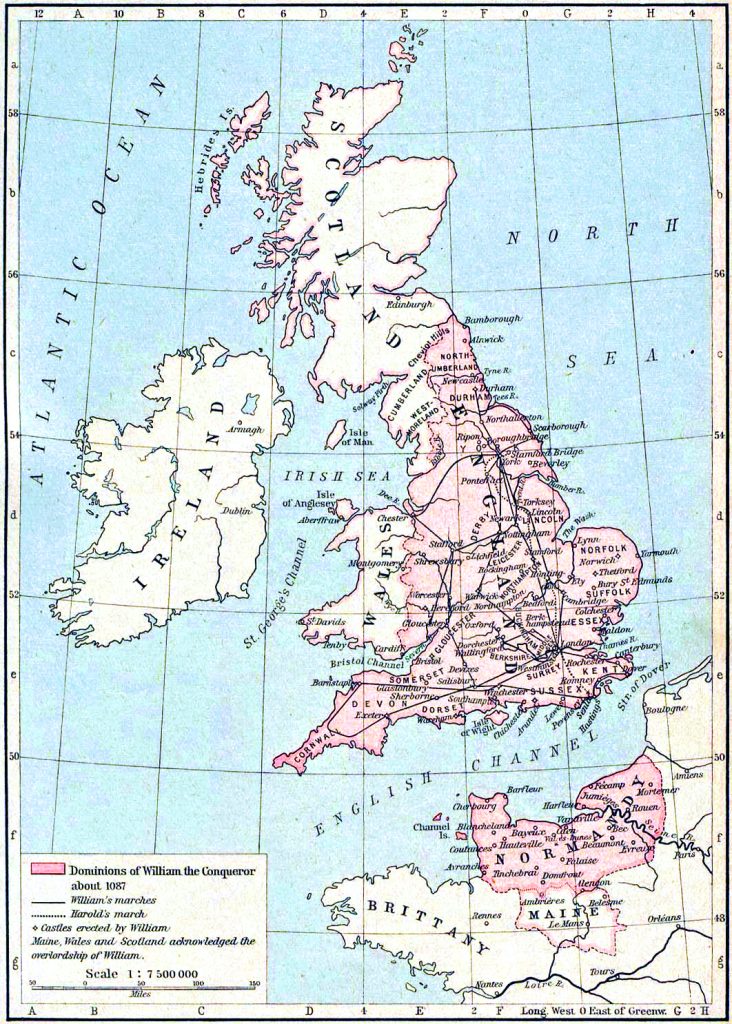
He was not gentle for all that. When the north rose, he had it burned in 1069 — villages, cattle, stores — until a famine carried off tens of thousands, a deed that even Norman chroniclers condemned. But he laid waste out of calculation, not bloodlust. His calculation was to stay and rule, not to plunder and leave.
How much he meant it shows in his most famous work: the Domesday Book of 1086, a survey of the whole country, manor by manor, pig by pig. It was the most thorough tax audit Europe had yet seen, and the English named it after the Last Judgement — because there was about as little appeal from its findings as from the verdict on the Day of the Lord.
What happened in Bologna
While England kept its old toolkit, the Continent found a new one — or rather a very old one. Around 1100 scholars at the University of Bologna rediscovered the Corpus Iuris Civilis, the vast body of law the Emperor Justinian had assembled some six hundred years earlier. It was as if someone had found in an attic the complete operating manual of a vanished empire.
The effect was enormous. Bologna became Europe’s first great school of law, and its graduates fanned out — to Pavia, Orléans, Montpellier, into the courts and chanceries. Everywhere they carried the same single idea, and the idea changed everything: law is set by a legislator at the top. A system learned from books, applied by experts, decreed from above — not something that grows from the custom of a neighbourhood, from below.
That is the fork. On one side, law that one finds. On the other, law that one sets. And for a few decades it stood open which road England, too, would take.
The special case of the Empire
A detour pays off here, because it clears away a stubborn misunderstanding. One might think England went a different way because it was Germanic and the Continent Romance. It did not. A glance at Germany shows why.
William the Conqueror was himself no native Germanic chieftain. His ancestors were Vikings, but within three generations the Northmen in Normandy had become Frenchmen — Romance language, Frankish feudalism, Latin Church. A thoroughly Romanised ruler, then, crossed to England. And still England did not become a code-law country. It was not the origin of the conqueror.
The Empire ran the other way. East Francia, the later Germany, had never been a Roman province. The Rhine was the border; east of it Rome had never ruled, and the German language has next to nothing to do with Latin. By England’s logic, Germany above all should have preserved the Germanic law of the assembly like no other land. It did the exact opposite. Why?
Because it did not turn on language, but on form. Germania was not Romanised — it was imperialised. Charlemagne, who resided in the Romanised west, in Aachen and Rome, forced Christianity and the Frankish order on the heathen Saxons by the sword (Part 3). The Latin Church brought written law and the notion that order comes from above. And then the Empire did something with long consequences: it claimed to be the Roman Empire, continued and revived. Whoever would be Rome’s heir takes, in the end, Roman law as well — as his ancestral imperial law. That is why Roman law was later received so completely in Germany. The language stayed Germanic; the constitutional form became Roman-imperial.
In William’s time the difference becomes almost tangible. While William was measuring his England manor by manor, the German emperor was locked in struggle with the Pope. Henry IV quarrelled with Gregory VII over who appoints the bishops — and in 1077 stood three days barefoot in the snow before the castle of Canossa, begging absolution from his excommunication. It is one of the most humiliating scenes a ruler ever brought upon himself. It shows the Empire as it was: forever entangled with Rome and the Pope, fraying from within, the princes rising, the emperor weakened. England built a machine. The Empire wrestled with its soul.
A generation later the fork of Bologna emerged in its purest form — in two men who ruled at the same time. In England, Henry II (1154 to 1189). In the Empire, Frederick Barbarossa (emperor from 1155 to 1190). The one built, as we shall see, the common law from below. The other had the four most famous jurists of Bologna spell out for him, at the Diet of Roncaglia in 1158, what rights belonged to him as emperor — derived from Roman law, from above. The same Italian source, the same years, two opposite answers to the question of where law comes from.
Henry II — the fork no one saw
It is tempting to make Henry II the hero: the king who showed Bologna the door and invented the common law. Many books tell it so. It simply is not true.
Henry was no legal philosopher. He was a restless, hot-tempered, immensely energetic administrator who held together a realm from Scotland to the Pyrenees and rarely slept two nights in the same place. What he wanted was not freedom but control — and money. Royal justice was lucrative. So he built it up: fixed courts at Westminster, itinerant judges who rode the country in regular circuits, the jury as standard procedure. Anyone with a grievance could buy a royal writ and bring his case before the king’s court, rather than before the capricious local baron.
This was no decision against Bologna. While the Roman-law jurists were working their way into the chanceries on the Continent, England’s royal justice had already taken the field. The travelling judges carried their decisions from county to county, matched them, cited one another — and so there arose, almost as a by-product of administration, a uniform law that was common to all: the common law. It was not set from books. It grew from cases. By the time Roman law knocked in England, there was no room left.
Henry himself would probably not have recognised it as his work. He wanted judges who collected money for him and kept order. That he set, in passing, the switch at which half the world would divide in law is one of those jokes for which history has a reliable talent: the largest consequences grow from the smallest intentions.
The King under the Law
Henry’s sons ruined the family firm. Richard the Lionheart spent his reign in the saddle and in foreign captivity. John, his brother, lost Normandy, taxed the barons into the ground, and picked a fight with the Pope at the same time. By 1215 the barons had had enough. On a meadow at Runnymede they forced John to set his seal to a long sheet of parchment — Magna Carta, the Great Charter.
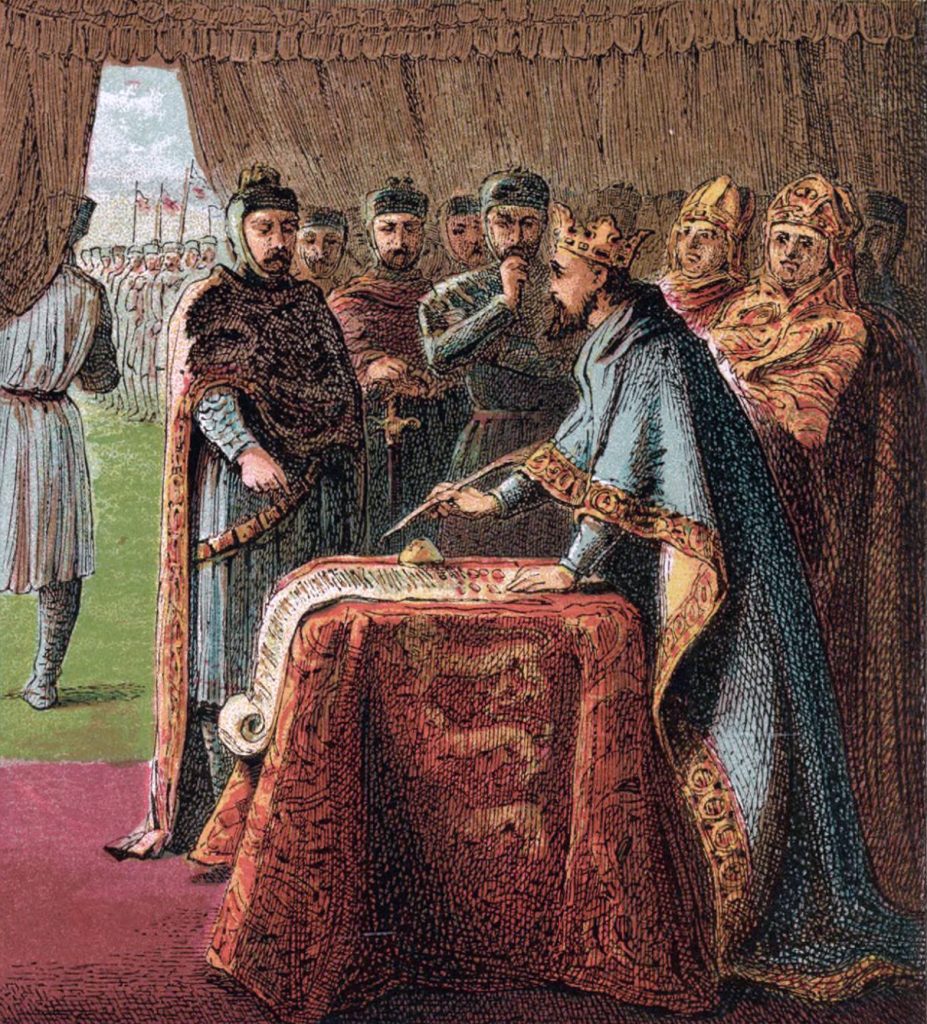
The myth makes this the birth of freedom, but it was first of all a feudal deal: barons securing their own privileges against an incompetent king. Most of the articles concern feudal dues, inheritance levies, and fish-weirs in the Thames. And the document failed at once. Not ten weeks later Pope Innocent III declared it null and void, John broke his word, and England fell into civil war. As a sunrise of liberty, Magna Carta lasted about as long as a modern politician’s campaign promises.
And yet — it held. It was reissued, confirmed, reissued again, and over the centuries something grew into it that was scarcely meant in 1215. In the seventeenth century jurists like Edward Coke turned the barons’ deal into the ancient charter of English liberty. That reading was half invented, and it became true because enough people believed it.
David Hume, the sceptic, saw both clearly. Magna Carta, he writes, “either granted or secured very important liberties and privileges to every order of men in the kingdom; to the clergy, to the barons, and to the people”. To every order, not only the barons. But it contained, he adds soberly, “no establishment of new courts, magistrates, or senates, nor abolition of the old”, no new distribution of powers; it only guarded, “merely by verbal clauses”, against tyrannical practices. And yet, says Hume, it became “a kind of epoch in the constitution”.
More precise than any myth. Magna Carta invented no system of freedom. It anchored a principle: the king stands under the law, not above it. On the Continent, where the Bologna jurists were just then proving to the emperor that his will was law, that was heresy.
The lever of the purse
A principle alone holds no king. It needs a tool, and the tool was money.
Hume named the gap of the old days exactly: there was “no established council or assembly which could protect the people, and, by withdrawing supplies, regularly and peaceably admonish the king of his duty”. That assembly now grew up. In 1258 the barons forced the Provisions of Oxford on Henry III, an early form of parliamentary control. In 1295 Edward I summoned the so-called Model Parliament, with Lords and Commons, with representatives of the counties and the towns.
The mechanism was simple and irresistible. Wars cost money, more money than a king could raise from his own estates. For new taxes he needed Parliament’s consent. And Parliament soon learned that it could make demands in return. Whoever controls the money controls, in the end, the king. From this plain dependence — no money without consent — grew the whole institutional foundation on which an English absolutism never gained a footing. Even Henry VIII, who smashed the Church and seized the monasteries, had to get Parliament to allow it.
Where the two roads lead
By the end of the thirteenth century the two roads lie open. The Continent has law that is set from above, the learned jurists, the emperor who would be Rome’s heir — a road that over the centuries leads to absolutism and finally to the Code Napoléon. England has law that is found from below, the bound king and a parliament with its hand on the purse — a road that leads to constitutional monarchy.
Neither road was chosen on purpose. No one stood at a fork and decided. They were administrators who wanted to collect money, barons who secured their perks, a conqueror too thrifty to throw away a good filing system. Out of such small, self-interested steps came the greatest constitutional difference in the Western world.
But soon a tremor came that would test both roads — one that at first had nothing to do with law, but with faith. When a German monk nailed ninety-five theses to a church door in 1517, the Reformation met two very different constitutions. On the Continent it strengthened the princes. In England it went, as almost everything there does, through Parliament. But that is the next part.
Sources and references
Primary sources – David Hume, The History of England, vol. I, “Appendix II: The Feudal and Anglo-Norman Government and Manners” and ch. XI (John / Magna Carta), 1762 — all Hume quotations in this part are from it – Domesday Book (1086); Magna Carta (1215); Provisions of Oxford (1258)
Secondary literature – Frederic William Maitland (with Frederick Pollock), The History of English Law before the Time of Edward I (1895) – R. C. van Caenegem, The Birth of the English Common Law (1973) — on the contingency of the common law’s emergence – Harold J. Berman, Law and Revolution: The Formation of the Western Legal Tradition (1983) — on the Bologna reception and Roman law in the Empire
Image credits – William the Conqueror’s dominions c. 1087: from the Historical Atlas by William R. Shepherd, public domain – King John and Magna Carta: chromolithograph by Joseph Martin Kronheim (1810–96), from Pictures of English History (1868), public domain
Schreibe einen Kommentar