
Blood and Faith.
The second part left a question open. When the Anglo-Saxons came to Britain in the fifth century — did they drive out the British Celts, or mix with them? If they settled a swept-clean land, then the shared Germanic-Celtic law the second part spoke of is a fine construction with no people to carry it. If they mixed, the fusion sat deeper than any charter could reveal.
A myth has clung to this question for two hundred years: the myth of the “pure” Anglo-Saxon, an island people of unmixed, noble Germanic descent. The Victorian historians loved it, the racial ideologues of the twentieth century abused it, and to this day the word “Anglo-Saxon” haunts political debate as a cipher for a purity that never existed. The genetics of the last ten years has finished it off.
Who came
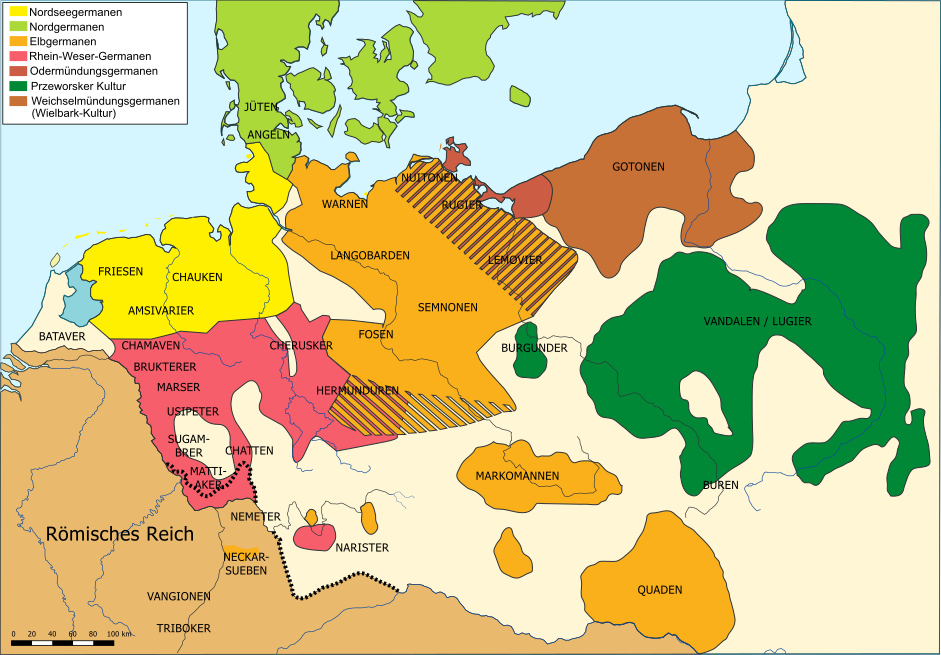
In his Ecclesiastical History of the English People (731), Bede names three tribes. The Angles came from the district of Angeln between Schleswig and Flensburg — a quiet corner of land that still bears the name and yet lent it to a whole kingdom: England. The Saxons came from the Lower Saxon and Westphalian country, the Jutes from Jutland. Archaeology and genetics add a fourth that Bede passes over: the Frisians, whose language is to this day the nearest living relative of English — so close that an old rhyme insists “Bread, butter and green cheese is good English and good Fries”.
Around AD 50 they all sat together along the North Sea coast — Angles, Saxons, Jutes, Frisians — cheek by jowl with Lombards, Goths and Vandals. It is the same kinship the second part described: what the Anglo-Saxons carried across the sea was no peculiarly English law, but common West Germanic stock — assembly, kindred, elected kings, compensation in place of punishment. The difference from the Franks, the Goths and the Lombards lay not in the luggage. It lay in the destination.
For the other Germanic wanderers of the fifth century moved into deeply Romanised provinces. The Franks came to Gaul, the Visigoths to Hispania, the Lombards to Italy — and everywhere the Romance language and culture of the conquered land swallowed them in the end. The Goths in Spain became Spaniards, the Franks in Gaul became Frenchmen, the Lombards became Italians. Only in Britain did it run the other way: there the Roman layer lay so thin that it was not the conquerors who were assimilated, but the conquerors’ tongue that prevailed. The Anglo-Saxons did not become Romano-Britons. They became the English.
The crossing
When Rome withdrew in 410, it left a wealthy but defenceless province behind. Bede tells the beginning as a legend: the British chieftain Vortigern is said to have called in Germanic mercenaries — Hengist and Horsa — to fend off the Picts from the north, and the mercenaries turned the tables on him.
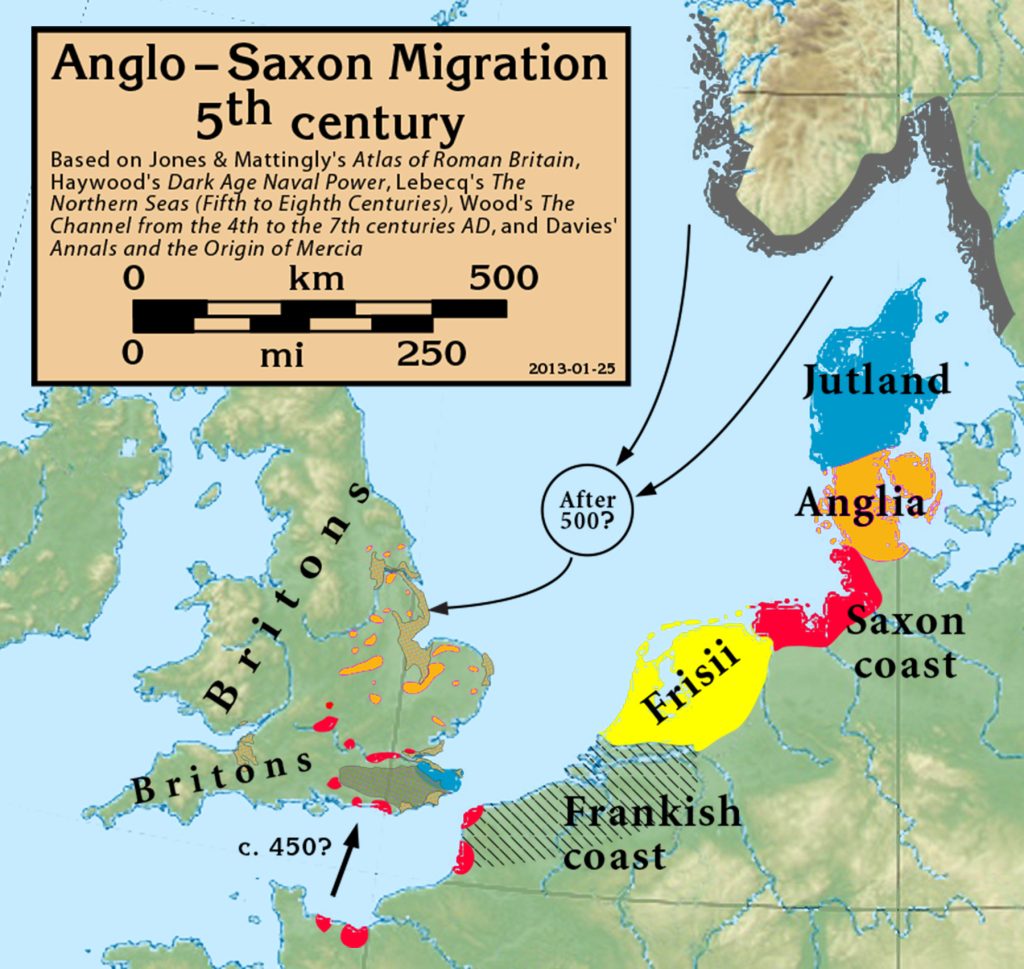
It is surely the oldest recorded version of the mistake of taking into the house a guard you can no longer get rid of. How much of this is saga, no one knows. The movement itself is certain: across the fifth and sixth centuries warriors, families and whole settler groups came over the North Sea, first to Kent and the east coast, then inland.
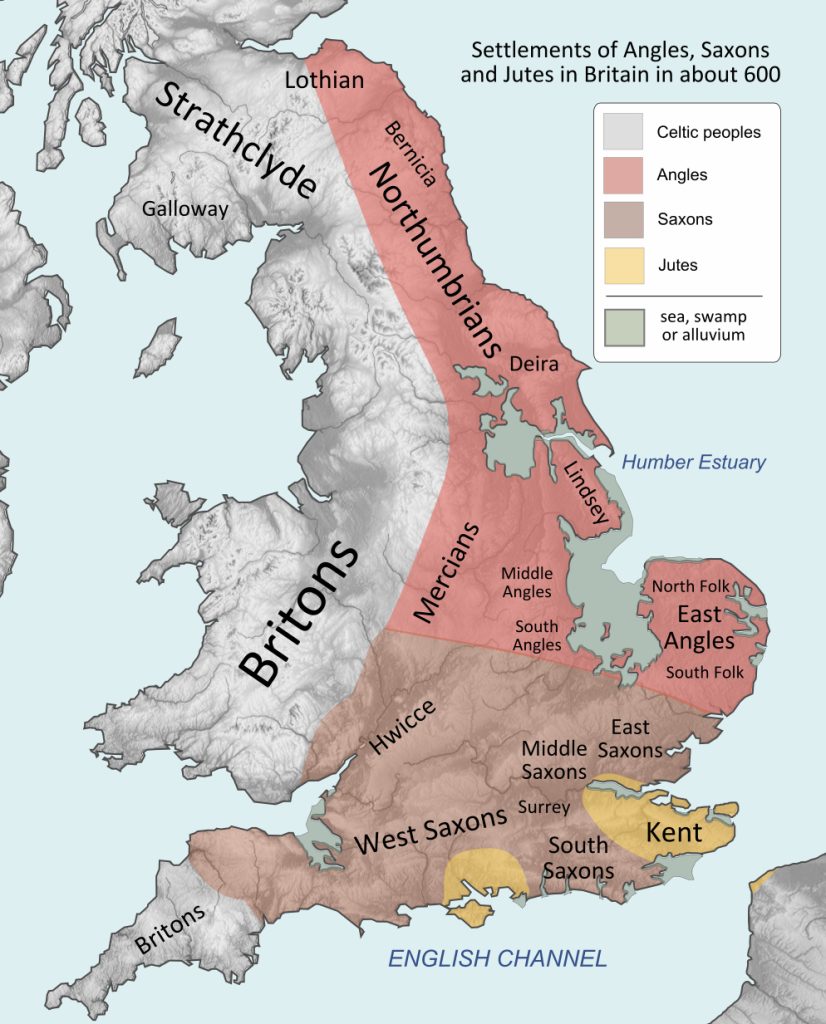
By about 600 the island was divided: in the east and centre a patchwork of Anglo-Saxon kingdoms — Northumbria, Mercia, the East, South and West Saxons, Kent — and in the west the Britons, pushed back into Wales, Cornwall and the north. The language betrays the victors’ point of view: the Old English word for the Britons left behind was wealh, “the foreigner”. Wales means, literally, “land of foreigners” — the Anglo-Saxons called the natives foreigners in their own country.
Driven out or mixed in?
So the answer seems clear: displacement. That is how Bede read it, and the Victorians after him — a conquest in which the Britons were killed or fled west. In the late twentieth century scholarship swung to the opposite: perhaps it was no mass migration at all, but a small warrior elite that merely stamped its language and culture on the existing population — much anglicising, few Anglo-Saxons.
Only ancient DNA has settled the question, and the answer is neither extreme. The great genetic studies of recent years — Schiffels in 2016, Gretzinger in 2022 — show a substantial, real migration: in early Anglo-Saxon cemeteries in eastern and central England, as much as three-quarters of the ancestry comes from the European mainland, from what is now northern Germany, the Netherlands and Denmark. So it was not merely an elite. Many came.
But — and this is the point — it was no extermination. The British population lived on, mixed, and its share grows the further west and north one goes. The modern English genome is predominantly north-west-European Germanic in the east and south, British-Celtic in the west and north. So it was both: a great migration and a fusion. The “pure” Anglo-Saxon is an invention; the real Englishman is, from the very beginning, a hybrid.
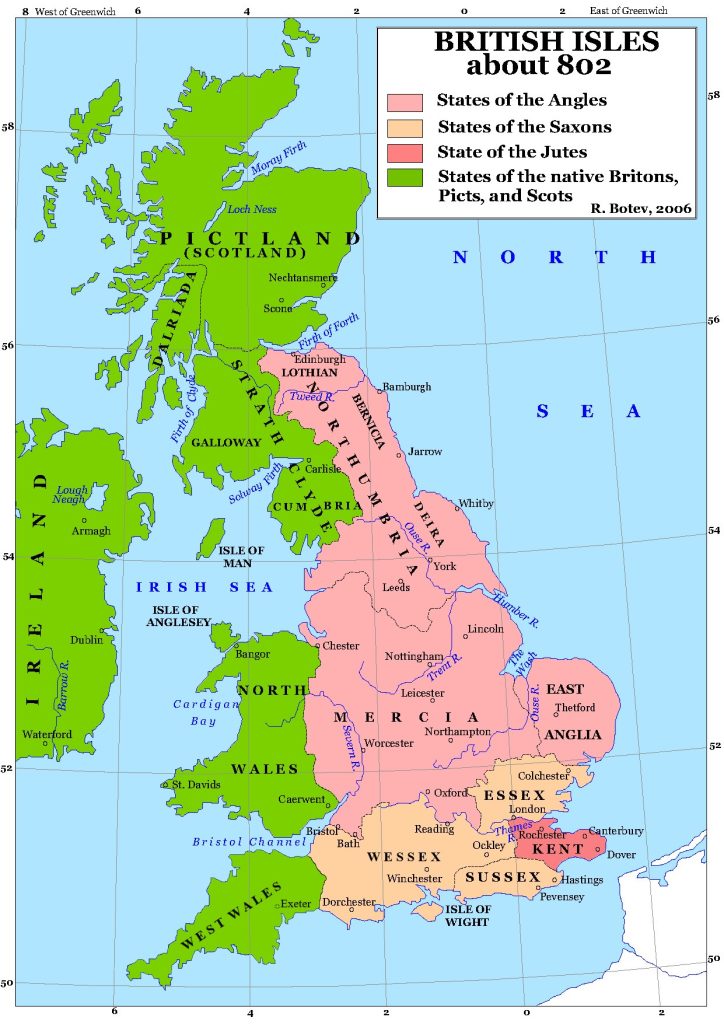
This confirms, in retrospect, the thesis of the second part: the Germanic-Celtic legal substrate could fuse because the people fused. And it is confirmed a second time on the map. By about 802, when the migration was “complete” and historians no longer distinguish between Angles, Saxons and Jutes, the Celtic realms still lie around the edges of the island — Wales, Cornwall in the west, Strathclyde, the land of the Picts, and Ireland. Precisely there, at the western edge, the old substrate survived that the second part spoke of. The island had not erased the old. It had taken it in.
The very same thing — absorb rather than erase — happened a second time, in something quite different: in religion.
Faith arrives — on the island by mission and synod
The Anglo-Saxons came as heathens; they worshipped Woden and Thunor, while Roman Britain had long been Christian. They were converted in a way that needed no army — and from two directions at once.
From the south came the Roman mission in 597: Pope Gregory the Great sent the monk Augustine to Kent, whose king Æthelberht already had a Christian Frankish princess for a wife. And Gregory gave an unusual instruction. In a letter of 601 he expressly required that the heathen temples not be destroyed but consecrated and repurposed; even the sacrificial feasts were to be turned into feasts of the saints — “so that the people, seeing their temples not destroyed, may put away error from their hearts”. Conversion as accommodation, not erasure. It is the religious version of what happened in the blood: take in what is there, rather than clear it away.
From the north and west came the second stream, Irish monasticism. Ireland had become Christian in the fifth century, entirely without Roman conquest, for Ireland had never been part of the empire. From the monastery island of Iona (founded 563) and from Lindisfarne (635), Irish monks evangelised the north of England. Where the two streams chafed on questions of practice — the date of Easter and, no joke, the correct monastic tonsure, the haircut of the monks — the dispute was settled in 664 at the Synod of Whitby: King Oswiu weighed the arguments and decided for Rome. The losing side, Bishop Colman and his monks, withdrew unharmed to Iona. A question of faith, settled by a convened debate, with the losers free to leave.
And on the Continent: the sword
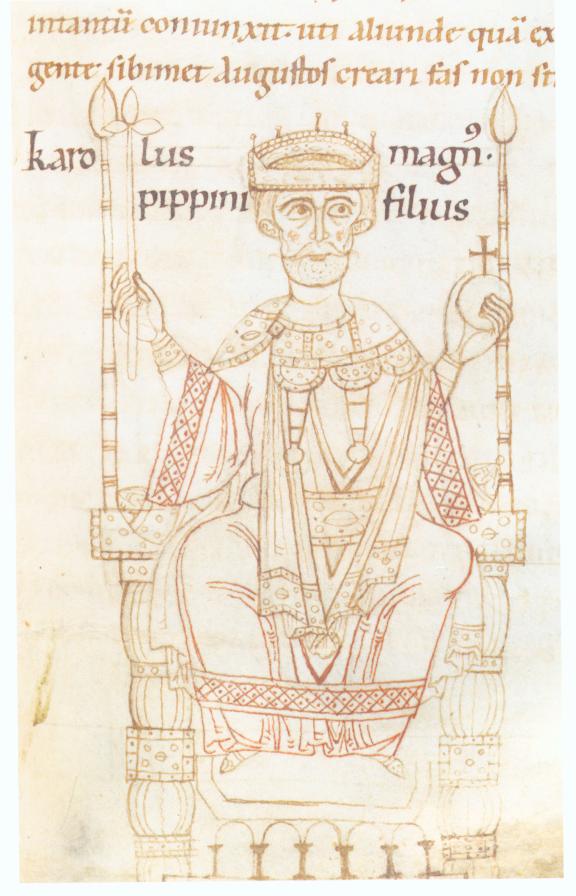
The enforcement of faith ran quite otherwise on the Continent. Charlemagne waged a war against the heathen Saxons that lasted thirty-two years (772–804). His law for Saxony in 785 set the death penalty for refusing baptism, for cremation in the heathen manner, for breaking the fast. In 782 he held a bloody assize at Verden — the royal annals name 4,500 beheaded Saxon prisoners; the figure is disputed, the thing is not. Christianisation as conquest, as command from above — the same structure of command with which Charlemagne, as the second part showed, also centralised law and administration.
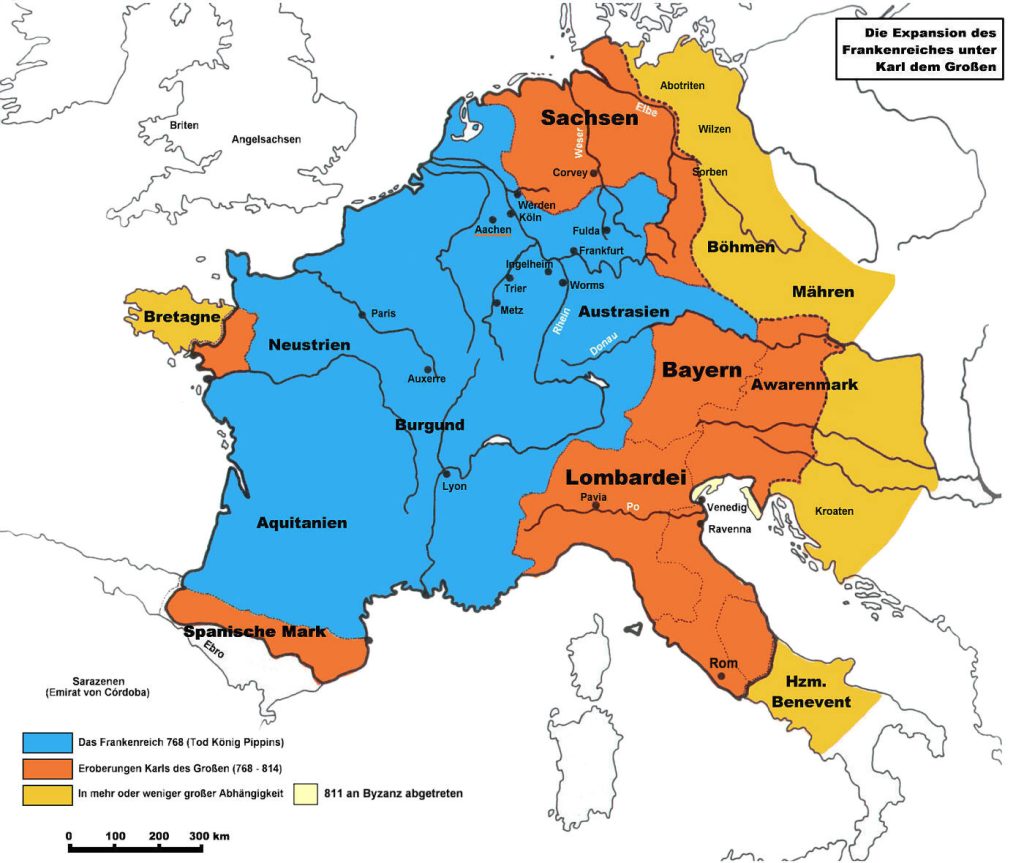
It is the fork from the second part again, now in religion. At Whitby an assembly decides, and the losers ride home. At Verden an army decides, and the losers are beheaded. The same question of faith, two procedures: negotiation against command, absorbing against erasing.
The honest complication
A too-smooth “gentle island” tale would be false, and this series lives by mistrusting itself. The island’s conversion too ran from the top, through the kings: a king converted — calculated, often through a dynastic marriage — and his people followed. The difference was not gentleness but structure; there was no imperial army to do it otherwise.
And an irony that touches us directly: the man who evangelised the Germans beyond the Rhine was himself an Anglo-Saxon — Boniface of Wessex, the “Apostle of the Germans”, who around 723 felled Donar’s Oak near Fritzlar. It was a fairly risky theological argument: he cut down the sacred tree of the thunder god and waited to see whether a bolt would come. None came, and that convinced more than any sermon. But Boniface worked under Frankish protection, and the completion of the Saxon conversion was taken over not by the missionary but by the Frankish state — by force. The same insular mission was practised gently as long as it stayed mission, and turned deadly the moment it entered the Carolingian structure of command. Here too it was not the idea that decided, but the ground it fell on.
The point reaches far ahead. The continental model — faith as a disposition of power — is the ancestral line to the Augsburg principle of 1555, by which the prince decides the confession of his subjects. The insular model — faith that arrives by mission and debate — is the ancestral line to English toleration in 1689. But that is the fifth part.
What comes next
Twice the island did the same thing. In blood it took the Britons in rather than wiping them out; in faith it took in what was there rather than burning it down. The Continent replaced and commanded; the island mixed and grafted. And both times the old survived beneath the new layer — the Celtic substrate at the edge, the rededicated shrine in the village.
Yet this whole grown fabric soon faced its hardest test. In 1066 a foreign duke crossed the Channel with an army, struck down Anglo-Saxon England in a single battle, and within twenty years replaced almost the entire upper class. It looked like the end of everything the island had built. That this conquest became not the end but the entrenchment of the old order — and that everything hung on the decision of a single king — is the subject of the next part.
Sources and references
Primary sources – Bede, Ecclesiastical History of the English People (731) – Gregory the Great, letter to Mellitus (601), preserved by Bede – Capitulatio de partibus Saxoniae (c. 785); the massacre of Verden in 782 after the Frankish royal annals (the recorded figure of 4,500 is disputed in scholarship)
Genetics and migration – Stephan Schiffels et al., “Iron Age and Anglo-Saxon genomes from East England reveal British migration history”, Nature Communications 7 (2016) – Joscha Gretzinger et al., “The Anglo-Saxon migration and the formation of the early English gene pool”, Nature 610 (2022)
Image credits – Maps 1, 3 and 6 (the migration; Britain c. 600; the Frankish empire): CC BY-SA 3.0, Wikimedia Commons — by Notuncurious, Hel-hama, and Wolpertinger (ed. Tsui) respectively – Maps 2 and 5 (Germanic tribes c. AD 50; the British Isles c. 802) and the depiction of Charlemagne: public domain
Schreibe einen Kommentar