
“Mr. Ehlert, that is just wrong!”
“Well, so’s taking the country away from a bunch of Indians, but aren’t you glad we did?”
— The Middle, Season 1, Episode 8 (2009)
The Other Side of the Order from Below
— The Middle, Season 1, Episode 8 (2009)
The last episode ended on a bright note. William Penn’s “holy experiment,” the freest colony in the world, a religion that organized itself from below. Now it is time to look at the same world from the other side.
Let us begin where the bright picture is brightest. In 1682, according to tradition, beneath an elm tree on the bank of the Delaware, at a place called Shackamaxon, Penn concluded a treaty with the Lenape. It bears no signature and no date, and some of it is legend, later romanticized by Benjamin West’s famous painting (Episode 11). But the core holds: Penn bought the land instead of taking it, learned a few words of Lenape, kept the peace. Voltaire quipped that it was the only treaty between Indians and Christians that was never sworn and never broken.
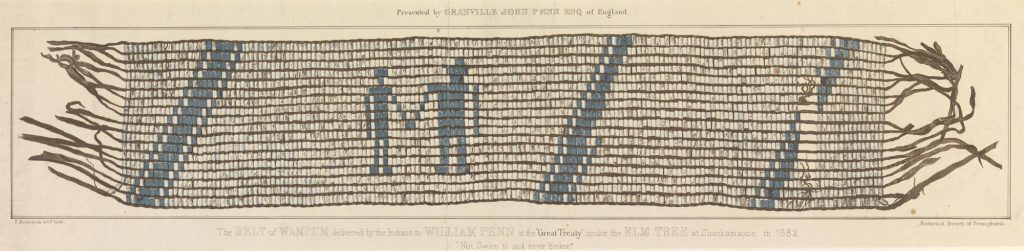
Was Penn a saint? More a realist with a conscience. His Quaker colony was young and weak, surrounded by numerous, powerful Lenape. Those without an army buy peace. Fairness here was conviction and prudence combined. For as long as Penn lived, it held.
The Fracture
Penn died in 1718, ill and burdened by debt. His heirs had other concerns, above all money. And in 1737 they did something that would stain their father’s name for generations.
Thomas Penn, the principal heir, and provincial secretary James Logan produced an old, unsigned draft deed from 1686 in which the Lenape had allegedly ceded as much land as a man could walk in a day and a half. Whether the deed had ever been valid is doubtful to this day. Penn and Logan let it stand. They quietly cleared a path through the forest, hired the three fastest runners in the colony, and sent them off.
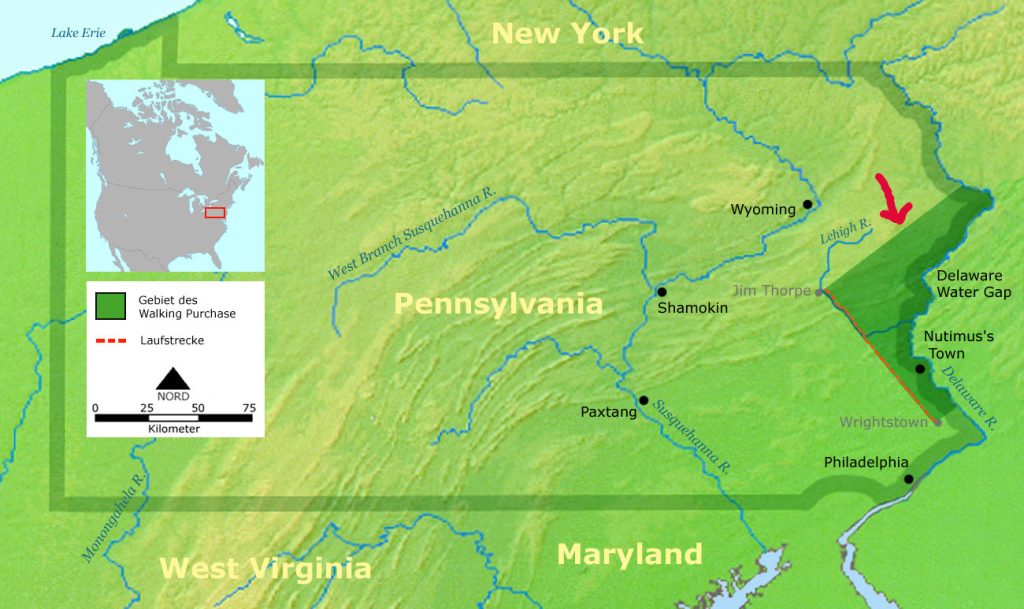
It was not a walk — it was a race. One of them, Edward Marshall, held on and covered roughly seventy miles in the day and a half, far more than any Lenape had anticipated. Then, instead of taking the shortest line to the bounding river as agreed, they chose a right-angle course to the distance run, which vastly expanded the area. In the end, the Penn family had claimed a tract of roughly twelve hundred square miles — the entire Lehigh Valley. The Lenape called it fraud. They were right.
A Matter Among the Indians Too
Here the story becomes more uncomfortable than the simple picture of white thieves and red victims allows. For when the Lenape refused to move, Pennsylvania did not call out the militia. It called on the Iroquois.
The Six Nations, the powerful league to the north, had long claimed a suzerainty over the Lenape; they had, in the Iroquois account, once subjugated them and “made them women” — disarmed them, reduced them to dependents. In 1742, at a council in Philadelphia, the province turned this to its advantage. The Onondaga speaker Canassatego rose, denied the Lenape any right to have sold the land at all, and closed with a humiliation: “You are women. Take the advice of a wise man and remove immediately.” The Lenape removed.
In the seventeenth century, the Six Nations had in the so-called Beaver Wars subjugated or scattered entire peoples — the Huron, the Erie, the Susquehannock — in the contest over hunting grounds and the fur trade. War was as much a part of the world of the indigenous peoples as of the Europeans’, and it was no gentler. Prisoners were adopted to replace the fallen, or ritually tortured to death. The image of the peaceful natural man to whom the white man first brought violence is as false as its caricature, the bloodthirsty savage. There was power, conquest, and cruelty on all sides.
The expulsion thus ran not merely against Indian power, but through it. Pennsylvania cheated; the Iroquois enforced, from their own calculation of interest. This does not diminish the land theft, but it makes it truer. It was not a Western.
The Man Who Stayed in the Middle
In this space moved Conrad Weiser, the father-in-law of Mühlenberg from the last episode. When Pennsylvania and the Iroquois negotiated, he interpreted; the alliance that drove out the Lenape ran through his words.
Weiser was the interpreter, not the wire-puller; the fraud had been Thomas Penn’s, the order was Canassatego’s. Weiser was something rarer: a man both sides trusted. The Iroquois had years before named him Tarachiawagon, “he who holds up the sky,” after he had walked through snow and frost in a winter of starvation to their capital at Onondaga to make peace. When he died in 1760, Indians came to his grave, and an Iroquois chief said: “We have sustained a great loss and sit in darkness; since his death we can no longer understand each other so well.”
The most just mediator the frontier had, respected by both sides, could not halt the land theft. The machinery ran on.
As Far as the Light Reached
The machine had an engine, and it was an idea. We encountered it already in Episode 6: John Locke’s theory of property.
It did not spring from greed, but from the fear of arbitrary power. But he wrote the chapter on property not only as a philosopher in his study. He was simultaneously secretary to the Lords Proprietors of Carolina — the consortium that owned the colony. The theory and the administrative business lay on the same desk. This does not make him a hypocrite; his contemporaries saw no contradiction because none existed in their time. But it explains why the theory worked so precisely from the colonist’s perspective.
In the century of civil wars, he sought a foundation on which property was secure against the reach of an absolute king. His answer: property arises from labor. Whoever is his own master possesses his own labor; whoever “mixes” it with nature — plows a field, fences it, cultivates it — makes the land his property, prior to the state and against it. This was meant as a bulwark against tyranny, built from below. In this way it also became a foundation of American freedom.
And the same logic dispossessed the Lenape. If only labor, only “improvement,” creates property, then land that nobody cultivates in the European sense belongs to no one and awaits whoever will cultivate it. Locke wrote the sentence in which all of America is contained: “In the beginning all the world was America.” Unused abundance, made valuable only by labor. The colonists read this literally. Even the Puritan idea of the vacuum domicilium, the “empty habitation,” had anticipated it: John Winthrop in Massachusetts declared that because the Indians did not fence and “improve” the land, they could not own it; whoever cultivated it acquired it lawfully. By this logic, the colonists were taking nothing from the indigenous people at all. They were creating property where none had existed.
This was a fiction, and the Indians knew it. The Iroquois farmed very well indeed — the “three sisters,” corn, beans, and squash; they kept the forest open through controlled burns, they tended the land, they possessed it only differently: as a common gift from the Creator, not as a commodity with a fence. European law recognized only the one form, the form with the fence.
And the fiction was not merely cultural blindness. The philosopher John Douglas Bishop showed in 1997 that whoever applies Locke’s own criteria — labor, improvement, cultivation — without selective bias must recognize the Iroquois’ property claims. Corn, beans, squash, and managed forest satisfy them. The theory contained its own refutation. Locke did not see it because his time did not see it.
Sharper still: the European commons, too, was communal land — collectively worked, mostly without fences, governed by customary right. A Bavarian farmer could not use the pastures of northern Germany; English common land was strictly regulated, the use-rights of the village community were established in law. Locke recognized this collective property right in Europe — because a state stood behind it to protect it. America he declared to be the state of nature before the state, because he denied the indigenous peoples any statehood in his sense. Therefore: no state, therefore no protectable property, therefore free land. On both sides of the Atlantic, people managed land communally. What was missing was not the use. What was missing was the state Locke recognized. That is the double standard.
And here is the point more troubling than any hypocrisy: Locke did not conceal it. He applied it openly; for him it was not a standard at all. That the same logic which dethroned the king also stripped the Lenape of their land was for him not a hidden side but simply not a question. Land-taking in his time was not recognized as wrong — it was the normal business of power: the Iroquois, as we have seen, waged their Beaver Wars, Louis XIV pushed his frontier to the Rhine, the Ottomans stood before Vienna. No one asked whether one might, only whether one could. That Locke was also a shareholder in the Royal African Company, which shipped enslaved people across the Atlantic, was in this world no contradiction to his doctrine of freedom. It saw nothing objectionable in it.
What is remarkable is not the intent, but the language. Locke offered no Conquista rhetoric, no “we bring light to the heathen,” but a secular, rational justification that required no God and yet produced the same result. Where the old justification had invoked the Pope and God, reason now sufficed. The land remained taken; only the justification was new.
And here — not at the fence — is where the Anglo-American path parts from the continental one. On the continent, property came from the state, granted from above and reclaimed if necessary. Locke inverted this: property arises from below, from the labor of the individual, prior to the state and against it. This was the root of American freedom. And it was the same root from which the land-taking grew. Whoever derives his right from his own labor needs no king to grant it, and tolerates no one to block him — not even a Lenape.
Enlightenment is not a state but a process. Whoever stands in the middle of it sees only what the next step illuminates. Locke shed light as far as he could — one step beyond the papal bull — and beyond that lay a darkness that no one in his time recognized as darkness.
The Doctrine of Discovery
Above any single deed stood a larger legal construction, and it was ancient. As far back as the fifteenth century, papal bulls had authorized Christian powers to take possession of “discovered” land belonging to non-Christians: Dum diversas in 1452, Inter caetera in 1493.
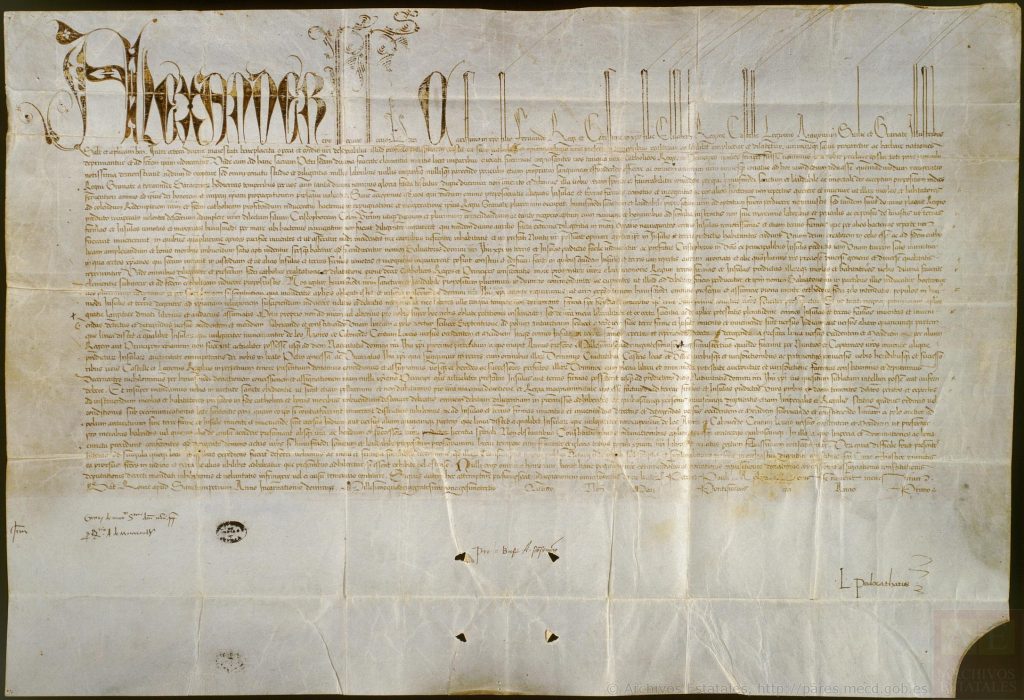
Inter caetera document of 4 May 1493, Archivo General de Simancas, Public Domain
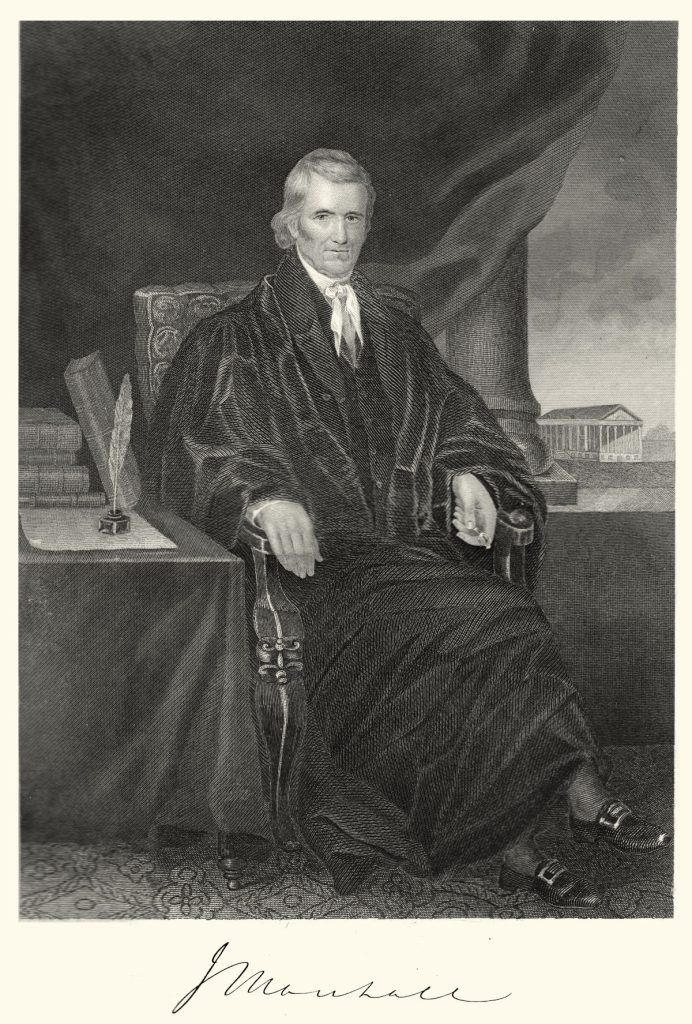
From this Doctrine of Discovery, long after the Reformation, came American law. In 1823, Chief Justice John Marshall wrote in Johnson v. M’Intosh that discovery gave the discovering state the title to the land; to the indigenous peoples remained only a “right of occupancy” that the state could extinguish at any time. The bull had become a paragraph.
This is the core of what is today called settler colonialism, and it distinguishes the Anglo-American pattern from the others. The Spanish conquistador wanted the indigenous peoples as labor and as souls; the French fur trader wanted them as partners and hunters; both needed them alive and in place. The English settler wanted the land. Whoever wants the land does not need the people — he needs them gone. Precisely the dynamic from below, the free, hungry, self-spreading settler society that this series has praised, was also the most relentless engine of displacement.
This dynamic came from the cradle. The settlers had children at a rate almost without parallel; land was cheap, marriage came early, and Benjamin Franklin calculated that their numbers doubled roughly every twenty-five years — from one million around 1750 to two and a half million by 1775. Each of these children needed a farm, and — what is easily overlooked — each was permitted to go and find one. This was not self-evident. It was the era when Europe still knew serfs. The peasant in Saxony, Bohemia, or Brandenburg was bound to the manor and could not even leave his lord, let alone acquire land of his own; in Russia serfdom held until 1861. Freedom of movement was the precondition of settler pressure, and on the continent it was absent. The same personal freedom that drove the American settler toward land-taking was simply not available to the European peasant. It was not a colonial minister in London who pushed the frontier westward, but millions of families who had to find somewhere to place their sons. And it was not even the grand enterprise one might imagine. William Penn died in debt, the proprietary colonies often ran at a loss, and economic historians still debate whether the empire brought the British taxpayer any net gain at all. The hunger for land was no plan from above. It was the sum of countless hungers from below.
And there was no plan at all. That is the most unsettling thing about the story: the settler did not wait for the lawyer. He felled the trees, built a cabin, called the land his, and the law followed after and ratified what had long since occurred. There is even a word for it — squatting, the occupation of land subsequently legalized; the Preemption Act of 1830 gave those already sitting on public land the right of first purchase. Neither the settler nor the lawyer needed the other. Both together, without arrangement, produced the displacement.
What Remains
Penn was fair, Weiser beloved, Locke a friend of freedom — and in the end the land was taken. It required no villains and not even a plan. That is the double standard: no malice, but a machine without a machinist. What weighs more, the freedom that grew from it or the price others paid, is for each reader to decide.
Today America still wrestles with the legacy — in land acknowledgments and in the Vatican’s repudiation of the Doctrine of Discovery in 2023. But that is aftermath. As long as it could be claimed that the indigenous peoples did not use the land, one invoked Locke. When the Cherokee demolished that argument, built plantations, wrote a constitution, and won before the Supreme Court, the philosophy was set aside and the bayonets taken up. The Trail of Tears and the buffalo belong to a different, darker episode.
Sources and References
Primary Sources – John Locke, Two Treatises of Government (1689), Second Treatise, Ch. 5 “Of Property” — “in the beginning all the world was America” (§49) – The Treaty held with the Indians of the Six Nations, at Philadelphia, in July, 1742 — Canassatego: “You are women … remove immediately” – Johnson v. M’Intosh (1823), U.S. Supreme Court (Marshall) — “right of occupancy” – Papal bulls Dum diversas (1452), Romanus Pontifex (1455), Inter caetera (1493); counterposed with Sublimis Deus (1537)
Secondary Literature and References – On the Walking Purchase (1737): Thomas and John Penn with James Logan; the unsigned draft deed of 1686; the runners (Edward Marshall et al.); approximately 1,200 square miles of Lenape land – On Penn’s Treaty of Shackamaxon (1682) and Voltaire’s quip – On Conrad Weiser: the Iroquois name Tarachiawagon (“he who holds up the sky”); the mourning of the Iroquois upon his death in 1760 – On Locke’s role: Barbara Arneil, John Locke and America (OUP 1996) — demonstrates that the chapter on property was written in parallel with administrative work as secretary to the Lords Proprietors of Carolina; no surviving correspondence in which Locke discusses the implications of his theory for indigenous peoples (the question did not arise in his time) – David Armitage, “John Locke, Carolina, and the Two Treatises of Government” (Political Theory 32/5, 2004) — Locke’s acquaintance with the Carolina colony was more extensive and enduring than earlier commentators assumed; identifies the colonial administrative context as the direct background for the composition of Ch. V – John Douglas Bishop, “Locke’s Theory of Original Appropriation and the Right of Settlement in Iroquois Territory” (Canadian Journal of Philosophy 27/3, 1997) — applies Locke’s own criteria (labor, improvement, cultivation) consistently to the Iroquois and concludes that they satisfied the conditions for property rights; the exclusion was a selective application of the theory – On Locke’s entanglement: shares in the Royal African Company (c. 1672–1675) – On the vacuum domicilium: John Winthrop and the Puritan land-taking in New England – On the Doctrine of Discovery and its absorption into U.S. law (Johnson v. M’Intosh, 1823); repudiation by the Vatican (30 March 2023) – On the concept of settler colonialism (replacement rather than exploitation) distinguished from Spanish and French colonization – On indigenous warfare: the Beaver Wars of the seventeenth century (Iroquois against Huron, Erie, Susquehannock et al. over the fur trade and hunting grounds); “mourning wars” and the adoption and ritual torture of captives; Lawrence Keeley, War Before Civilization: The Myth of the Peaceful Savage (OUP 1996) — approximately 90–95 percent of all known premodern societies practiced warfare; prehistoric warfare was, in proportion to population, more lethal than modern; Richard J. Chacon / Rubén G. Mendoza (eds.), North American Indigenous Warfare and Ritual Violence (University of Arizona Press 2007) — osteological and ethnohistorical evidence for pre-colonial indigenous violence – On settler demography: Benjamin Franklin, Observations Concerning the Increase of Mankind (1751) — doubling approximately every 25 years (c. 1 million in 1750, ~2.5 million by 1775); early marriage, cheap land – On the contrast in freedom of movement: serfdom/manorial servitude in central and eastern Europe in the eighteenth century (binding to the manor, no right to leave one’s lord); abolition in Russia only in 1861 (and Prussia from 1807, Habsburg 1781/1848) – On the contested profitability of empire: Lance Davis / Robert Huttenback, Mammon and the Pursuit of Empire (1986) — the empire often a net cost for the British taxpayer; William Penn died in debt, many proprietary colonies ran at a loss – On law following fact: squatting (land occupation) and its subsequent legalization, including through the Preemption Act (from 1830) — right of first purchase for settlers already on federal land – Outlook: Indian Removal Act (1830), Worcester v. Georgia (1832), Trail of Tears (1838/39) — material for a later episode
Schreibe einen Kommentar