
Where the Enlightenment found roots.
In 1776 thirteen colonies declared their independence. In 1789 Paris stormed the Bastille. Both appealed to the Enlightenment, but to different strands: America to Locke, Montesquieu, and Hume, to liberty; France more and more to Rousseau, to equality. And they ended as differently as two revolutions can end.
The American one wrote, in 1787, a constitution that still holds, the oldest in the world. The French one spun within four years into the Terror, then into Napoleon, then into a whole century of coups, restorations, and fresh revolutions. The same era, the opposite result. Why?
A good part of the answer sits in a carriage that pulls up, in 1768, before a tiny colonial college in New Jersey.
The Scottish minister in New Jersey
The man in the carriage was a Scottish minister, John Witherspoon, called to lead the small Presbyterian college of New Jersey, the later Princeton. He brought the Scottish Enlightenment in his luggage, and he brought it into the lecture hall.
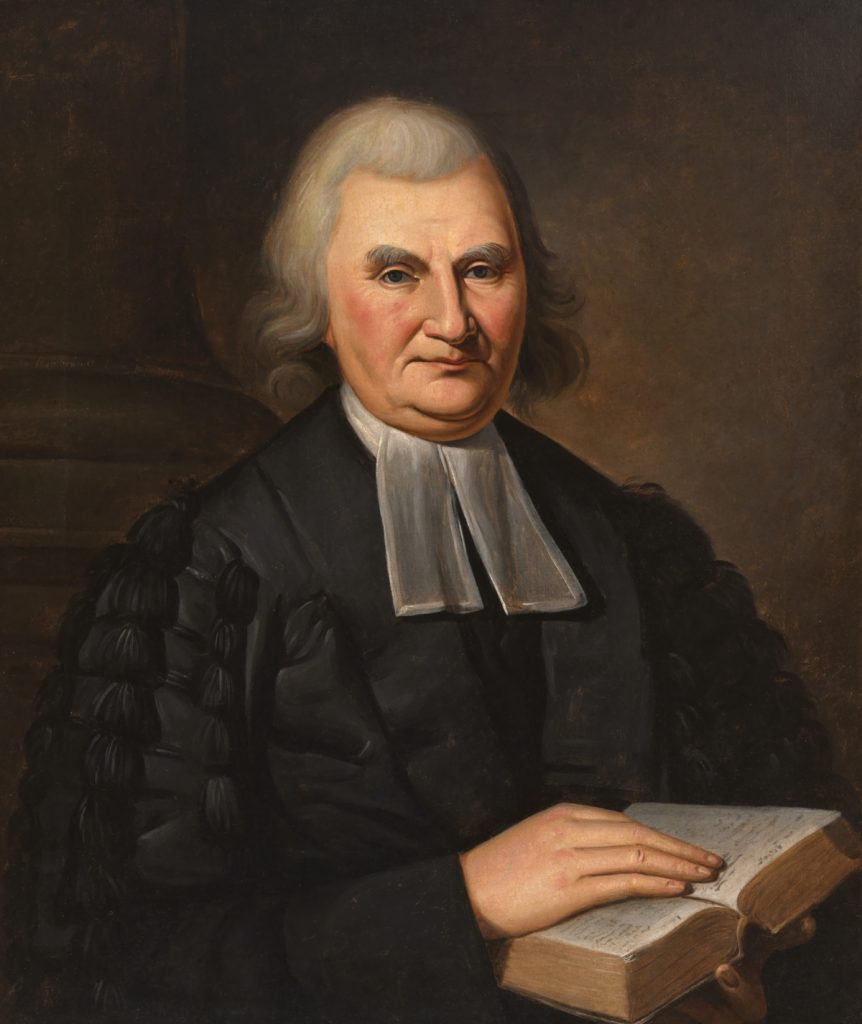
Witherspoon was no Humean; he taught the Scottish Common Sense philosophy, the school of Thomas Reid, which had been invented precisely to refute Hume’s scepticism. Where Hume doubted whether reason could prove the world, Reid insisted that common sense had long since known it. Witherspoon stood on Reid’s side.
But he carried the other, the lasting part of the Scottish Enlightenment across the Atlantic: the sober, empirical, anti-utopian view of man and his institutions. Every good form of government, he taught, must be complex, “so that the one principle may check the other”. That is a sentence about distrust. And Witherspoon did not speak it into a void. He spoke it to a whole generation of future Americans; out of his lecture halls came a vice-president, dozens of congressmen, judges and ministers, and his best student.
Madison, the student
The best student was James Madison. He sat under Witherspoon at Princeton, read the Scots there, and at home read Hume in the original as well. When the time came in 1787 to defend the new American constitution, Madison wrote, with Hamilton and Jay, the Federalist Papers, and the most famous, Number Ten, reads like applied Hume. Hume had written an essay arguing that politics could “be reduced to a science”. Madison made it real.
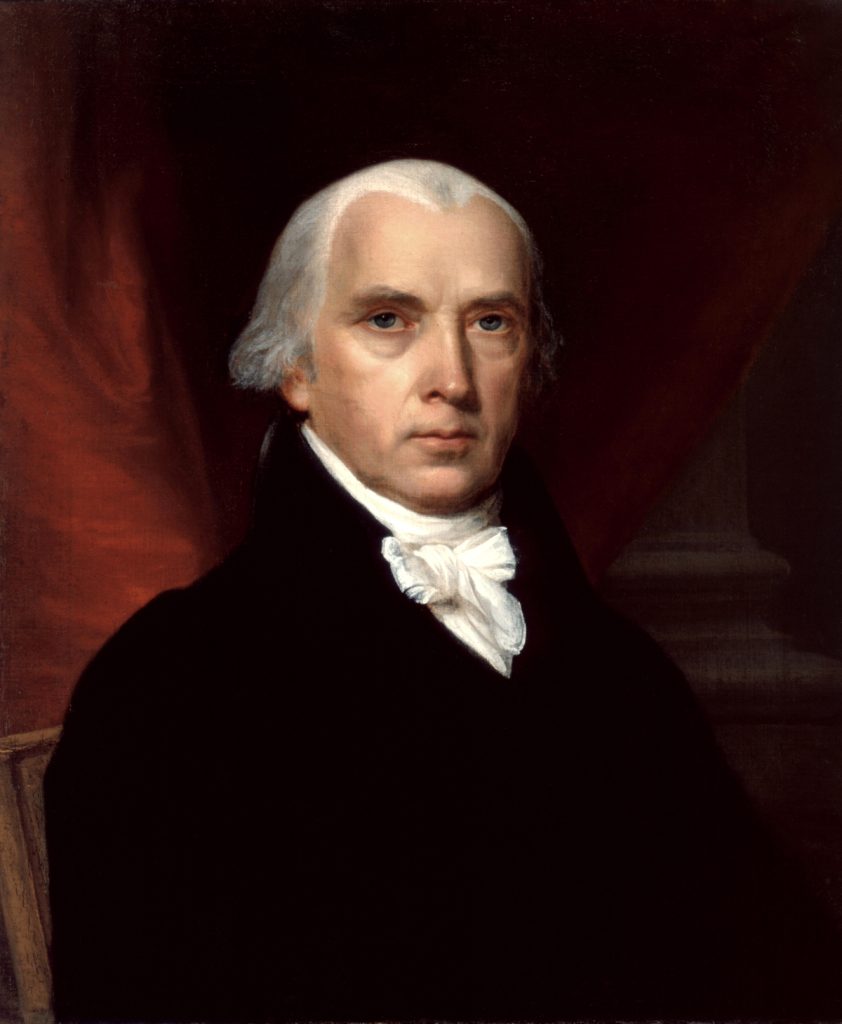
The idea is the core of the American design and the exact opposite of all enthusiasm. Do not trust man. Do not build a republic that presupposes virtuous citizens, for there are no such citizens reliably. Build a mechanism in which self-interest brakes self-interest, in which power divides power and faction neutralises faction. “If men were angels, no government would be necessary,” Madison wrote. Since they are not, there must be separation of powers, federalism, and a country so wide, with so many interests, that none can crush the others. An order from below, but constructed out of the clear knowledge that man is no angel.
Old law that travelled along
The Americans brought something the French revolutionaries did not possess: an inherited habit of law and liberty.
The colonists had carried the common law across the Atlantic, along with the “rights of Englishmen”, the juries, the local self-government, the plain practice of governing themselves. When they rose in 1776, they did it not in the name of a new man but in the name of old rights that the crown was withholding from them. It was, to a good part, a conservative revolution: the restoration of the inherited, not the leap into the unknown.
No one shows this more beautifully than Thomas Jefferson. When Congress had a state seal designed in 1776, Jefferson proposed for the one side Hengist and Horsa, the Saxon chieftains from Part 3, “from whom we claim the honor of being descended, and whose political principles and form of government we have assumed”.
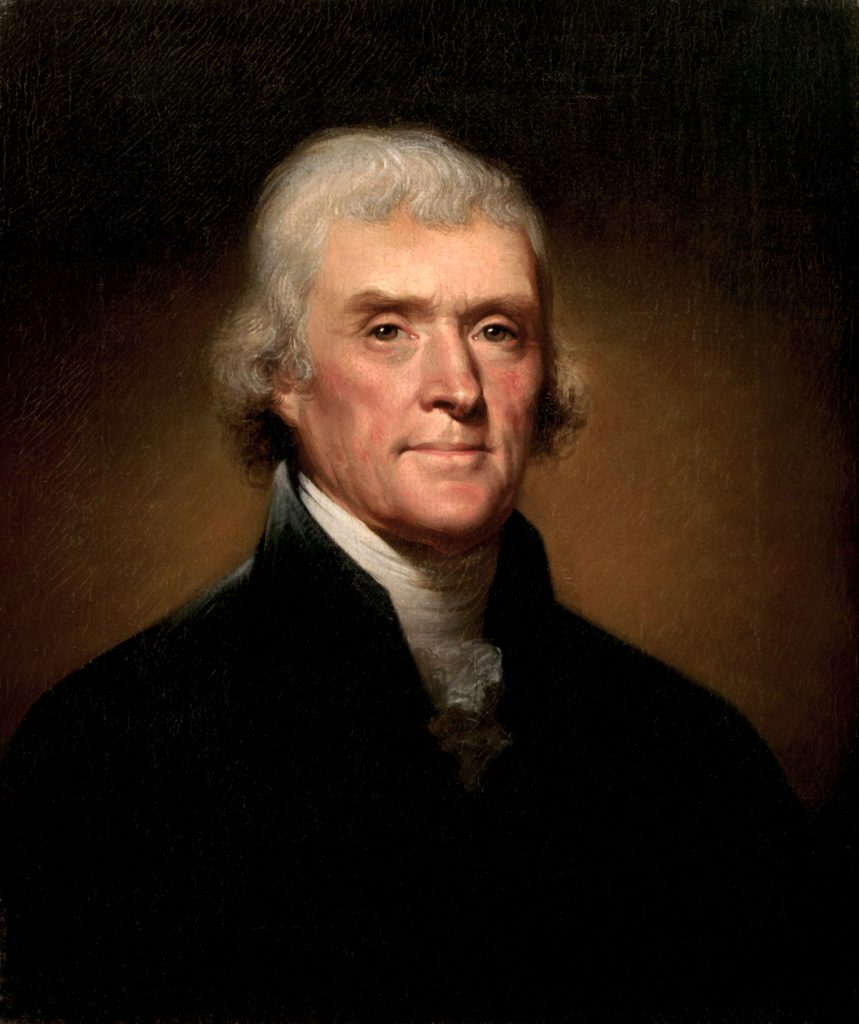
Thomas Jefferson (Rembrandt Peale, 1800). Public domain.
Jefferson believed in all seriousness that the foundation of American law came from the Anglo-Saxon age before 1066, not from the Norman one after it. The “Norman Yoke”, the idea that the conquest of 1066 had smothered free Saxon liberties, was for him no folklore but a programme. America was, in this self-image, the true heir of the island that had betrayed its own ancient freedoms.
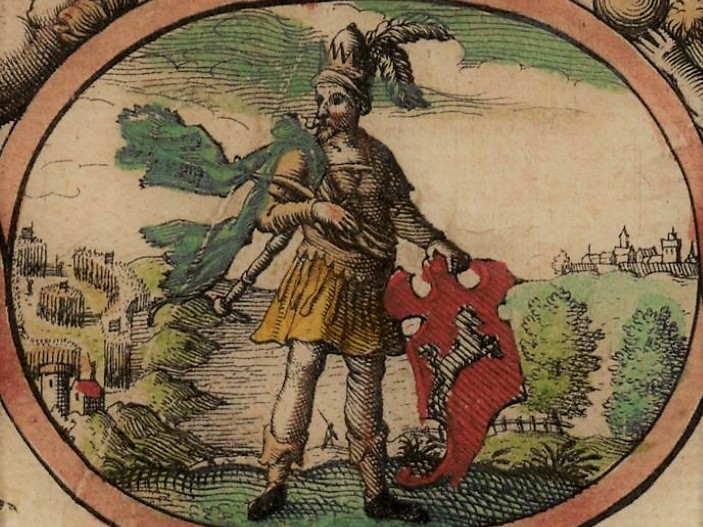
A detail any Lower Saxon recognises at once: the two names simply mean “stallion” and “horse”. The same Saxon horse that Jefferson claimed for America still trots across the gables of Low German farmhouses and through the arms of Lower Saxony and Hanover — that same Hanover from Part 8 — right down to the emblem of the Raiffeisen cooperatives.
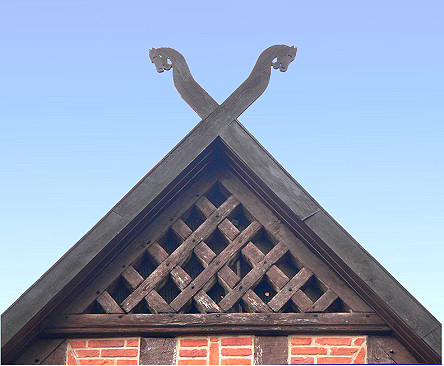
The test: 1776 and 1789
In France all of that was missing. There was no common law, no grown self-government, no “rights of Frenchmen” to fall back on; there was the absolutist state and little in between. So the French revolutionaries did not rebuild but built from scratch. The Declaration of the Rights of Man and of the Citizen of 1789 is a great document, clear, bold, universal, and it hovered over a country that had no institution to carry it. What followed was the search for that institution: constitution after constitution, 1791, 1793, 1795, 1799, with the Terror in between and a general with a crown at the end.
It is the bitter irony of this story that the thinker who gave America its separation of powers was himself a Frenchman. Montesquieu, who admired the English constitution and made the dividing of power a principle, was cited in the Federalist more often than almost anyone. France exported its best institutional mind to Philadelphia and turned, at home, to Rousseau, who wanted not to divide power but to proclaim the one, undivided will of the people. Out of that undivided will came, under Robespierre, the guillotine.
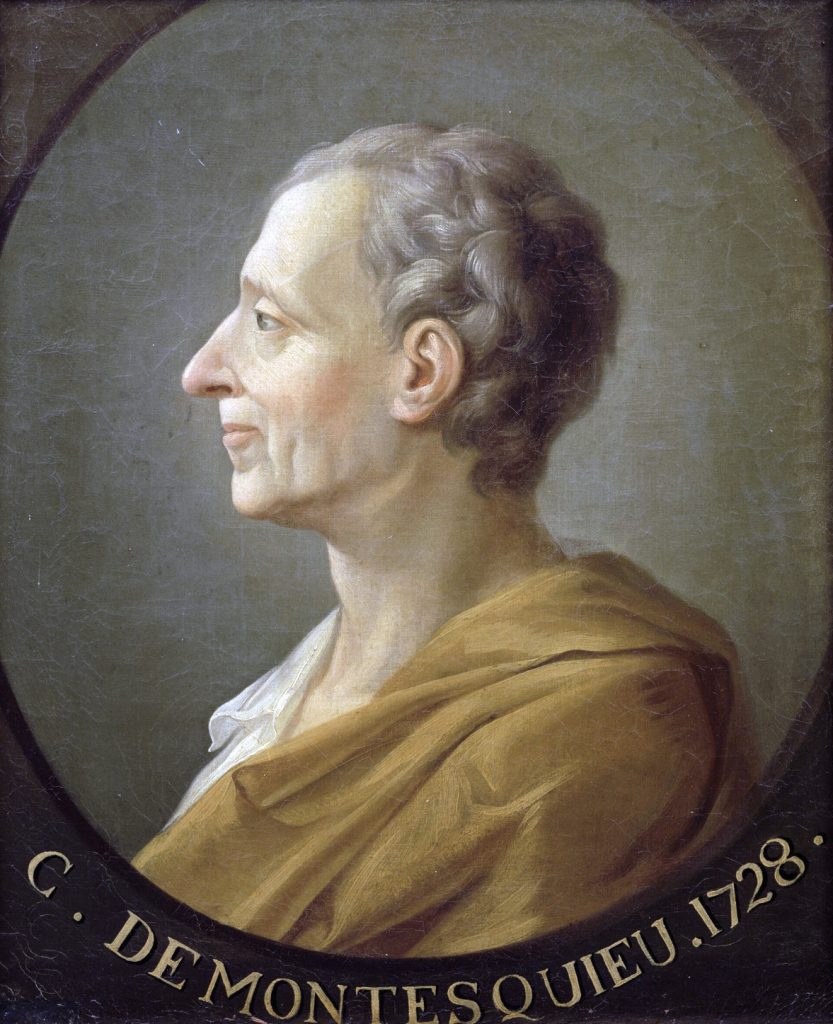
After Jacques-Antoine Dassier — Collection Château de Versailles, public domain.
And a second thing came into it that had nothing to do with ideas at all: naked hunger. France in 1789 was a bankrupt state — ironically bankrupt in part because it had helped finance the American Revolution — over a people that was not being fed. After a failed harvest and a hard winter, by July 1789 the price of bread ate almost the whole daily wage of a labourer; the storming of the Bastille and the women’s march on Versailles in October were bread riots too. The American colonists, by contrast, were among the wealthiest, best-fed people on earth, with land in abundance. A revolution of the desperate radicalises differently from one of the propertied defending an inherited right.
A contemporary saw both with unusual clarity. Edmund Burke, the Irish member of the British Parliament, had spoken up in 1775 for the American colonists, because they were defending English liberties. The same French Revolution that half of Europe cheered, he condemned in 1790 as presumption: men redesigning a whole society on the drawing board, as if nothing had existed before them. In the main, he was proved right.
The American order held, and held so well that it lasted two hundred and thirty years, to this day. But it wrote slavery into the very constitution that celebrated liberty, and shut women, the propertyless, and the native peoples out of its “we”. The French declaration spoke the rights more universally than any American dared — “men”, without a footnote — and paid for the claim in blood and decades of disorder. Which weighs more, the durable with its blemish or the universal with its chaos, every reader may decide for himself.
But this bridge to Britain was not the only one, and not purely Scottish and Presbyterian. While Witherspoon’s students were devising the constitution in Princeton, not a hundred miles away, in the German congregations of Pennsylvania, another man was building another bridge. He came from Halle, from exactly that Pietist school which Prussia had harnessed for its state (Part 8) — and in America, without a state and without a prince, something new grew out of it. How a religion organised itself there from below is the next part.
Sources and references
Primary sources – The Federalist (1787–88), especially No. 10 (factions, the extended republic) and No. 51 (“If men were angels, no government would be necessary”) — James Madison – Thomas Jefferson, proposal for the Great Seal of the United States (1776): Hengist and Horsa, “from whom we claim the honor of being descended, and whose political principles and form of government we have assumed” – David Hume, Essays — “That Politics May Be Reduced to a Science” (1741) – Montesquieu, The Spirit of the Laws (1748) — separation of powers; the most-cited authority in the Federalist – Declaration of the Rights of Man and of the Citizen (1789) – Edmund Burke, Speech on Conciliation with America (1775); Reflections on the Revolution in France (1790)
Secondary literature and references – On Witherspoon: the Scottish Common Sense school (Thomas Reid, against Hume’s scepticism); president of the College of New Jersey/Princeton (1768–1794); the only clergyman among the signers of the Declaration of Independence; Madison as his student; “every good form of government must be complex…” – On the Hume–Madison link: Douglass Adair, “That Politics May Be Reduced to a Science”: David Hume, James Madison, and the Tenth Federalist (1957) – On the “Norman Yoke” and Jefferson’s Anglo-Saxon “ancient constitution” (liberties before 1066) – On the common law and the “rights of Englishmen” as the colonists’ imported inheritance – On the distinction between the moderate (Locke, Montesquieu, Hume) and radical (Rousseau) Enlightenment; liberté against égalité (cf. Tocqueville) – On France’s subsistence and fiscal crisis of 1788/89: failed harvest, the price of bread, state bankruptcy (partly caused by war aid to the USA); the women’s march on Versailles (October 1789)
Schreibe einen Kommentar