
What Lay Beneath the Empire.
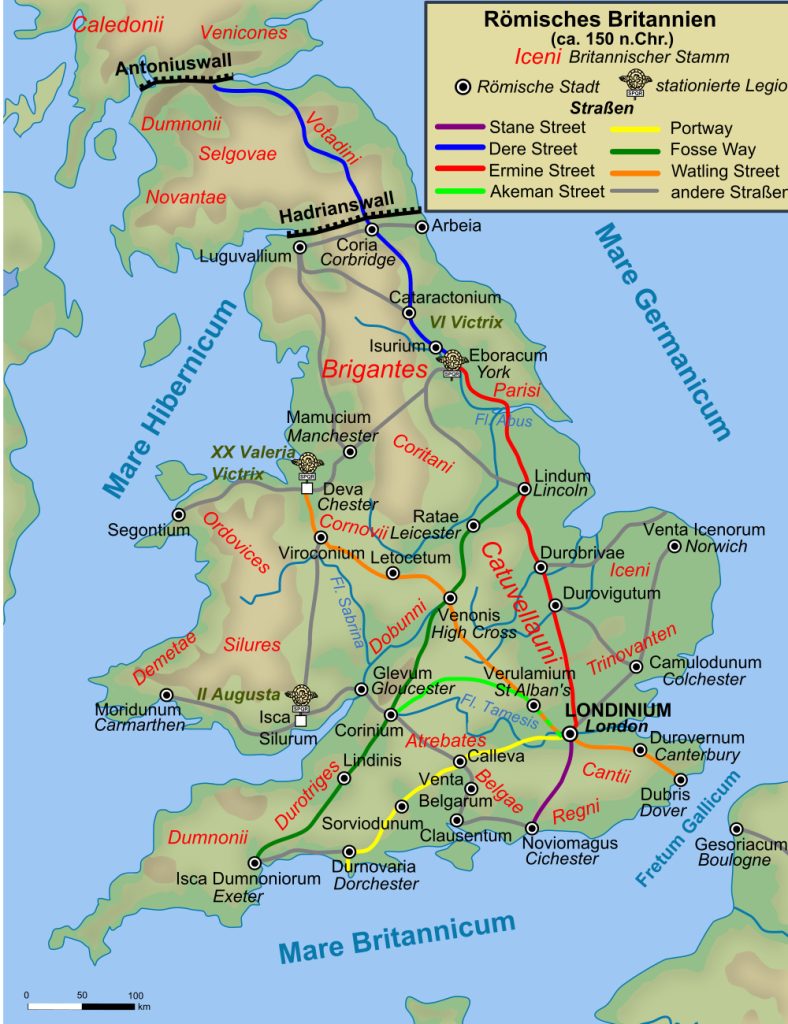
When Rome gave up its province of Britain, an older law surfaced beneath the crumbling administration — assemblies, elected kings, compensation in place of punishment. The map above shows the “before”: a lattice of dead-straight Roman roads and Latin town-names — Londinium, Eboracum, Camulodunum — laid over a land that in truth belonged to the Brigantes, the Iceni and a dozen other tribes. Rome lay here as a thin, neatly varnished coat. What kind of law lay beneath it is the real question. It leads straight into a poisoned quarrel, and that has to be cleared out of the way first.
The dangerous word
The moment you say that the Anglo-American tradition of freedom is rooted in a Germanic substrate, an alarm bell rings — and it rings for good reason. The notion of an original Germanic freedom has a poisonous history. It feeds on a single small book: the Germania of the Roman historian Tacitus, written around AD 98. The work was almost lost in the Middle Ages; a manuscript resurfaced only around the middle of the fifteenth century and reached Italian, then German, humanists. What they read in it was a lost golden age: noble, free, unspoilt Germans, morally superior to a decadent Roman civilisation.
The classicist Christopher Krebs devoted a whole book to this reading and called it A Most Dangerous Book. For the line runs from the humanists of the sixteenth century through German Romanticism into the racial ideology of the twentieth, which wanted Tacitus as proof of the purity and election of a people. In 1943 Heinrich Himmler sent an SS detachment to Italy to seize the original manuscript. This is no harmless inheritance.
And yet it would be a mistake to make of it a German pathology of its own. Turning the race question into a supposed science had its centre of gravity not in Germany but in France. The diplomat Arthur de Gobineau published his Essai sur l’inégalité des races humaines between 1853 and 1855 — the founding book of modern racial ideology, which declared history itself a product of blood. In Paris it fell flat; meanwhile the Société d’anthropologie under Paul Broca was measuring skulls, and Georges Vacher de Lapouge sorted humanity by head shape in 1899 into master and servant races — the ‘Aryan’ as a social category is French laboratory ware of the nineteenth century. The irony is that Gobineau was overlooked at home and canonised only in Germany: Ludwig Schemann founded a Gobineau Society in 1894 and translated him around 1900, and the Bayreuth circle around Wagner turned the French aristocrat into a German house-prophet.
And the Germania itself had a second career, running clean against the first. In England Tacitus was translated early — the Germania appeared in English in 1598, long before German enthusiasts claimed it — and the English read in it not the purity of a race but the cradle of their liberty. Out of the picture of the Germanic assembly of free men grew the myth of the ‘ancient constitution’: the claim that the Anglo-Saxons had already known assembly, elective kings and a bounded crown, and that the English struggle for liberty was merely the recovery of that pre-Norman freedom, struck down by the ‘Norman yoke’ of 1066. Montesquieu put the reading into a famous phrase in 1748: the English system of government was borrowed from the Germans of Tacitus, and this ‘beautiful system’ had been “found in the woods”. Through Montesquieu the myth flowed to the American founders; Thomas Jefferson, an ardent admirer of ‘Saxon liberty’, wanted in 1776 to put the Saxon leaders Hengist and Horsa on the Great Seal of the United States.
The same small text, two readers, two outcomes: in Germany a weapon of race, in England a charter of liberty. Gobineau’s Essai, for its part, a French book, became a German programme. What a book becomes is rarely decided by who writes it, and almost always by who reads it.
Whoever digs up the Germanic layer must therefore do two things at once: take seriously that something lay there — and clear away every myth that has fastened onto it, the racial as much as the libertarian. That both can be done was shown by one man, of all people the most important witness of the tradition. David Hume praised the layer in the large and described it in detail with merciless sobriety; to his own Whig countrymen he said, as bluntly as to the later German enthusiasts, that the vaunted Saxon paradise of freedom had never existed.
What Tacitus actually described
What is actually in the Germania — without the romantic lens. Tacitus describes no idyll but a rough warrior society. But he describes a set of institutions that are the opposite of what Rome was.
The kings of the Germans, Tacitus writes, do not rule without limit. The assembly of free men decides the important matters; the leading men deliberate the lesser ones. Leaders are chosen less by birth than by valour, and their power rests on example and persuasion, not on command. Around the leader gathers the following — what Tacitus calls the comitatus — a circle of warriors who serve him out of personal loyalty, not subject’s duty. Law is spoken in the assembly, not decreed from above. And for injury and killing there are fixed tariffs of compensation: a set number of cattle, or a sum, atones for a given deed. It amounted to a price list for violence: every tooth, every finger, every severed ear had its tariff — a grim actuarial table, long before anyone had the word “insurance”.
Hume, a millennium and a half later, gives the same following almost word for word: the warriors of each tribe clung to their leader “with the most devoted affection and most unshaken constancy”; they attended him “as his ornament in peace, as his defence in war, as his council in the administration of justice”; and for them, “to die for the honour of their band was their chief ambition”. This is not folklore. It is the description of a political order in which binding runs upward — through loyalty, election and assembly — not downward through administration and edict.
What the schoolbooks often miss: these institutions were not English, and not even insular. They were common West Germanic stock. The Franks had their Mallus, the Lombards their Gairethinx, the Alemanni their Thing, the Visigoths their assemblies. Every tribe brought the same toolkit when it settled on the rubble of Rome. Island and Continent differ not in the tools — but in what later became of them.
The Celtic parallel substrate
And it was not even only Germanic. When the Anglo-Saxons came to Britain in the fifth and sixth centuries, they met the Romano-British Celts — and Celtic law, so far as we can reconstruct it from Irish Brehon law and the Welsh Cyfraith Hywel, shows a strikingly congruent pattern.
Celtic law too knows compensation in place of punishment: in Irish the éric, the body-fine, and the lóg n-enech, the ‘honour-price’, in which honour itself becomes the unit of measure; in Welsh the galanas, the blood-price. Here too the kindred is the legal unit — the Irish fine, the Welsh cenedl — and crime is settled through the collective responsibility of the family, not through a royal apparatus of punishment. Here too there is the assembly; oath-helping, in which the accused must muster a set number of co-swearers; and a distinct class of law-keepers who carry the unwritten law in memory — the brehons in Ireland, akin to the law-speaker who in Iceland recited the whole law aloud every three years. And the Celtic king too is a war-leader from a royal kindred, elected and bound to the assembly — not a legislator.
Whence the resemblance? Three reasons interlock. First, a shared Indo-European inheritance: the linguist Émile Benveniste showed in his Vocabulaire des institutions indo-européennes that the words for oath, debt, kindred and law across the Indo-European languages point back to an originally shared practice. Second, a similar social situation: both peoples were organised by kindred, without a central state, and had to tame violence without a royal police — such societies invent similar solutions independently. Third, centuries of neighbourhood in central Europe.
The point is that the British Isles thereby preserved not merely a Germanic but an older, shared, pre-Roman West European legal substrate — Germanic and Celtic at once, because the two were structurally akin and so merged easily. That is why Wales, Scotland, Ireland and the Isle of Man fit to this day so naturally into the peculiarly many-limbed British constitutional pattern: they have related legal prehistories. What was buried threefold on the Continent survived at the western edge.
Hume’s antidote: no paradise
None of this was freedom in any modern sense. And the one who says so most sharply is, of all people, the same David Hume who otherwise praises the Germanic tradition.
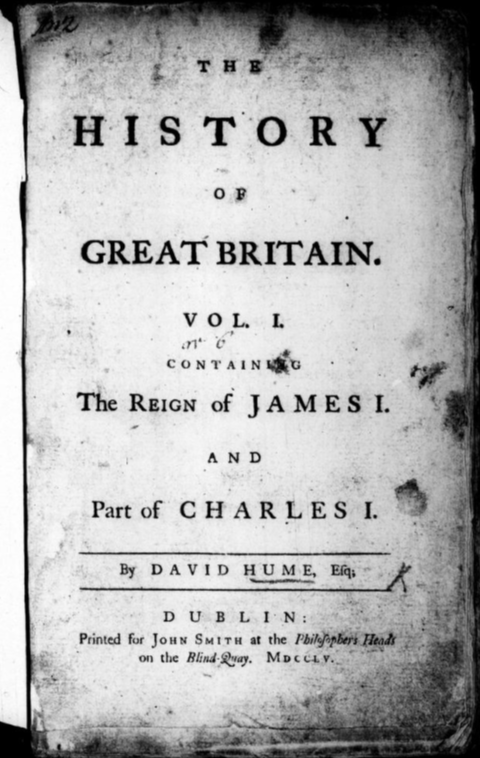
The title page above, by the way, holds a small joke. It announces, proudly, “Vol. I” — the reign of James I, the seventeenth-century Stuart material. For Hume wrote his history backwards: he began in 1754 with the Stuarts and worked his way, volume by volume, deeper into the past, until he reached the Anglo-Saxons only in 1762. The famous “first volume” is what he thought first; the passage we are about to quote comes from the part he supplied last of all.
In his appendix on the Anglo-Saxon constitution Hume first writes the sentence that sounds like the motto of this whole series: the free constitutions those “northern nations” set up on the ruins of Rome gave Europe its superior sentiments of “liberty, honour, equity, and valour”; it owes them “chiefly to the seeds implanted by those generous barbarians”. One cannot state the thesis of this series more strongly — and it dates from 1762.
Yet in the same appendix Hume takes off the spectacles. His verdict on the Anglo-Saxons themselves: “On the whole, notwithstanding the seeming liberty, or rather licentiousness, of the Anglo-Saxons, the great body, even of the free citizens, in those ages, really enjoyed much less true liberty than where the execution of the laws is the most severe.” The seeming liberty, Hume says, was in truth licence, and its very excess prevented real freedom: “all anarchy is the immediate cause of tyranny.” Where the laws do not protect, a man seeks protection from someone powerful — and hands himself over to him.
The evidence Hume cites is sobering. The common people were largely unfree: villeins, “the property of their lords”, who could themselves own nothing — by the Domesday reckoning the far greater part of the rural population. The society knew three ranks, “the noble, the free, and the slaves”, and that threefold division the Saxons brought with them from Germany. Even murder could be discharged by payment; a conspiracy against the king’s life, Hume writes almost in disbelief, “might be redeemed by a fine”. And the procedure of oath-helping was no test of truth but a social one: whoever could muster enough co-swearers was in the right — the mustering of support counted as proof.
So much for the romantic reading. What survived on the islands was no realm of freedom. It was a toolkit: law that grows from below out of cases and custom, rather than being decreed from above; an assembly before which even the powerful must answer; a kingship that is elected and bounded; the idea that conflicts are settled by negotiated compensation. Tools, not a finished house. Whether freedom ever came of these tools depended on what was built with them — and that took another thousand years and a good deal of luck. Whoever sells the substrate as a golden age is lying; whoever dismisses it as inconsequential misses that every later building used precisely this material.
Why the Continent drew less on it
That leaves the question of why. If all the Germanic tribes brought the same toolkit — the Franks as much as the Anglo-Saxons — why did the Continent reach for less and less of it over time, while the island kept it?
Three developments pushed the old tools back, one after another. The first was the deeper Romanisation the first part dealt with. In Gaul, Hispania and Italy the Roman layer had never wholly collapsed: the bishop’s city, the chancery, Latin literacy, the notion of a law set from above all survived the fall of the empire. The Germanic conquerors grew into this existing form instead of imposing their own.
The second was Carolingian centralisation. Around 800 Charlemagne deliberately reanimated the Roman imperial model: he sent missi dominici, royal envoys, into the provinces; he issued capitularies, legislation from above; and with the imperial coronation of 800 he sacralised the monarchy. This was the first great attempt to replace the Germanic structure of consent with a Roman structure of command — and it succeeded. The same logic of command seized religion too: Charlemagne Christianised the continental Saxons between 772 and 804 by the sword, with the death penalty for refusing baptism — while the British Isles, in the same span, came to Christianity through mission, monasteries and a convened synod. This religious fork runs along exactly the same line as the legal one, and it leads straight to the Reformation and the question of who disposes over conscience; later parts will take it up in their own right.
The third, and perhaps the most consequential, came around 1100: the rediscovery of Roman law at the University of Bologna. Justinian’s Corpus Iuris Civilis became the foundation of a new class of jurists, who studied at Bologna, Pavia and Orléans and then moved as chancellors, judges and royal advisers into the courts of Europe. They brought a single, all-changing notion: that law is set by a legislator at the top — not found from the custom below. Where this thought won, the old toolkit was superfluous.
One already recognises the code reflex that the first part traced in the present — the Brussels matter-of-course that something new is first defined by a law and then permitted. It is no trait of a people. It is the late consequence of a decision taken at Bologna, which the Continent, unlike the island, adopted. How narrowly that decision went in England — and on which single king it hung — is the subject of the fourth part
The islands of survival
One last thing, to guard the finding against its own romanticism: the British Isles were not the only place the old toolkit survived. In Iceland the Althing first met in 930 on the plain of Þingvellir — older than the English Parliament. On the Isle of Man the Tynwald, first recorded in the tenth century, claims to be the oldest continuously sitting parliamentary body in the world, and proclaims its laws to this day each year on a hill, in two languages. In the Swiss valley communities the Germanic tribal assembly lives on in the Landsgemeinde of Appenzell and Glarus, an annual vote by show of hands. Picture the contrast: while Versailles was reducing its nobility to courtly decoration, the men of Appenzell went on settling their own affairs by a raised hand. The toolkit survived everywhere that no strong central power grew up after Rome to replace it.
What is special about the British Isles is not the mere survival of this inheritance. Iceland and the Appenzell valleys preserved it too — but in seclusion. England, by contrast, joined it to a strong monarchy and carried it, in the end, halfway round the world. That is how a provincial peculiarity became world history.
But we have skipped a question, and more hangs on it than appears. When the Anglo-Saxons came — did they drive out the British Celts, or mix with them? If they settled a swept-clean land, then the shared Germanic-Celtic substrate is a fine construction with no ground under it. If they mixed, then the fusion sat deeper than any charter records. The answer was given ideologically for centuries — from Victorian fantasies of conquest to their defiant opposite. Only the genetics of recent years has settled it. That is the next part.
Sources and references
Primary sources – Tacitus, Germania (c. AD 98); first English translation: Richard Grenewey / Henry Savile (1598) – David Hume, The History of England, vol. I, “Appendix I: The Anglo-Saxon Government and Manners” (1762) — all Hume quotations in this part are from it (full text: Project Gutenberg) – Montesquieu, De l’esprit des lois (1748), Book XI, ch. 6 (the system “found in the woods”) – Arthur de Gobineau, Essai sur l’inégalité des races humaines (1853–55); Georges Vacher de Lapouge, L’Aryen et son rôle social (1899)
Secondary literature and references – Christopher B. Krebs, A Most Dangerous Book: Tacitus’s Germania from the Roman Empire to the Third Reich (2011) – Émile Benveniste, Le vocabulaire des institutions indo-européennes (1969); Fergus Kelly, A Guide to Early Irish Law (1988) – On the ‘ancient constitution’ and the ‘Norman yoke’: J. G. A. Pocock, The Ancient Constitution and the Feudal Law (1957); Christopher Hill, “The Norman Yoke” (1954) – On the German reception of Gobineau (Ludwig Schemann, the Bayreuth circle) and French racial anthropology (Paul Broca, Société d’anthropologie de Paris) – On the Carolingian conversion of the Saxons: Capitulatio de partibus Saxoniae (c. 785); the massacre of Verden in 782 after the Frankish royal annals (the recorded figure of 4,500 is disputed in scholarship)
Schreibe einen Kommentar