
We Are Free Only in the ‘We’.
At a Green Party event in Germany not long ago, the party’s co-leader Franziska Brantner said it was time to rethink what freedom means. We are free only in the ‘we’. It is a misunderstanding, she argued, to think of freedom as a possession. That picture — freedom as private property — comes above all from America, and was never the European idea of freedom. Brantner then cited the German philosopher Hannah Arendt, for whom freedom is an activity: it exists only while it is exercised, and only where people act together. Instead we sit alone in front of our screens and call that freedom. Someone who lives that way, she said, is not free but alone. It is worth hearing this from the far side of the Atlantic, because it is a claim about the reader as much as about a German party event.

Anyone who ends up as a wall-high portrait in their home town, cigarette in hand, usually has more to offer than a memorable line. The position is not casual. It stands in a venerable tradition. In The Human Condition (1958) and On Revolution (1963), Arendt worked out an account of freedom that goes back to the Greek polis: freedom is not a stock the individual carries about, but a practice that arises between people when they act together. Whoever falls out of that practice — through tyranny, through mass isolation, through the reduction of the human being to a consumer — loses freedom, even while formally holding every right. Brantner takes the ‘we’ from Arendt and turns it against the American tradition. That is a political shortening of the philosophical position, but it is not careless. She has a point.
What the point gets right
It is true that the American tradition thinks freedom differently. Jefferson, Madison and Hamilton write of rights the individual brings into the community, not of a community that grants the individual his rights. This is not egoism, and it is not what Brantner implies — the isolated consumer in front of a screen. It is a different answer to an old question: where does freedom arise, and who holds it?
The continental answer, the one humming in Brantner’s sentence, runs: freedom arises in the community and belongs to the ‘we’. The Anglo-American answer runs: freedom arises in the individual and is protected by the community. Both answers are philosophically defensible, both have a tradition, both produce consequences — for legal systems, for social policy, for the question of what the state may do and what it may not.
What Brantner does not say
What she does not say: this divide did not arise in America. America inherited it. Nor did it arise in the English Glorious Revolution of 1689, nor in Magna Carta in 1215, nor in the twelfth century under Henry II, who systematised the building of the Common Law. It reaches back into a layer that lies further down — into the question of how deeply Western Europe was Romanised, and which parts escaped Romanisation.
When Brantner stands where she can say this was never the European idea of freedom, she stands in a place that genuinely never took that idea up. But the reasons lie far before Hannah Arendt, far before Hegel and Rousseau, far before the Peace of Augsburg. They lie in an institutional layer from the fifth century — from the years when the last Roman troops left Britain while the Romanised administration in Gaul simply carried on.
The larger picture
You might think this a quarrel for the philosophy seminar. It is the opposite. The same dividing line that runs through Brantner’s sentence runs through the most concrete politics of the present — through the question of who regulates the digital age, and on what principle.
Brussels regulates pre-emptively. The General Data Protection Regulation of 2018, the Digital Services Act and the Digital Markets Act of 2022, the AI Act of 2024 — all set rules before a technology has established itself, to minimise the risks to society in advance. The guiding idea is written expressly into the European treaties: the precautionary principle, Article 191 of the Treaty on the Functioning of the European Union. When in doubt, secure first. Brussels means to set standards before reality forces them — and it succeeds often enough that people speak of a ‘Brussels effect’: whoever wants to sell in Europe adopts the European rules, and they become the global benchmark.
Washington regulates the other way round. The American default lets private actors move first and steps in when a concrete harm appears in the market — reactive, case by case, after the fact. When in doubt, permit first. That the AI wave of recent years arose almost entirely in the United States and in China, and barely in Europe, has many causes; but one of them is this basic stance. Europe, meanwhile, writes compliance procedures for models built elsewhere — rather like drawing up strict house rules for a flat that someone else has rented.
These are not two whims, two decisions of the day that might as well have gone otherwise. They are two answers to the very question buried in Brantner’s sentence — translated out of the language of philosophy into the language of administrative law. If freedom belongs to the ‘we’ and the community grants it to the individual, it follows that the community — the state, the Commission — should fix in advance what may be allowed. If freedom belongs to the individual and the community only protects it, it follows just as plainly that the individual acts first and the state steps in only once a real harm has been done. Permission-in-advance against correction-after-the-fact. It is the same fork, in another century and with another object.
The question
If the divide runs deep enough to carry both a sentence about Hannah Arendt and a regulation on artificial intelligence, then the question is when it arose.
The obvious answers are all too young. It did not begin with Trump or with Brexit — those are its symptoms, not its origin. It did not begin in 1789, for the American republic inherited it rather than inventing it. It did not begin in 1689 with the Glorious Revolution and Locke’s Two Treatises — those codified what was already there. It did not begin in 1215 with Magna Carta, which already presupposes a king who can be legally bound, and the notion that one may bind him. It did not even begin in the twelfth century, when Henry II systematised the Common Law — for he too only ordered what had long existed in practice.
Each of these dates is a station, not a source. The source lies beneath them all, in a layer no constitutional document ever described, because it is older than the idea of writing constitutions down. To find it, one has to go back to the day the Roman Empire stopped governing one of its provinces.
The trail back
In the year 410, Rome withdrew its last troops from Britain. The emperor Honorius is said to have told the British cities that they would henceforth have to see to their own defence — possibly the most disheartening administrative memo of antiquity, about as comforting as a note pinned to the door: “Gone for good. Best of luck.” No orderly handover, no succession — Rome simply left. The Romano-British upper class tried to hold the province on its own, and failed. Within a few generations the Roman layer — administration, taxation, towns, written culture — largely collapsed.
This layer had lain thin from the start. Britain was a Roman province for nearly four hundred years, from about 43 to 410, but it stayed a frontier province: held by the military, with few large towns, and Latin never really displaced British Celtic among the population. When Rome went, the Roman order went with it. Little was left to which any continuity could have clung.
On the Continent it was the other way round. Gaul had been Romanised since Caesar’s conquest around 52 BC — over four hundred and sixty years before the British withdrawal, half again as long and incomparably deeper. (Four hundred and sixty years: from today, that is the entire way back to the birth of Shakespeare.) The language was Vulgar Latin, out of which French would grow; the towns stood, the law stood, and above all the administration of the bishops stood, which in late antiquity had become the real bearer of local order. Hispania, Italy, the Rhine provinces — everywhere the same picture of a Romanisation that sat deep enough to outlast the collapse of the empire.
And outlast it, it did. When the last Western Roman emperor, Romulus Augustulus, was deposed by Odoacer in 476 — a boy whose name summoned both the founder of Rome and its first emperor and shrank him in the same breath: Augustulus, the little Augustus — that was no institutional zero hour in Gaul. The Frankish kingdom of the Merovingians, and later the Carolingians, settled onto the existing Roman administrative and episcopal infrastructure. The Frankish kings took over tax categories, the chancery, Latin literacy, the network of bishoprics. The form stayed Roman even when the rulers were Germanic. Law went on being thought of as something set down from above and written.
In Britain the Anglo-Saxon conquerors found no such layer left to grow into. They brought their own order — Germanic tribal law, not decreed from above but spoken in the assembly of free men; kings one chose and could depose; law as shared memory, not imperial edict. Where the Roman cover had torn, the older layer came back to the surface and set the shape of things.
This is the earliest fork between continental and insular development. It is not dramatic, it carries no date that stands in the schoolbooks, and no one at the time felt it as a decision. It was a difference underground: where Rome had lain thick, Rome carried on — as administration, as written law, as the matter-of-course that order comes from a summit. Where Rome had lain thin, the older law grew back — the assembly, the bounded power of kings, law from below. Everything that comes later — Magna Carta, Parliament, the Common Law, finally Locke and the American republic — is the long unfolding of this single difference. And everything that comes on the Continent — the code, absolutism, the state as ethical idea, finally the precautionary principle of Article 191 — is the unfolding of the other.
What this series does
The divide that Franziska Brantner caught in a single sentence one weekend in 2026 is, then, a millennium and a half old. Settled it is not — it still decides who governs the digital age.
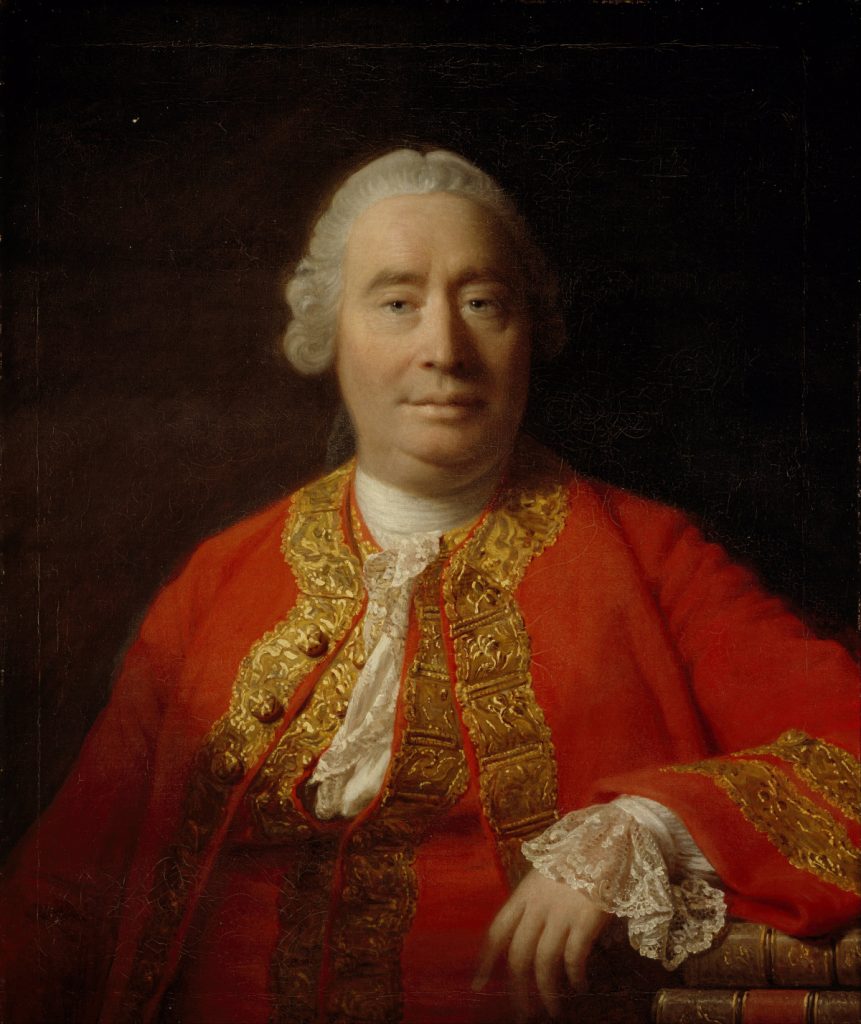
The man in the splendid red will occupy us again: David Hume, who doubted cause and effect but plainly not his next dinner.
The parts that follow trace the trail that leads from this fifth-century fork to the present. They go layer by layer: the Germanic-Celtic law the islands kept and the Continent let go; the Anglo-Saxons and the question of what really became of the Britons; the Reformation as a switch-point that strengthened the princes in Germany and the conscience in England; the Scottish Enlightenment with David Hume at its centre, which gave the old inheritance its modern philosophical shape; the bridge to Princeton over which this thinking flowed into the American founding; and the moral shadow the same tradition cast when it turned the law of free citizens into the instrument for dispossessing the first inhabitants. At the end stands the question we began with, in its sharpest form: is Europe today prepared for its upheavals — or is a pattern repeating that once let an Enlightenment bounce off the institutions?
Right at the end, it should be said, there will be a negotiating table in Pennsylvania, between settlers and Native Americans. But that is still far off. The next part begins where this one leaves off: with the layer that grew back when Rome withdrew. What kind of order was it? And is it even true that it was free? Its most important later witness — David Hume — had grave doubts.
Sources and references
- Franziska Brantner’s remarks, reported (in German) by nius.de: «Frei sind wir nur im Wir»
- Hannah Arendt, The Human Condition (1958); On Revolution (1963)
- EU regulation: General Data Protection Regulation (GDPR, 2018), Digital Services Act and Digital Markets Act (2022), AI Act (2024); precautionary principle: Article 191 of the Treaty on the Functioning of the EU (TFEU)
- On the ‘Brussels effect’: Anu Bradford, The Brussels Effect: How the European Union Rules the World (2020)
- On differential Romanisation and the withdrawal of 410: Peter Heather, The Fall of the Roman Empire (2005); Bryan Ward-Perkins, The Fall of Rome and the End of Civilization (2005)
Schreibe einen Kommentar