
Why the Dairy Farmer Is Making Himself Obsolete — and What Is Really Being Lost
By Andreas Paul John, Lower Saxony, Germany
Konrad Zuse, the inventor of the first programmable computer, left behind a sentence that grows more precise with every year: “The danger that the computer becomes like man is not as great as the danger that man becomes like the computer.”
He meant it abstractly. But it applies quite concretely — to cows, to milk, to farmers, to what we eat.
Nearly twenty years ago I took a photograph on a pasture in Lower Saxony, Germany. Wilhelm, a colleague and friend, was fetching cows in from the pasture — milking time.
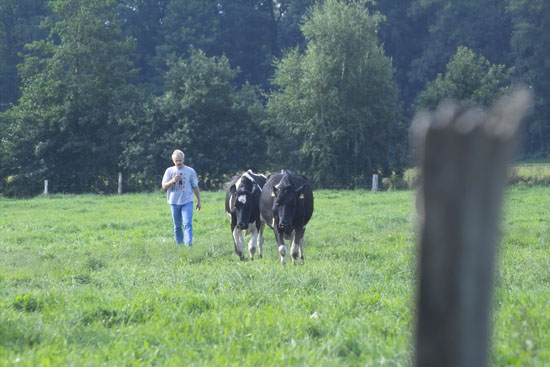
Wilhelm fetching the two divas from the pasture to the barn
Most of the herd, twenty animals strong, had already rushed into the barn on their own — there is grain concentrate waiting at every milking. Only these two strong-willed cows required extra effort. Not really driving, exactly — they wanted to be collected. Wilhelm knew this; it was always the same. He took it in his stride. His cows had personality.
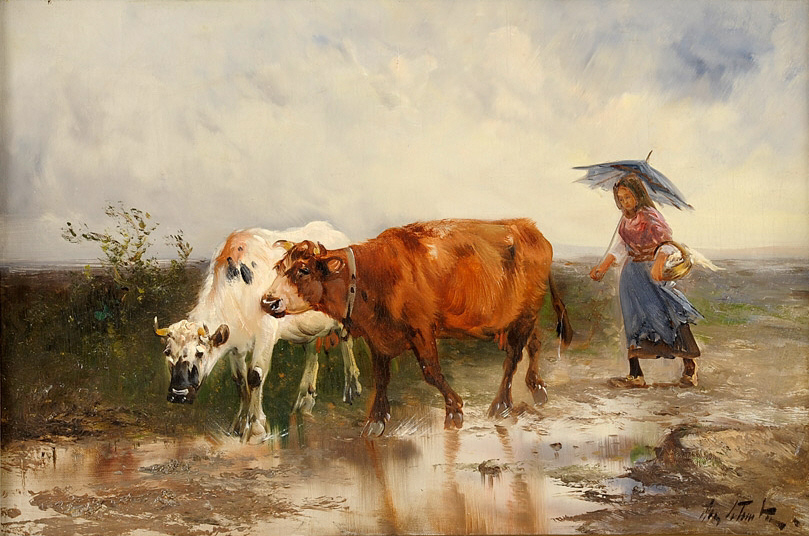
Three paintings from my book show similar relationships, only older. A girl leads two cows through mud and rain, a parasol in her hand.
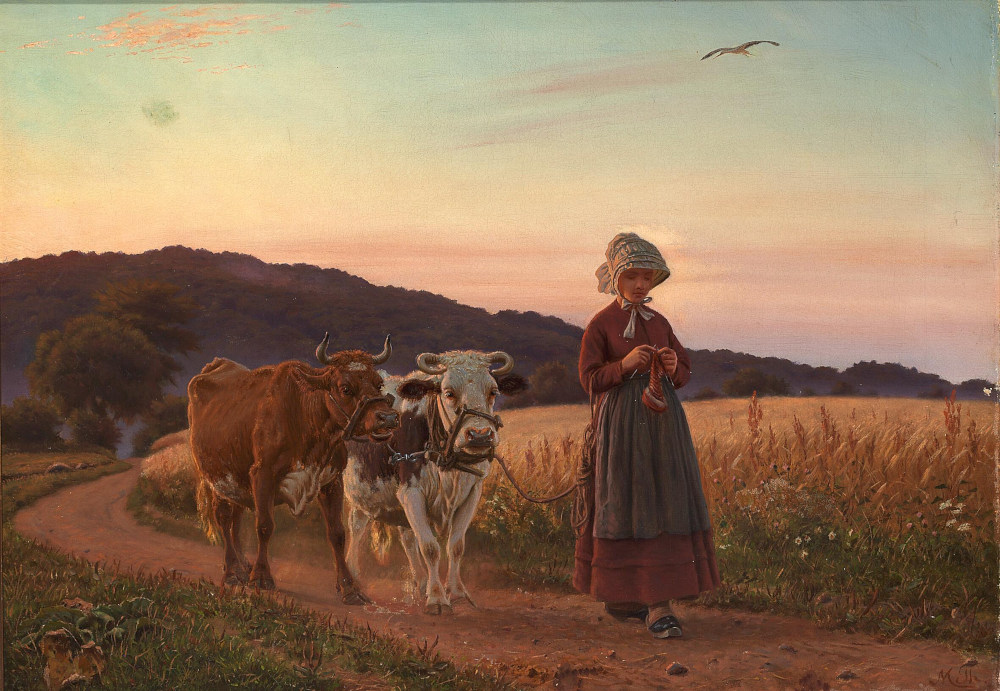
Another knits while driving two animals home on a rope through evening light — she is not watching them, she doesn’t need to.
A third depicts the painter Paulus Potter in 1647, sketching what would become his famous bull “De Stier”. All three images show how close the relationship between human and livestock once was. This knowledge was not learned. It was lived.
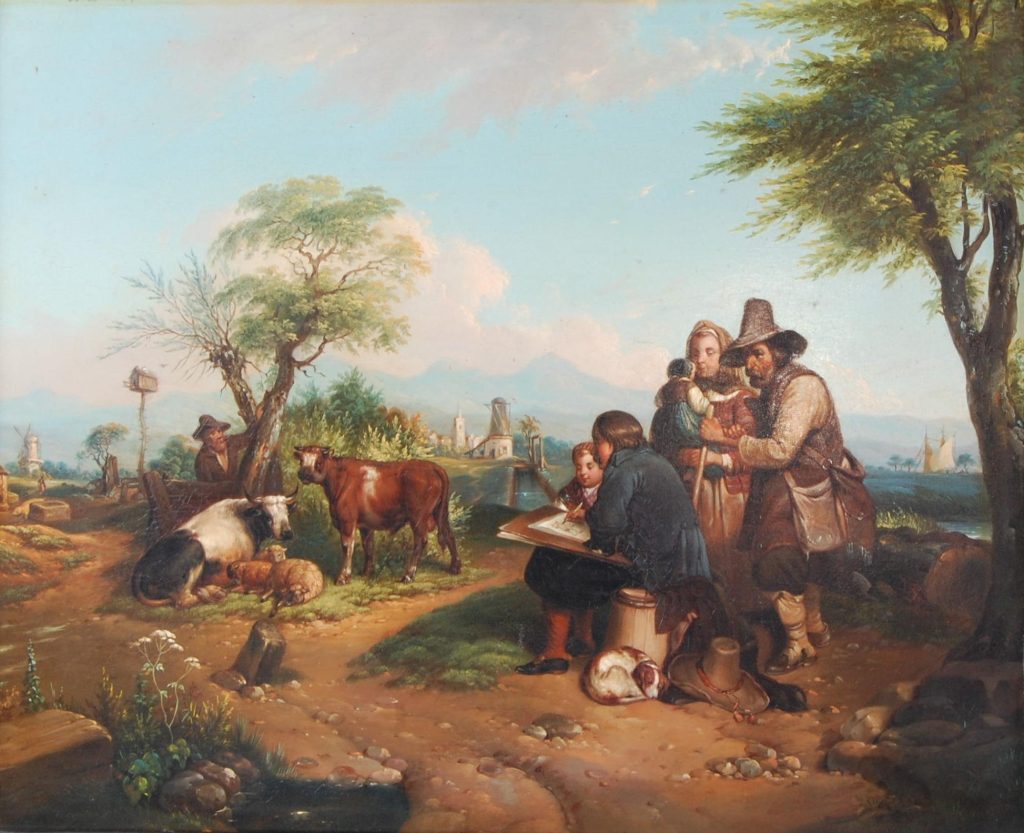
Eugène Lepoittevin, Paul Potter painting The Young Bull, 1843, Public Domain
Today we discuss algorithms that decide autonomously, deployed in drones, in medical protocols, in hiring decisions.
Between those images and today lies not technology. It lies a civilisation.
Milk is one of the most tangible examples of this loss. Not because it is more important than other things. But because it is so everyday, so ordinary — a loss leader that supermarkets use to draw shoppers through the door — and because what happened to it happened in complete silence, while nobody was watching. And because it shows what happens when you optimise a living system long enough for it to stop being alive.
The Cow Becomes a Machine
A modern Holstein-Friesian produces 12,000 to 15,000 liters of milk per year. Individual peak cows approach 18,000. A medieval cow gave 800. For every liter of milk, the animal’s body pumps roughly 500 liters of blood through the udder. At 40 liters of daily output, that is 20,000 liters of blood daily — a circulatory demand like an extreme endurance athlete, around the clock, without rest, without pause.
At the same time, four stomachs run a continuous fermentation. Perkilogram of milk produced, 1.84 megajoules of additional heat are generated. At 50 liters per day that equals the output of five 250-watt heat lamps burning permanently inside the animal’s body. The comfort temperature for a high-performance cow approaches zero degrees Celsius. Above 77°F (25°C) outside, she can no longer dissipate her own heat. She pants, feed intake collapses, metabolism derails.
The solution: high-capacity fans, curtain systems, sprinkler systems in hot regions. When in 2012 the power failed for three hours in Mato Grosso, Brazil, 23 Holstein cows died of heat stroke on one operation of 1,000 animals. The neighbour kept five old Gir cows, an Indian breed. They survived the day in the shade, without technology. He said afterwards: “My cows only give 3,000 liters. But they’re not prisoners of technology.”
The udder of a high-performance cow weighs around 40 kilograms or more at twice-daily milking.
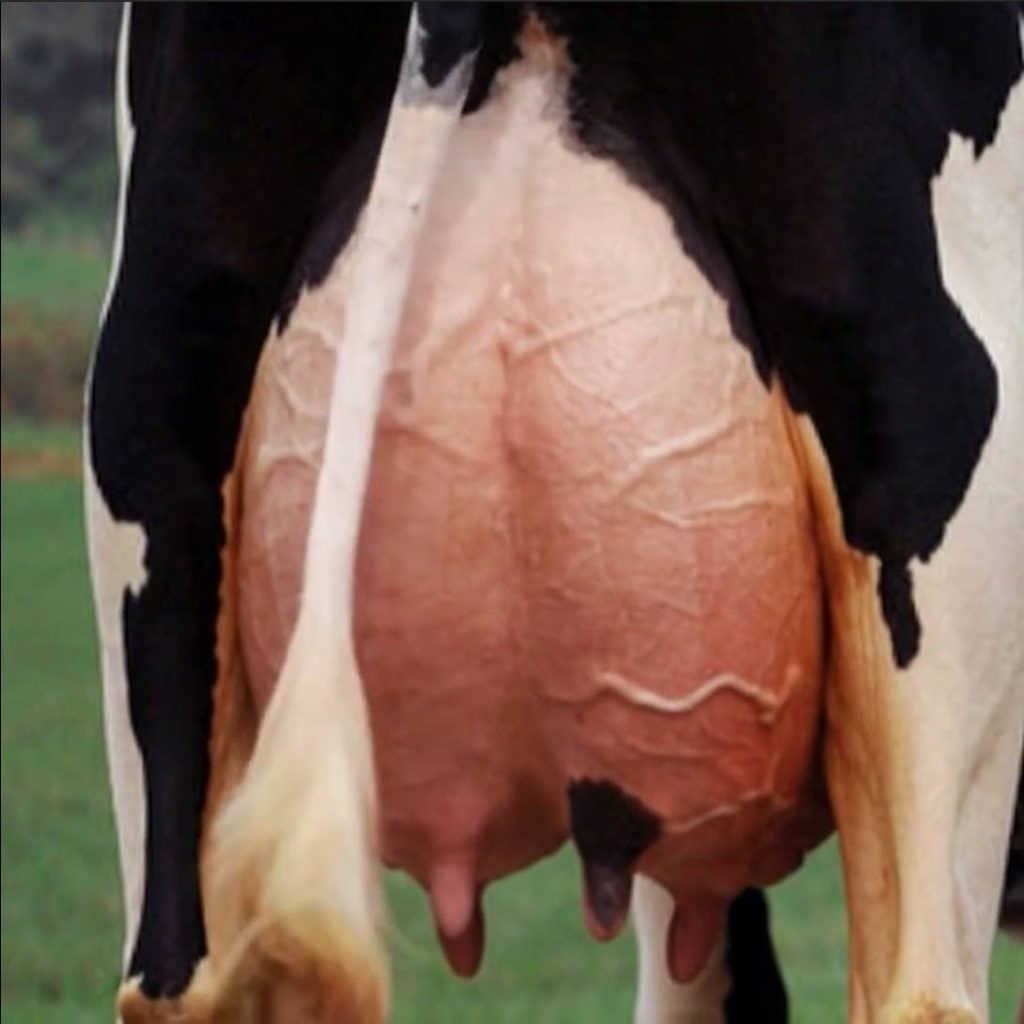
These wide udders demand so much pelvic width that little room remains for muscle. Operations invest large sums in rubber mats for the walkways — non-slip, joint-sparing. The problem got smaller. Technically. It would never have arisen if the pelvis were not so broad, the udder not so heavy.
Breeding creates the problem. Technology treats the symptom.
The milking robot fits the same pattern. It helps, relieving the farm manager and staff: the cow chooses for herself when she is milked — two, three, sometimes four times a day, as her body, the pressure in the udder, demands. Stalls grow quieter because nobody needs to drive the herd to the parlour twice daily on a fixed schedule. The farmer sets a maximum frequency; milking too often reduces milk quality.
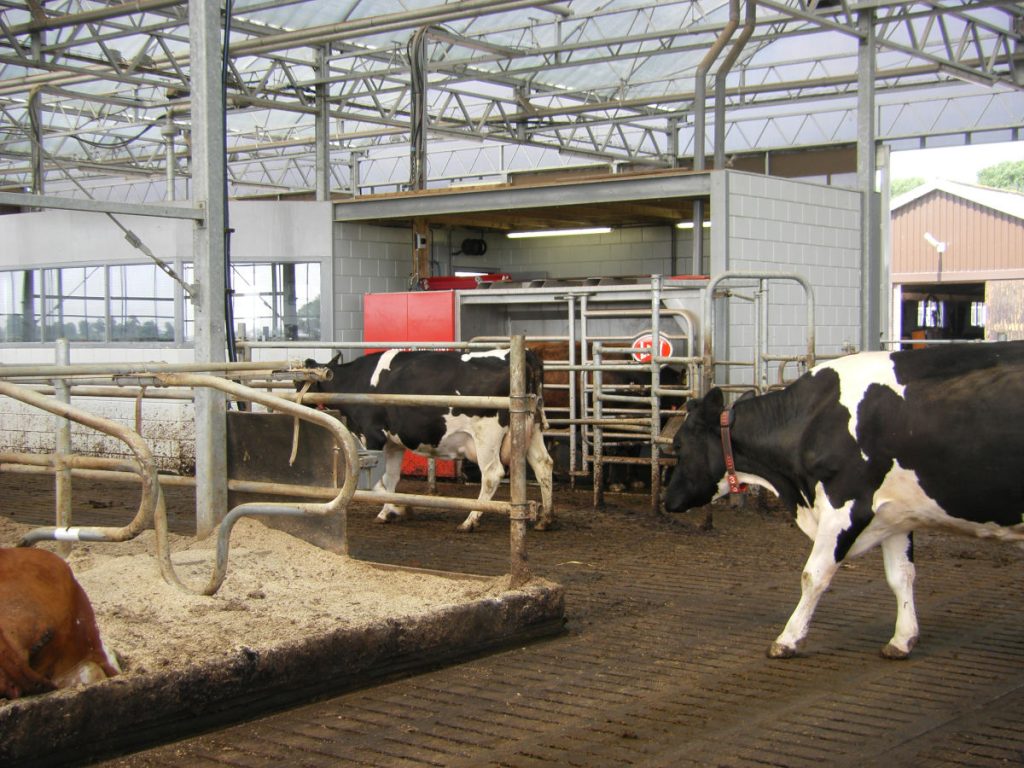
Milking robot barn with greenhouse-style roof, the Netherlands
What it does not solve: the cow now has even less contact with human beings. In traditional operations the farmer meets his animals twice daily, face to face. He sees which one is lame. He smells whether something is wrong. The robot takes these encounters away from him. Some cows grow shyer. They know the human only as a silhouette that occasionally walks through the barn.
The comparison that seems most apt comes from engineering. When cylinder liners become more wear-resistant, compression can be raised and more power extracted. The engine endures higher loads — but it does not live longer; it produces more efficiently at the limit of its tolerance during its short lifespan. I recall the first health breeding values for leg soundness in the 1970s and 1980s, in the breeding associations of the upper Midwest and northern Germany. That was no act of animal welfare. It was economics: a cow culled in her first lactation because of ruined hooves has not earned back her rearing costs. The improved health indices do not necessarily extend life. They increase the total milk produced over a cow’s lifetime.
A breed made in America — and the world that followed
The Holstein is, in a meaningful sense, an American creation. The cattle came from the Netherlands, Friesland, and the German coast — exported in the nineteenth century to New England, Wisconsin, Iowa. Winthrop W. Chenery, a Massachusetts gentleman-farmer, imported Dutch cows in 1852 and for the first time documented their yields systematically: this cow gives this much milk, her daughter gives more.
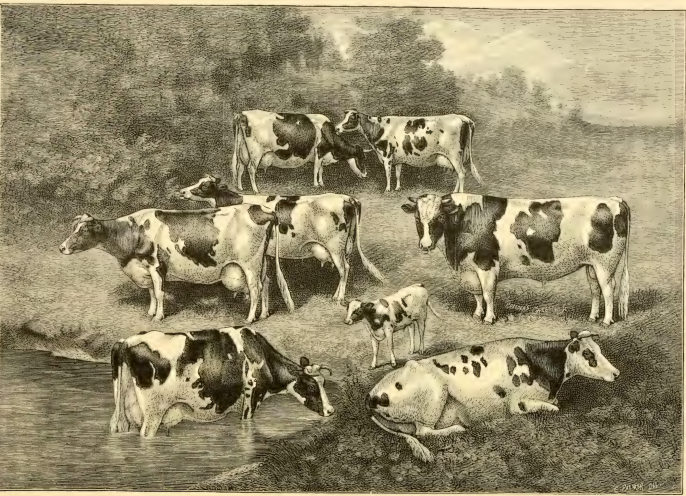
The “Aaggie Family” is a prominent branch of the Johanna Foundation Family, Lakeside herd of Messrs Smiths, Powell & Lamb of Syracuse, N.Y., 1871–1891
In 1885 the Holstein-Friesian Association of America unified two rival breed societies under a single herdbook. What followed was a century of selection so intense it reshaped the animal entirely. The bull Johanna Rag Apple Pabst, purchased at auction in Wisconsin in 1926 for $15,000 — the equivalent of over $200,000 today — set a template for udder attachment and butterfat that still runs through virtually every Holstein alive. A generation later, Round Oak Rag Apple Elevation from a modest Virginia farm gave five traits simultaneously — production, udder health, mobility, fertility, longevity — and became so genetically dominant that his DNA makes up 8 percent of the entire genomic reference population. Every registered Holstein on earth carries both of them. The Americans then sold these genetics back to Europe. Germany imported the bull Pabst Ideal in 1964, rescued him from Hamburg customs in an episode worthy of a film, and within a decade he had daughters in show rings across Lower Saxony.
The calf ranch is the logical conclusion of that system. Hall’s Calf Ranch in Kansas holds up to 50,000 calves — more than a quarter of all calves in Bavaria, on a single property.
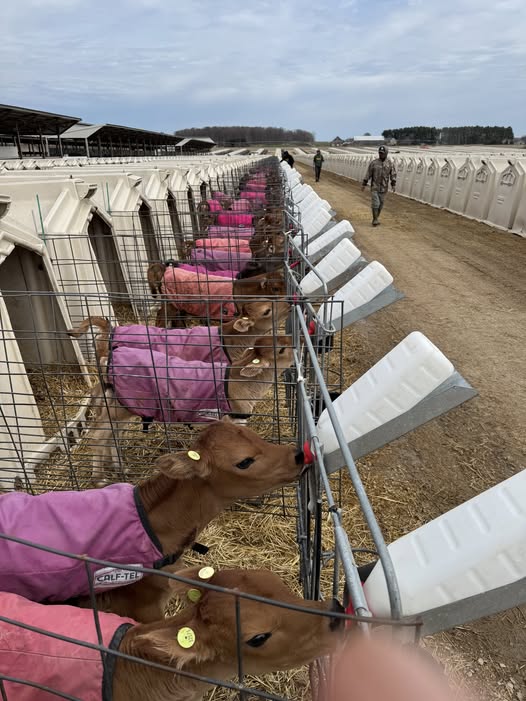
Hall’s Calf Ranch, Kansas. Photo: https://www.facebook.com/p/Halls-Calf-Ranch-100057316876404/
Each calf lives individually in a plastic hutch roughly 5 by 6 feet. She cannot touch the calf beside her. Individual housing until eight to twelve weeks is standard practice in the US to minimize disease transmission. The feeder has roughly ten seconds per calf. She learns early that humans are functions — they bring feed, then disappear. Calf mortality on large American ranches runs five to eight percent. On small European farms with cow-bonded rearing it stays below two.
Dairy farming was made more like the computer. Zuse would have understood.
The Dairy Turns Milk into Chemistry
What the cow has produced, the dairy takes apart at the molecular level.
The milk is centrifuged, separated into fat, protein and skim, then recombined in exact laboratory ratios — 1 percent, 2 percent, whole, according to the product. It is homogenized under up to 300 bar of pressure, so no cream rises. It is ultra-heat-treated, kept shelf-stable for months, microbiologically sterilized.
Pasteurization counts officially as a hygiene measure. 72 degrees Celsius (161°F), 15 to 20 seconds — that kills Listeria, Campylobacter, Salmonella. True. It is half the story.
The other half: a dairy needs the same raw material every single day. Not approximately the same — exactly the same. Automated pasteurization lines, plate heat exchangers, separators — these cannot distinguish milk from a cow that has been on spring grass for three weeks from milk from a cow on silage since October. An experienced cheesemaker could. He smelled it, felt it in the way the casein coagulated. He adjusted his process accordingly. The machine cannot. So farmers feed the same calculated ration nearly year-round — silages, concentrates, standardized nutrient profiles. The milk becomes uniform. Machines can process it.
Then there is the logistics. Once, farmers brought milk daily to the local creamery. Today the milk tanker comes two or three times a week — milk sits in cooled bulk tanks in the meantime, holding 50,000 gallons or more. That means: the milk must already be nearly sterile at the farm, before it is even loaded. Pickup every three days cannot work with milk in which the bacterial count has been doubling since milking. The long supply chains shifted the demand for sterility back onto the farm — before the dairy, not after it.
What was lost in the process, almost nobody notices today. There was once a tradition in American farmhouses — and in farmhouses throughout the world, well into the twentieth century — of setting a bowl of fresh raw milk in a warm spot in the kitchen: near the woodstove in winter, on the south windowsill in summer. After a day or two, the result was clabber: thick, tangy, pleasantly sour, with no starter culture added. The natural lactic acid bacteria of raw milk had done the work. No packet of starter. No instruction sheet. Just knowledge of which spot in the kitchen worked best. Today the same bowl of supermarket milk would putrefy. The protective flora is gone. The milk was pasteurized.
In the process, 10 to 20 percent of vitamins are lost. The omega-3 fatty acids and conjugated linoleic acids that form only from fresh grass and have anti-inflammatory properties — gone. The natural lactic acid bacteria that once allowed raw milk to sour on its own — gone. Today supermarket milk no longer sours; it rots, because the protective flora is absent.
What is still missing, companies like Palsgaard from Denmark supply. Emulsifiers and stabilizers that repair the mouthfeel the processing destroyed. The product tastes rich, though it is biologically impoverished.
About 80 percent of milk in the United States is sold through cooperatives: Dairy Farmers of America, Land O’Lakes, Organic Valley and others. The National Milk Producers Federation represents this system. The cooperative sets the schedule, the quality standards, the pickup frequency, the prices. It is efficient. It is the reason a gallon of milk is available in every gas station from Maine to Arizona at approximately the same price. It is also why there is no longer a local creamery that knew what spring-grass milk tastes like different from winter hay.
All of this can be read in the “Dairy Processing Handbook” from Tetra Pak, available in English and German.
Who makes a cheesecake from grandmother’s recipe today and uses modern supermarket cream cheese wonders why the cake sinks and weeps water. The reason: transglutaminase — an enzyme that binds whey proteins chemically to casein, trapping water in the process. As a processing aid, it need not be declared on the label. In the oven, heat breaks the bond, the water runs out, the cake collapses. That is not a defect. That is the system.
What Is Lost
Erika von Mutius, a pediatrician in Munich, has followed a simple observation for over thirty years: farm children get asthma and allergies less often. Two factors are decisive — contact with the livestock barn, and a cow must always be present (sheep and goats alone do not suffice), and fresh, untreated raw milk. Heating destroys protein structures that appear to be immunologically relevant. Which ones exactly — research does not yet fully know.
Tim Spector, a geneticist in London, has shown: ten days of fast food eliminates 1,400 bacterial species from the gut, 40 percent of the total microbiome. Raw-milk cheese, by contrast, measurably improves the microbiome.
This video shows how important a functioning gut microbiome is, and what raw-milk cheese can do for it, compared to fast food.
The public debate around dairy rarely makes this distinction. Podcast doctors and nutrition influencers — even thoughtful ones, even those with genuine expertise in the microbiome — compare the worst version of dairy: industrially processed, ultra-pasteurized, stripped of its living flora. Against the best version of plant-based alternatives. Raw milk, with its documented protective effects on childhood asthma and allergies, almost never enters the conversation. It has been regulated to the margins so thoroughly that most commentators have never seriously encountered it. This is not dishonesty. It is the urban amnesia the food system has produced.
Pasteurized supermarket milk does not produce this effect. It is microbiologically dead. Lab milk too. The difference between the two is, for the immune system, precisely zero.
This is the point that appears almost nowhere in the public debate: the dairy already destroyed the health benefit of milk long before anyone thought about precision fermentation. The biotech industry did not make the cow obsolete. The dairy did. Driven first by technological progress, then by the structural transformation every industrial economy has passed through on the road to becoming a high-technology country.
Israel: The Final Stage
Israel is the world leader in high-performance breeding. The national herd average exceeds 12,000 liters. Peak cows approach 18,000 to 19,000 liters. Pasture grazing is essentially non-existent. The animals live in fully climate-controlled free-stall barns, are sprayed with water up to eight times a day, force-ventilated with large fans. Sensors on the legs and boluses in the rumen monitor rumination activity, body temperature and step count every minute. Algorithms sound the alarm when a value deviates.
Feeding is an exercise in resource scarcity: Israel has almost no forage land of its own, no fresh grass in sufficient quantity. Rations consist largely of food industry by-products — citrus pulp, brewers’ grains, bakery waste, recycled cottonseed. The rumen microbiome is calibrated by feeding specialists so that these low-fiber, high-energy substrates can be digested without rumen acidosis. Feeding at the biological limit.
The thermal limit has been reached. To push output further toward 20,000 liters, metabolic heat would destroy the animals from within despite cooling.
And therefore — this is the punchline — Israel is simultaneously the country with the most lab-milk startups worldwide, alongside the United States. Those who push the cow to its biological limit know most precisely when the steel tank is the better solution. The steel tank needs no fans against heat stress. It gets no hoof problems. It requires no veterinarians. It runs 365 days a year, delivers exactly the same quality, can run on green electricity.
The cow was brought so close to the computer that the computer became the better cow.
The Innovator’s Dilemma — and Its Final Act
Clayton Christensen called it the Innovator’s Dilemma: established industries optimize their system to the absolute limit — and in doing so overlook the disruptive technology overtaking them from outside. The German automakers built the world’s most complex diesel engines while China was building electric-vehicle infrastructure. The dairy industry bred the most efficient high-performance cow in history while Perfect Day built the bioreactor.
But there is a difference from the automobile. The electric car is a genuine technological advancement — it drives cleaner, quieter, more efficiently. Lab milk is not an advancement. It is the logical continuation of a development the dairy already began: treating milk as a chemical raw material, taking it apart, reassembling it, optimizing it with additives. Perfect Day does the same — only without the detour through the cow.
And then there is the final act of this drama. Yakult. Activia. The growing shelf of artificially produced bacterial cultures meant to strengthen the microbiome, regulate digestion, reduce bloating. The system first destroys the natural microbiota of milk through ultra-high-temperature processing — and then sells the antidote. Two steps: first create the problem, then market the solution.
You can live with it to old age. That is not irony — it is true. Lab milk is not acutely harmful. Dairy milk from high-performance cows is not either. Life expectancy does not fall. What falls is something else: the complexity of what we eat. The diversity of the microorganisms that accompany us. The connection between what is on the plate and the soil, the animal, the person who produced it.
That is called innovation. Whether it is an improvement depends on what you consider important.
The Cost Treadmill
While the public debates animal welfare and pollinator strips, the farm manager is at his desk working through different numbers.
The United States has lost more than 95 percent of its dairy farms in fifty years. In 1970 there were roughly 650,000 dairy operations; by 2024 fewer than 28,000 remained. The average herd has grown from 15 cows to over 300, with operations of 5,000 and 10,000 cows now common in California, Texas and the Southwest. Larger means lower fixed cost per hundredweight — but it also means millions in capital investment in robots, barns and genetics, all locked into a commodity pricing system the individual farmer cannot influence.
About 80 percent of American milk moves through cooperatives — Dairy Farmers of America handling roughly 30 percent of national supply alone. The cooperative sets the schedule, the quality parameters, the pickup frequency, the prices. Milk pricing in the US runs through Federal Milk Marketing Orders, a system so complex it fills federal regulations several inches thick. What the farmer receives is a Class price calculated from commodity markets, mostly from cheese futures. A good year might bring $22 per hundredweight (cwt — 100 lbs, roughly 45 kg). A bad one, $15. Production costs for a modest operation: $21 to $23 per cwt. The scissors open — and do not close again.
At the same time, 80 percent of consumers say animal welfare matters to them. In the supermarket, 60 percent reach for the cheapest option. The research calls this the attitude-behavior gap. It is also simply the arithmetic of stagnant wages: when rent is already stretched, reaching for the $3.99 gallon is not indifference. It is survival.
Path dependence, as economists describe it, shows itself here in its purest form: billions have been invested in robotic milkers, large creameries, logistics chains, specialized genetics. Those who step outside this system — mother-bonded rearing, direct marketing, raw milk — lose their buyer, run into regulatory barriers, fight against an infrastructure built for something else. I know this from personal experience: six years of legal proceedings with the veterinary authority, a thousand pages of files, ending in an animal-keeping prohibition — not because the result was bad, but because the path to it was not anticipated in the regulatory forms.
CO₂ pricing hits livestock farming disproportionately because of methane emissions. Lab-milk producers who run their reactors on green electricity gain a growing artificial price advantage through this mechanism. The competition is not yet on the supermarket shelf in force — but the direction is set.
What Remains
When a farm closes, that is not a temporary condition. The knowledge leaves with the last farmer in retirement. The knowledge of how a cow walks when she is lame. How an animal smells when it is sick. How a herd behaves when you alter its social structure. Nobody rebuilds the same farm twenty years later.
Already today, cows have largely disappeared from many landscapes: fewer but larger herds, and high performance makes genuine pasture grazing nearly impossible. Village creameries are extinct. Primary production has become nearly invisible to consumers — a supply chain that begins inside a barn they will never see and ends on a refrigerated shelf with a standardized label.
What remains are niches. Raw milk direct from the farm, strictly regulated, banned for interstate sale by federal law, and illegal altogether in about half of American states. Milk from cow-bonded rearing, for which almost no cooperative has its own logistics. Farm experience programs for schoolchildren. Grass-fed beef for upscale restaurants. And perhaps soon: cow-contact retreats for executives who want to spend two days feeling what has been lost.
That is not mockery. Those are the remnants of a ten-thousand-year-old partnership surviving in niches because the main system has displaced it.
For beef the situation may be different. A grass-fed animal that dies without stress hormones tastes different — the texture, the marbling, the fat. That is sensorially demonstrable, not ideological. No bioreactor replicates it convincingly yet. The animal needs movement, grass, time. Here there remains a quality difference that the consumer tastes in the mouth. For milk, the dairy leveled this difference decades ago. Not the biotech industry. The dairy.
In twenty or thirty years milk will probably be split in two. Standard milk from the fermenter, CO₂-neutral, affordable, microbiologically dead like today’s supermarket milk — with a probiotic additive for bloating, naturally. And alongside it, as a luxury product, real milk from cows on pasture. Priced like a small-estate winery wine. A premium product for a minority that can still afford the luxury of the living.
Nestlé and General Mills are already working closely with biotech startups. Perfect Day produces at industrial scale. The novel food approval process in the EU is underway; FDA pathways in the US are being mapped.
The partly naive assumptions behind such production chains are evident in conversations like this one. That there will be many small enterprises running a little “milk factory” is very unlikely. That there will be more varieties of good cheese is not self-evident either. Connoisseurs of French raw-milk cheese — over 1,000 varieties recognized in France alone — might be horrified.
Zuse Was Right
Lab milk will not win because people want it. It will win because the system has so thoroughly destroyed the traditional alternative that nothing else remains in the end.
That is Zuse’s sentence, made concrete. Not the computer became like man. Man — as breeder, as dairy strategist, as consumer, as legislator — became like the computer. He optimized, standardized, scaled, documented. He turned a living system into a calculable one. And in the end the calculable system was replaced by an even more calculable one.
In the photograph from those years ago, Wilhelm is collecting his two divas from the pasture — a quiet agreement between animal and human.
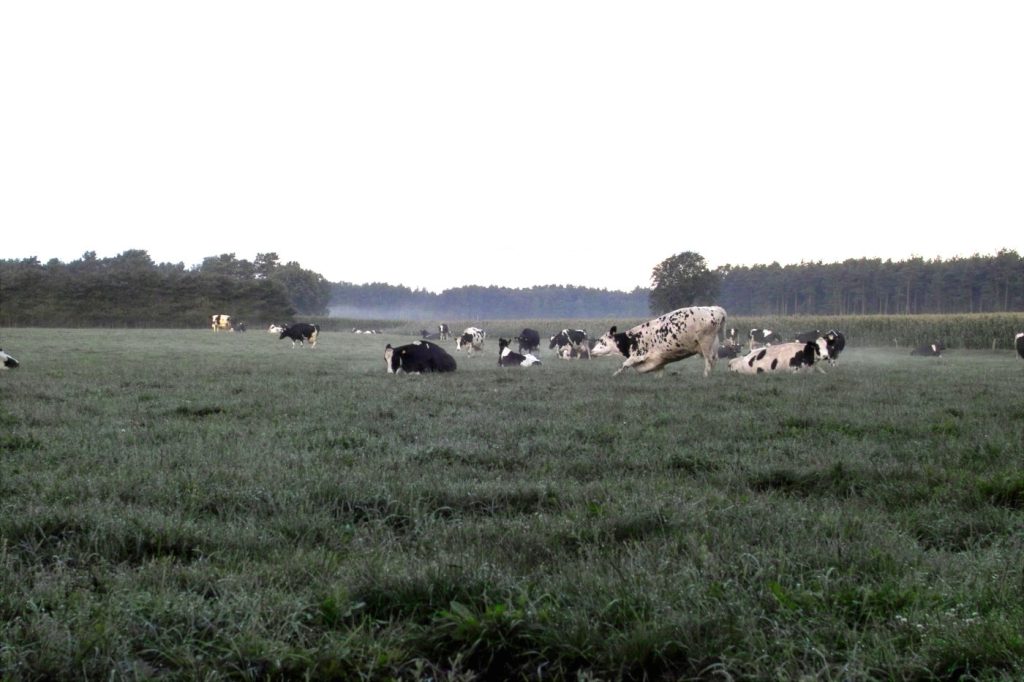
I know what that means. I know how long it takes before an animal trusts a person like that. And I know that I cannot put it into words that anyone would understand who has never experienced it.
That is the actual problem. Not the technology. Not Nestlé. Not the bureaucracy.
But that fewer and fewer people still know what they do not know.
Andreas Paul John is a master farmer, civil engineer and software developer. He has worked with cattle for decades and has written several books on the relationship between humans, animals and technology. His most recent book Audhumbla Remembers tells the story of the domestic cow from the Big Bang to the present — from the perspective of the Norse primordial cow. You can speak with her at voice.andreas-john.net. All books and more: andreas-john.net
Schreibe einen Kommentar