
The Situation
In February 1763 Europe was exhausted. For seven years a war had raged that Winston Churchill would much later call the first world war, and wrong as the label is, the instinct behind it is right: the Seven Years’ War was fought on four continents and across all the oceans. At its heart lay two struggles. In Germany, Prussia and Austria fought over the rich province of Silesia. In the wider world, France and Britain fought over everything else, over North America, India, the seas.
At the end stood a new order. Britain had won globally, driven France out of North America and India, and become the first power on earth. And an upstart had held its ground: Frederick II of Prussia, against three great powers at once, kept Silesia and made Prussia the fifth European great power. Survival turned into a myth, the myth of Frederick the Great, the soldier-king and commander, who would shape Germany far into the twentieth century.
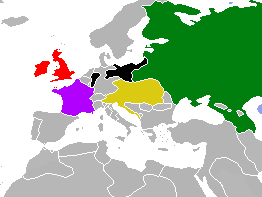
The European great powers around 1840: Britain in red, France in purple, Prussia in black, Austria in yellow, Russia in green (by 23PowerZ, after BlankMap-World-1840, GFDL)
These five, Britain, France, Austria, Russia, and now Prussia, would dominate Europe for a century; they are called the Pentarchy. Only five, and that was new. The old superpower Spain, in the sixteenth century still the empire on which the sun never set, had been worn out by endless wars and stripped of its American empire, fallen from the circle of those who decided, as had the Dutch Republic, Sweden, and a Poland carved up by its neighbours; five remained, and Prussia had only just joined them. Napoleon overturned the board once more, but the Congress of Vienna rebuilt it in 1815: the same five powers, a “Concert of Europe”, tuned by Metternich to suppress from above every stirring of nation and liberty. That was the order still standing in 1848, and the very order the revolution then rose against.
In North America the same war went by another name, the French and Indian War, and it was fought in the very world from which this series grew, the Pennsylvania of Conrad Weiser. A young officer named George Washington fought in it for the British Crown. The Native nations fought on both sides, each by its own calculation: the Iroquois mostly with the British, many peoples of the Ohio Valley with the French, among them the Lenape driven out in Episode 12, who now took up arms against Pennsylvania. What they lost after 1763 was therefore not simply an ally but the balance. As long as two great powers contended for the continent, one could be played against the other; when France vanished, that lever was gone, and the dispossession Episode 12 described gathered speed.
And the war had a sequel that is seldom told. In 1763, no sooner was it over, the British Crown drew a line. With the Royal Proclamation it forbade its own settlers to settle west of the Appalachians; the land beyond the mountains was to be reserved for the Native nations. London had honourable reasons for this.
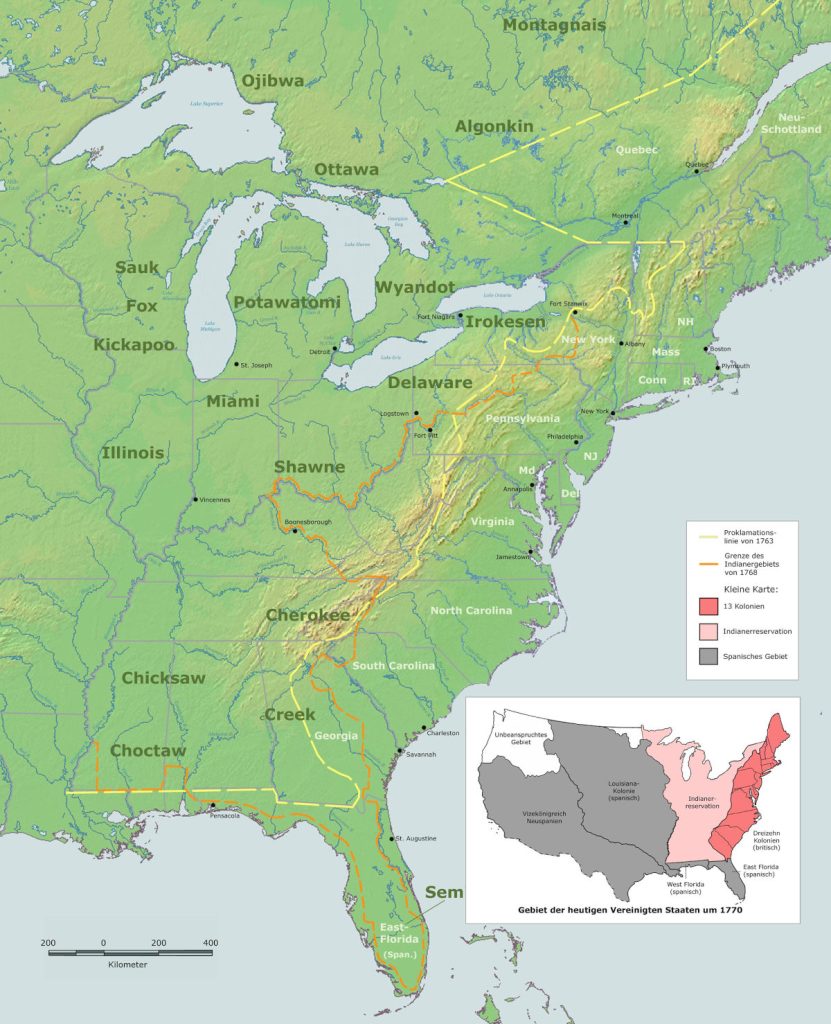
Eastern North America in 1770, with the Proclamation Line of 1763 (yellow) and the line after the Treaty of Fort Stanwix of 1768 (orange)
Peace with the Native nations was cheaper than a new war, and one such war the Crown was waging just then, the rising of the Ottawa chief Pontiac. But there was also a cooler reason. As long as the colonists stayed on the coast, they could be governed and taxed; out in the far west they would have slipped the Crown’s grasp. The line was meant to protect the Native nations and to keep the settlers together, both at once.
The settlers saw mostly the second. They were a people with a hunger for land, as Episode 12 showed, and now, of all things, the distant Empire stood in their way. The Proclamation Line became, alongside the taxes, one of the reasons they finally rose against the Crown. In that lies a bitter irony. The one power that for a moment placed itself between the settlers and the Native land was command from above, the Empire. And the settlers threw it off, partly to get at the land.
And it was not only the small settler with his axe. The great men of the coming revolution had hard interests too. Washington, the young officer of a moment ago, was not only a planter and slaveholder; he was one of the largest land speculators in the colonies. From his war service he held claims to lands in the west, beyond the mountains, and he had them secured, Proclamation or no; the line he privately called a mere expedient to quiet the Native peoples. He was no exception. A good part of the founding elite sat in land companies speculating on exactly the territory the Crown had closed. The liberty for which men soon took up arms was also the liberty to take this land.
But the disturbing thing about this war is not the battles, it is the bills. Both victors came out of it in debt. To pay off the debt, London taxed its American colonies, and out of the resistance to that came 1776. France, which had lost the war and then spent itself once more on America’s independence, slid into bankruptcy, and out of that came 1789. Two revolutions this series has already followed, two fuses, laid by one war. But there was a third, and it burned slowest. Its name was Prussia, and it led to the question of who would one day lead Germany, Berlin or Vienna. That fuse burned for a century. This episode follows it.
The Revolution That Failed
For a moment it looked as if Germany would take the other road, the one from below. In 1848 a wave of revolutions swept over Europe, and in Germany something convened that had never existed in this form: a freely elected parliament, the Frankfurt National Assembly in the Paulskirche, meant to write a constitution and unite the nation from below, by deliberation rather than by command. Professors, lawyers, citizens. The liberal dream, for once within reach.
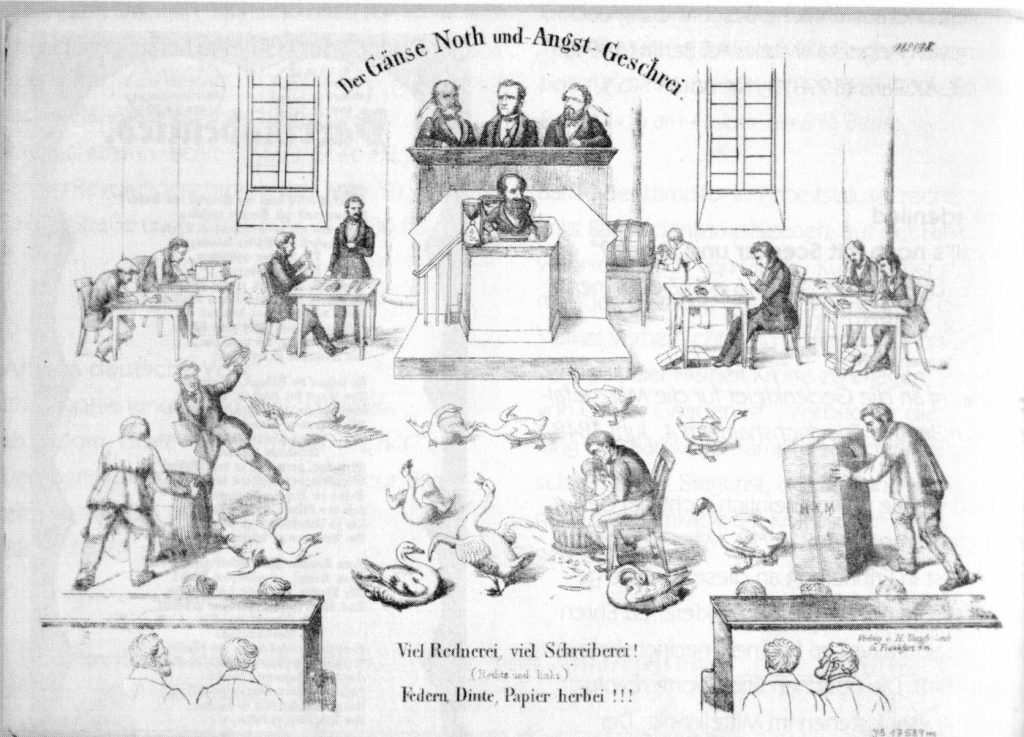
The National Assembly was a frequent target of satire. This cartoonist imagines the mountains of goose quills used up in recording the speeches (by Ws-KuLa, own work, CC BY-SA 3.0)
Why did it fail? Not only at the points of the bayonets. The men of the Paulskirche, professors and lawyers, debated for months over basic rights and constitutional articles, while the old powers reorganised their armies and the astonishment of the spring wore off. Many of the bourgeois liberals feared, in the end, the radical street, the mob, the republic, more than they feared the throne, and sought a compromise with the kings rather than a break. On top of that the movement was split: some wanted a constitutional monarchy, others a republic. While they argued, autumn came, and with it the army returned.
The end came with a single gesture. In April 1849 the assembly offered the Prussian king Frederick William IV the German imperial crown. He refused. A crown from the hand of an elected parliament, from the hand of the people, he would not pick up; it was, he said in effect, a crown “from the gutter”. He would accept it only by the grace of God and from the hands of his fellow princes, not from the street. It was the logic of Episode 13 in one sentence: right and power come from above, not from below. The parliament had no army. The kings had armies. The revolution collapsed.
The English historian A. J. P. Taylor caught it in a sentence that has stood over 1848 ever since: “German history reached its turning-point and failed to turn.” The road from below had been tried and closed. What took its place came from above.
The Forty-Eighters
The defeated of 1848 did not vanish. Thousands fled, first to Switzerland, which defended its young right of asylum against the massed pressure of Prussia and Austria, then onward to England and above all to America. There they were called the Forty-Eighters, and they came not as broken men but as convinced democrats with a second attempt in their luggage.
What had failed them in Germany, the cause of liberty from below, they took up again in the new world, and this time at the decisive front. They hated slavery on the same principles on which they had hated the princes. Carl Schurz, once a fugitive from the Baden rising, campaigned in German for Abraham Lincoln, delivered him the German vote, and later became a Union general, a senator, and United States Secretary of the Interior. Around Franz Sigel, a former Baden war minister, a battle cry went round the Union army, half German, half English: “I fights mit Sigel.” More than four hundred thousand men of German descent went to war for the North.
So a circle closed that no one had planned. The revolution from below, dashed in Germany against the bayonets of the princes, sent its men across the Atlantic, where they helped to save another union from below. Germany’s loss was America’s gain. And with that we are in the decade in which, on both sides of the ocean, everything was decided.
The Hinge Decade
And now the lesson, for in the same years two great nations were forged by war, on exactly opposite principles.
The one was America. From 1861 to 1865 the Civil War tore the country apart, the bloodiest war in its history, more than six hundred thousand dead, fought over the question of whether the Union would hold, that Union which had come into being from below, from the consent of its citizens, and which now threatened to break apart over slavery. Here too one should not paint the hero too brightly.
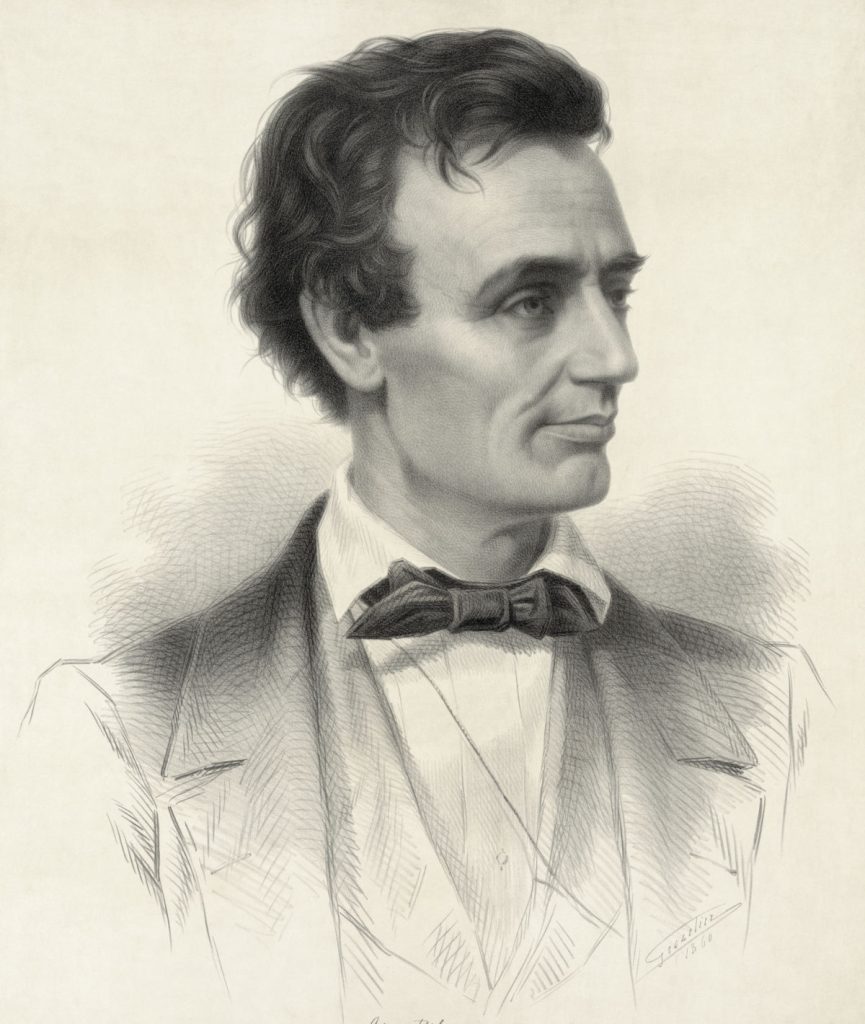
Abraham Lincoln in 1860 (restoration by Adam Cuerden, public domain)
Abraham Lincoln was a pragmatist; if it were up to him, he wrote in 1862, he would save the Union with slavery or without, whichever saved it. Only the pressure of the war, and the urging of Black abolitionists like Frederick Douglass, made him an emancipator; and the enslaved freed themselves in good part, fleeing the plantations by the hundreds of thousands and fighting, almost two hundred thousand of them, in blue uniform. Yet the sentence Lincoln spoke in 1863 at Gettysburg named the stakes so exactly that it still stands: a government “of the people, by the people, for the people”. The Union was preserved, at a terrible price, but on the principle of consent, and in the end the war cost slavery its life.
The other was Germany, the same years, a different man. Otto von Bismarck, minister-president of Prussia, stood before the parliament in 1862 and said that the great questions of the day would be settled not by speeches and majority votes, that had been the error of 1848, but “by iron and blood”. He is almost always misquoted, reversed, as “blood and iron”; that order was given him only by the French and English press of the 1870s, because it sounded catchier. Bismarck said iron first. And he made good on it: three wars in eight years. 1864 against Denmark. 1866 against Austria, the old rivalry from the Seven Years’ War at last decided, Prussia over Vienna, for the mastery of Germany. 1870 against France. In January 1871, in the Hall of Mirrors at Versailles, the German Empire was proclaimed. Germany was united, not by a parliament from below, but by a chancellor and an army from above.
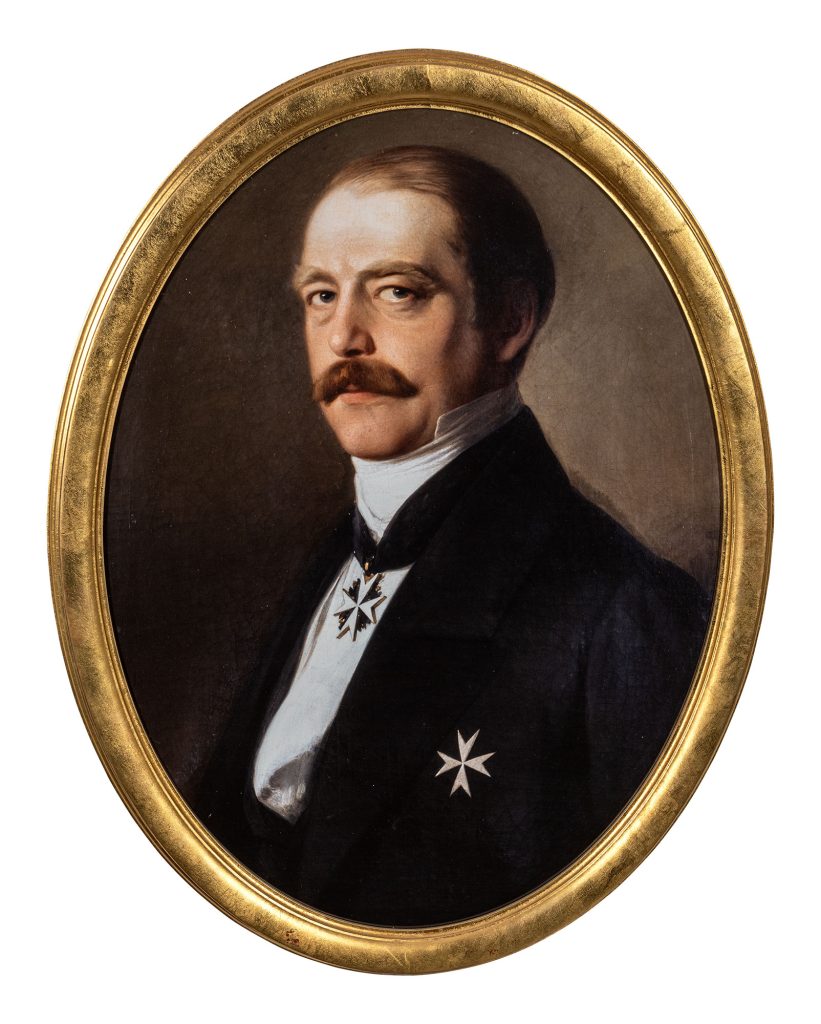
Bismarck as Prussian envoy to the Federal Diet, 1858, wearing the neck decoration and breast cross of an Honorary Knight of the Order of Saint John (by Jakob Becker, public domain)
And then there was a third case, the quietest, and it is the counter-design to both. Britain in these decades fought neither civil war nor war of unification. It widened the franchise, from below, step by step, by law: the Reform Acts of 1832 and 1867. The circle of voters grew, the state gave way, without a shot being fired. Three nations, three roads. America bled to save its union of consent. Britain reformed itself in stages. Germany was forged from above, with iron.
The Authoritarian State
The empire Bismarck built was a marvel and a warning at once. It was the most dynamic state in Europe, with the industry, the universities, and the social insurance of which Episode 13 told. But its constitution placed the Kaiser, the chancellor, and the army above the parliament. The Reichstag could talk and approve the budget, but the government answered not to it but to the Crown alone. The German was a subject who obeyed, not a citizen who governed. The unification had come from above, and the state stayed above.
The hero fit the part. The Frederick the Great of the Seven Years’ War, the soldier-king, became the national icon, revered far into the twentieth century. The state from above had its myth, and its myth was a warrior.
Here caution is needed, and in two directions at once. It is tempting to draw a straight line from 1871 through 1914 to 1933, as though Germany had been condemned to disaster by a “special path”. Historians like Christopher Clark and Thomas Nipperdey have warned against this straightness, and they are right: nations are not condemned to their fate. And one should not make the nationalism of 1848 the scapegoat. Nationalists then were all of them, from Paris to Warsaw, and nationalism was not merely an aggressive urge. With the nation the citizen was born, the equal before the law, in place of the subject and of aristocratic privilege. The men of the Paulskirche too thought nationally, quarrelled over Posen and Schleswig; that did not set them apart from their neighbours.
What set Germany apart was not that it became a nation, but how. It got the nation without the control from below. And there lies the sentence that can be defended. A strong parliament makes every war harder; it must consent, it must pay, it can say no. A Kaiser, by contrast, to whom the army and foreign policy belong alone, can lead a people into war before the parliament is even asked. That is exactly what happened in 1914: over war and peace it was the Kaiser, the generals, and the chancellor who decided, not the Reichstag, which afterward was left only to vote the war credits. The unification from above had taken the lever of war out of the people’s hand and placed it in the Crown’s.
The road was thus not predetermined. But it was open, and it stayed open. A nation raised to obedience, whose army stood above its parliament, was less guarded against catastrophe than one built on consent. The catastrophe that began in 1933 is hardly thinkable without the authoritarian state of the Kaiserreich, without its practised habit of obedience. Where the road led, through two world wars, is the darkest chapter, and not one to be told as fate.
What Remains
Here too one must lay both ledgers open. From above, Germany got unity, power, and the most modern state on the continent, and faster than any parliament could have managed. Where consent from below had failed, command from above delivered the result. The price stood on the other side of the account: the citizen as subject, the army as mistress, the habit of obedience that a later regime would so terribly exploit.
One more thing, by way of outlook. The young empire quickly became the strongest industrial and scientific power in Europe. It contended with Britain for the seas and carried within it the old enmity with France, a reckoning that reached far back. Where this road led, to the abyss of 1914, and how far back one must go at all to understand the deep rift between state and individual that this series set out to trace, is the final episode.
Sources and References
The principal names, wars, and events are linked directly in the text. Listed here is only what cannot be linked:
- On the dictum about 1848: A. J. P. Taylor, The Course of German History (1945) — “German history reached its turning-point and failed to turn.”
- On Bismarck’s speech of 30 September 1862 to the budget commission: in the original “not by speeches and majority votes … but by iron and blood”; the common reversal “blood and iron” comes from the later (chiefly French and English) reception.
- On the refused imperial crown: Frederick William IV declined the crown offered him by the Frankfurt National Assembly on 3 April 1849 (invoking the grace of God, not popular sovereignty); the phrase about a crown “from the gutter” is the summary attributed to his stance.
- On the Forty-Eighters: Carl Schurz (later Union general, US senator, Secretary of the Interior), Franz Sigel, and others; the mobilisation of German-American voters for Lincoln in 1860, more than 400,000 men of German descent in the Union Army; the battle cry “I fights mit Sigel”.
- On the nationalism of the Paulskirche: the pre-parliament declared in March 1848 the restoration of Poland a duty; on 27 July 1848 the National Assembly voted 342 to 31 for the partition and annexation of Posen; Wilhelm Jordan’s speech on a “healthy national egoism”; and the Schleswig-Holstein question against Denmark.
- On the Sonderweg debate: for (Hans-Ulrich Wehler, A. J. P. Taylor) against (Christopher Clark, Thomas Nipperdey, Heinrich August Winkler) — against a historical determinism from 1848 to the world wars.
- On the demythologising of Lincoln: his letter to Horace Greeley (22 August 1862, “If I could save the Union without freeing any slave I would do it …”); the self-liberation of the enslaved (mass flight to Union lines, almost 200,000 Black soldiers of the USCT) and the urging of Black abolitionists like Frederick Douglass; cf. the documentary series Lincoln’s Dilemma (Apple TV+, 2022).
- On the Pentarchy and the Congress of Vienna (1814/15): the five great powers and the “Concert of Europe”; Metternich’s restoration and the suppression of liberalism and nationalism (including the Carlsbad Decrees of 1819) until 1848.
- Dates: Seven Years’ War 1756–1763 (Peace of Paris and of Hubertusburg, 1763); first partition of Poland 1772; US Civil War 1861–1865, Gettysburg 1863; the Prussian wars of unification 1864/1866/1870–71, the Empire proclaimed in the Hall of Mirrors at Versailles on 18 January 1871; the British Reform Acts of 1832 and 1867.
Schreibe einen Kommentar