
Religion from below
In the late summer of 1742 a thirty-two-year-old pastor stepped ashore in Philadelphia who spoke barely any English and knew almost no one. Heinrich Melchior Mühlenberg had come from Halle, sent by the Francke Foundations to look after the German Lutherans of Pennsylvania. What he found, a European churchman would have taken for a hopeless muddle. In truth it was a Christian-religious primordial soup, and out of it grew something Europe did not know: freedom.
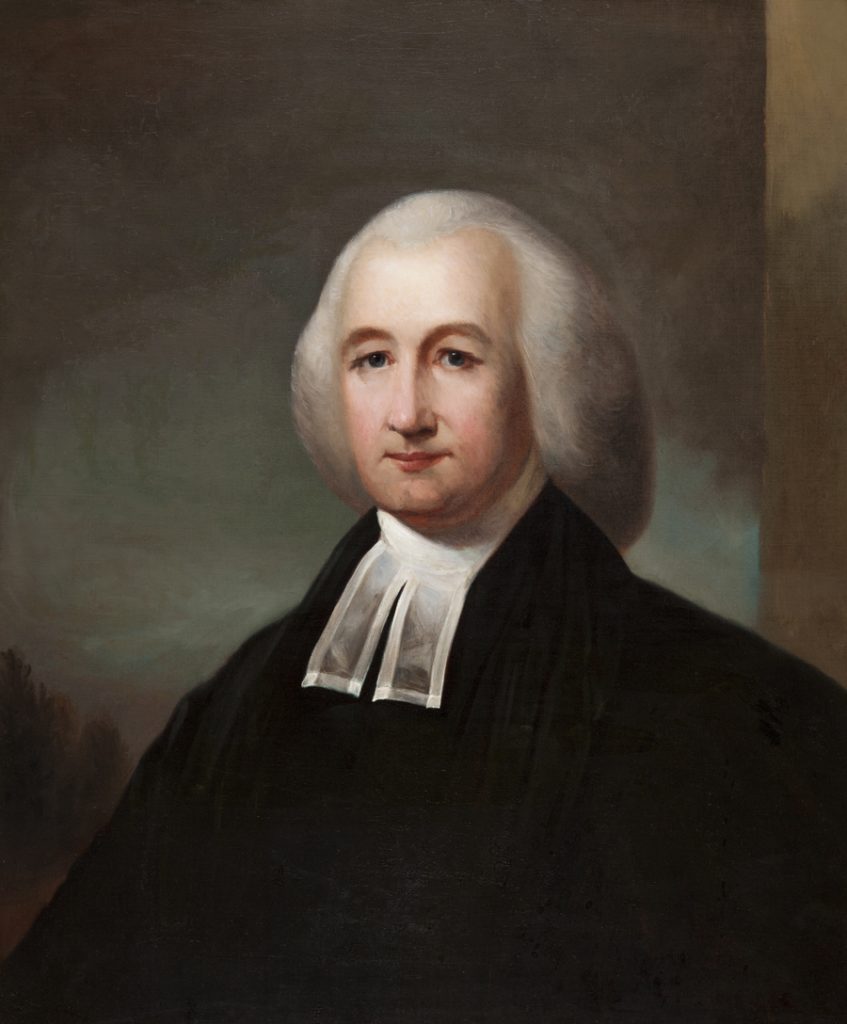
For what was missing here was not the faith but the apparatus. No bishop, no consistory, no prince who decreed the confession from above, and no tax to pay the pastor. In Europe the church came with the state; here there was none. That had its price: where no one kept watch, many an impostor could throw on a cassock and a runaway schoolmaster play the preacher. But above all it had a consequence Europe did not know. Whoever wanted a church here had to build it himself, congregation by congregation, and the people on the spot did it: they called their own pastor and paid him voluntarily. And whoever pays has a say. How does a church come into being when no state makes it, but the believers themselves?
Penn’s holy experiment
To understand this soup, one must know where Mühlenberg had landed. Pennsylvania was an experiment, and its inventor had called it that himself: a “holy experiment”. William Penn, a Quaker, had founded the colony in 1681 as a refuge for the persecuted and written into it something that existed nowhere in Europe. No one was to be troubled on account of his faith.
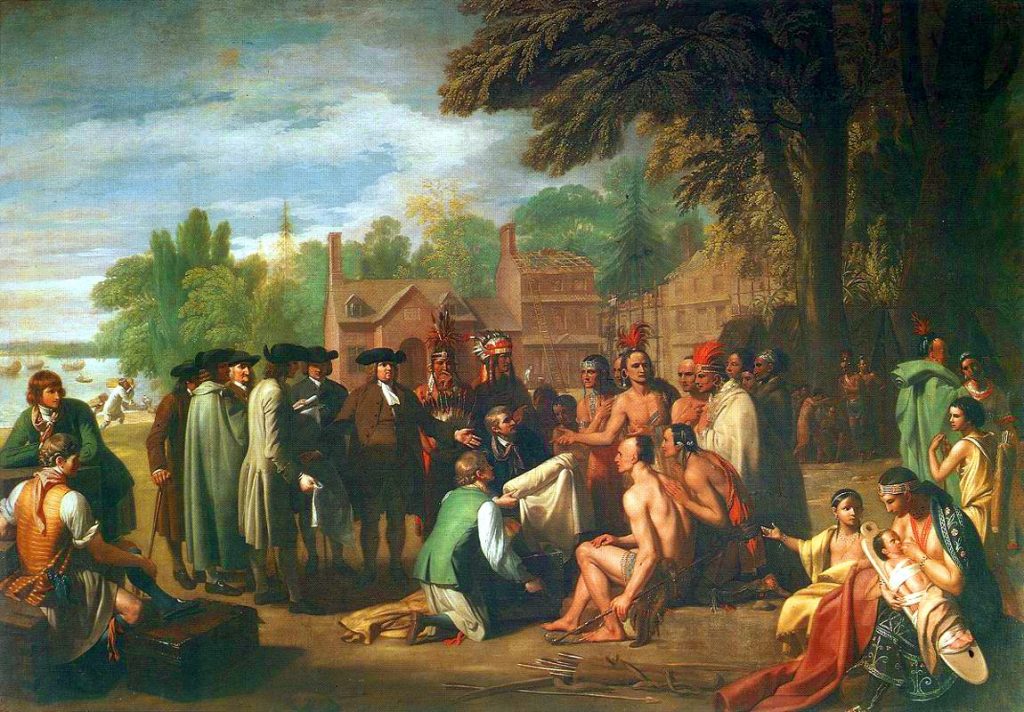
What came of it was the most colourful religious patchwork in the Western world. Quakers and Lutherans, German Reformed and Presbyterians, Mennonites and Amish, the Moravian Brethren at Bethlehem, Schwenkfelders and Dunkers, plus Catholics and a few Jews, tolerated to a degree unthinkable elsewhere. None of these groups was large enough to raise itself into a state church. The religious freedom of Pennsylvania was not first an idea of the philosophers. It was a practical necessity, forced from below. Where twenty sects live door to door, one must tolerate one another, or there is war. Out of the diversity came the freedom, not the other way round.
Not everyone found it charming. Benjamin Franklin, otherwise a tolerant man, viewed the German immigrants with unease; in 1751 he asked why the “Palatine Boors” came in such swarms that they would “Germanize us” instead of letting the English Anglify them. Remember this worry. We will come back to it.
There was much movement in this religious landscape. Around 1740 the first great revival, the Great Awakening, swept through the colonies; itinerant preachers travelled the country, and new, fervent movements such as the Baptists and the young Methodists outpaced the old, stiff churches. Religion here was not only free, it was a competition one could lose. Even the founders felt it. In 1756 the Quakers, to whom Pennsylvania belonged, gave up their majority in the Assembly, because as pacifists they would not help finance the Seven Years’ War. Whoever carries no weapon eventually loses power to those who do, a foretaste of what the next part will tell.
Ecclesia plantanda
Into this throng Mühlenberg set his life’s motto: Ecclesia plantanda, the church must be planted. Planted, not transplanted. He grasped early that he could not, and must not, erect a copy of the German territorial church. It had to become an American church, one that stood on its own feet without the arm of the state.
So he built it the way everything was built in America, from below. He travelled without rest, settled quarrels, exposed the false preachers, gave the congregations orders of their own to keep. In 1748 he convened in Philadelphia the Ministerium of Pennsylvania, the first Lutheran synod in America. Its composition says everything: six pastors and twenty-four laymen, elected representatives of the congregations. In Germany an authority would have decided over the church. Here the farmers and craftsmen sat at the table too, the ones who paid for it all. A church as the association of its members, a synod of elected representatives, clergy and laity together, governing itself. Lived self-determination in Philadelphia, almost four decades before a constitution was written in the same city.
The same seed, a different soil
Here a circle closes that began in Part 8. Mühlenberg was a child of Halle, that Pietist school which in Prussia had become a tool of the state. Francke’s institutions supplied the disciplined officials and officers of the king. The same piety, the same seed. In Prussia it fell on the soil of the state and was harnessed. In Pennsylvania it fell on a soil without a state and grew free.
In Germany the church was a matter of the prince, who was at the same time its supreme bishop, the summus episcopus; the faith came with the land, from above. In America there was no prince to whom the church belonged, and no tax to carry it. Whoever wanted a congregation had to persuade the neighbours, gather money, call a pastor and pay him. Religion became voluntary, or it was nothing at all. And the astonishing thing: it flourished precisely because of that. A church no one compels must advertise, must be worth something, must be alive. Halle had supplied the seed; the American soil determined what grew from it.
Not only the Pietists
Mühlenberg was only one of many, and it would be wrong to grant the Pietists a monopoly on building from below. Whoever looks finds the same thing everywhere, some of it even earlier.
The Scots-Irish Presbyterians were ahead of Mühlenberg. Francis Makemie, their patriarch, founded the first presbytery in Philadelphia as early as 1706, two generations before the Lutheran Ministerium. The very name carries the principle: Presbyterian comes from the Greek presbyteros, “the elder”. This church is not steered by bishops from above but by elected elders, the presbyters, from the midst of the congregation.
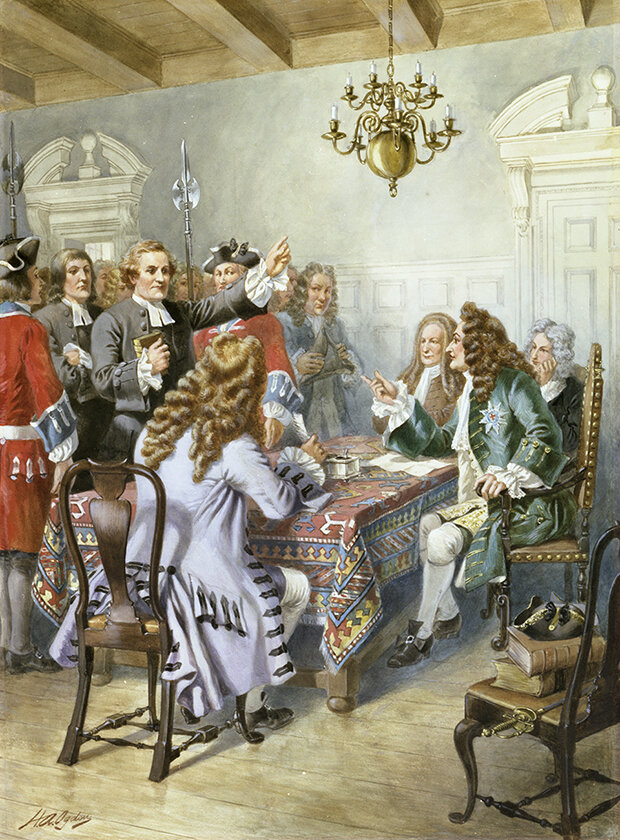
Their constitution was from the start an order from below: presbyteries, synods, a self-government in tiers that later stood godfather to the federal structure of the republic. And their zeal for education was legendary. Out of the Log College, the log-cabin school of William Tennent, grew the College of New Jersey, that Princeton where, in Part 10, Witherspoon taught the young Madison.
Even the Anglicans, the most state-bound of the confessions, learned from Halle. Their American name betrays the opposite principle: Episcopalians, from the Greek episkopos, the bishop, the overseer, the church from above. The two names are the whole fault line in two Greek words: the elder against the bishop, below against above. And yet they too learned. Their societies for the promotion of Christian knowledge and of the Gospel, founded around 1700, built charity schools and sent out missionaries; their school work drew expressly on Francke’s model, and the first Protestant mission to India was a joint Anglican-Lutheran undertaking. Halle was no isolated case but a seed that flew on. From it came also the Moravian Brethren, the most zealous missionaries of the century, and through them even the young John Wesley was infected, whose Methodists soon stirred up the whole English-speaking world from below.
Why, then, the same thing everywhere? Not because one confession was especially devout, but because the soil imposed the same compulsion on all. Where no state church ruled, every community had to carry, advertise, and organise itself. Even the church of the bishops got no bishop of its own in the colonies; it too had to make do like everyone else.
The counter-image is supplied by the Catholic Church. In sheer achievement it surpassed them all: the Jesuits in New France, the Franciscan missions of New Spain, the teaching and nursing orders. Only this apparatus came with the state. The Spanish crown financed the missions, the fathers were evangelists and instruments of empire at once. In the British colonies, by contrast, where no state helped, Catholicism remained a small, often persecuted minority. The same church that created great things from above in the Catholic empire scarcely got off the ground from below. That too is an answer to the question of this part.
The man in the middle
Mühlenberg did not stand alone in this German world, and he married into its very centre. In 1745 he took as his wife Anna Maria, the daughter of a man who lived between the worlds like almost no other: Conrad Weiser.
As a boy Weiser had gone among the Mohawk, had learned their language, their diplomacy, their way of thinking, and became the most important interpreter and negotiator between the colony of Pennsylvania and the Iroquois League, the Six Nations. When the English and the Indians negotiated, a German stood in the middle and translated not only words but two world-pictures. And because Pennsylvania was what it was, Weiser was allowed to wander in his faith too. For six years he lived in the cloister of Ephrata, the mystical Seventh-Day community of Conrad Beissel, before he found his way back to the Lutheran world of his son-in-law. A life possible only in this colony.
The cloister that became a hospital
Mühlenberg ordered the Lutheran cause; the other currents, though, remained, each in its own way, and none was stranger than the one at Ephrata. Conrad Weiser’s six years there were no marginal whim. Beissel’s cloister was the outermost edge of what Pennsylvania’s freedom allowed: an ascetic, mystical, celibate community that sang in white robes, slept little, and rested on narrow wooden benches. In Europe such a thing would have been forbidden. Here it was allowed to exist. And of all groups, this world-renouncing sect, when it mattered, did something great.
In the winter of 1777, after the battles of Brandywine and Germantown, Washington’s army urgently needed room for its wounded. Ephrata gave it. The pacifist brothers and sisters, who themselves touched no weapon, turned their cloister into a hospital and nursed some two hundred and fifty sick and wounded soldiers. It cost them their lives. Camp fever leapt from the soldiers to the carers, several of the order died of it, fifty-seven soldiers likewise; the contaminated buildings had to be torn down afterwards. The graves lie to this day in the cemetery of Mount Zion.
A bitter point belongs to this, and it is true. The most famous work of the Ephrata press was the Martyrs Mirror, the largest book of colonial America, a history of the Anabaptists who had died for their non-violence. In the war, soldiers seized the unsold copies and cut the pages into cartridge papers, paid for with nearly worthless Continental paper money. The leaves about the martyrs of peace became ammunition. So close, in this free world, lay holiness and war.
Pulpit and Congress
From Mühlenberg’s marriage and Weiser’s grandchildren came the generation that answered Franklin’s worry, thoroughly and with irony.
Mühlenberg’s eldest son, Peter, was a pastor in Woodstock, Virginia. According to tradition, recorded by a great-nephew in a biography of 1849, he preached in January 1776 on Ecclesiastes: to everything there is a season, a time of peace and a time of war, “and this is the time of war”. Then, so the story goes, he threw off his cassock and stood there in the uniform of a colonel. Whether it happened exactly so, no one knows; the scene was written down a hundred years later. But Peter Mühlenberg did indeed lead a regiment into the War of Independence, became a general and later a member of Congress. The “fighting parson”.
His brother Frederick took the other path, likewise from the pulpit. He became the first Speaker of the House of Representatives of the United States and, as such, set his signature under the promulgation of the Bill of Rights. The one German pastor’s son led soldiers, the other led Congress.
One episode rounds this off and at the same time clears away a stubborn legend. In 1794 German immigrants from Virginia asked Congress to print federal laws in German as well; the motion failed narrowly, by forty-two to forty-one votes. From this later grew the myth that German had missed becoming the official language of the United States by a single vote, and that of all people the German-descended Mühlenberg had prevented it. Both are false: it was never about an official language, only about translations, and Mühlenberg abstained. But a sentence of his has come down that says it all: the sooner the Germans became Americans, the better.
So much for Germanization. Franklin’s fear that the Germans would remain a foreign block went thoroughly wrong, and the reason is the point of this part. The American “we” was no blood and no language. It was a profession of faith, in rights, in self-government, in freedom of belief. Exactly what the Germans, the Scots-Irish, the Huguenots had fled, they found here; and exactly for that reason they could become Americans without ceasing to be Lutherans or Mennonites. A people one enters by a creed, not by birth.
Full churches, empty pews
It is worth a glance across into our own time. Germany still levies a church tax to this day, administered by the state, and the pews empty year by year. America knows no church tax and no state church, and its churches are fuller than those of any other Western nation. And the primordial soup of 1742 keeps bubbling: the Amish still plough with the horse, Jewish communities flourish, and around Detroit, in Dearborn for instance, whole suburbs are Muslim in character. What began in Pennsylvania has never come to an end. The American religion is alive, fragmented, sometimes loud, and often open to revival preachers and profiteers; the European is orderly and dignified, but weary. Which of these is the better inheritance, every reader sees differently, depending on what he expects of religion.
One thing, though, is certain: the church Mühlenberg planted was America’s order from below, translated into faith. But so far we have seen only the bright side of this world, the settlers, the congregations, the bridge-builders. There was another, one that took the land from the first inhabitants. The double face is the next part.
The currents at a glance
The terms easily get muddled; “Episcopalian”, “Presbyterian”, “Dunker” are hardly in daily use today. So here is a rough guide through the Pennsylvania of the eighteenth century, with no claim to completeness.
| Current | Origin | Defining trait |
| Lutherans | Germany | Mühlenberg’s church; congregations with an elected synod (the Ministerium of 1748) |
| German Reformed | Germany, Switzerland | Calvinist, organised presbyterially |
| Presbyterians | Scotland, Ulster | Calvinist; led by elected elders (presbyteros), from below |
| Episcopalians (Anglicans) | England | state church; led by bishops (episkopos), from above |
| Quakers (Society of Friends) | England | no clergy, the “inner light”, pacifist; founders of Pennsylvania |
| Mennonites | Anabaptist (Switzerland, Netherlands) | adult baptism, non-violence, plain living |
| Amish | split from the Mennonites (1693) | the strictest separation from the world |
| Dunkers (Brethren, Tunkers) | radical Anabaptist Pietists | baptism by triple immersion |
| Moravian Brethren (Herrnhuter) | Bohemia, Saxony (Zinzendorf) | communal settlements, world missions; Bethlehem |
| Ephrata Cloister | radical Pietism (Beissel) | ascetic, celibate Sabbatarian commune |
| Catholics | Rome | hierarchy under the Pope; tolerated only in Pennsylvania |
| Huguenots | France | Calvinist refugees, quickly assimilated |
| Jews | Sephardic | economic freedom, but no political office |
| Baptists | England, the colonies | adult baptism, congregational autonomy; rose in the Great Awakening |
| Methodists | England (Wesley) | evangelical revival, classes and itinerant preachers |
Sources and references
Primary sources – Heinrich Melchior Mühlenberg, journals and reports to Halle; the Ministerium of Pennsylvania (1748) – Benjamin Franklin, Observations Concerning the Increase of Mankind (1751) — “Palatine Boors”; the worry about the “Germanizing” of Pennsylvania
Secondary literature and references – On Mühlenberg: sent in 1742 by the Francke Foundations of Halle to Pennsylvania; Ecclesia plantanda (an independent American church, not a copy of the territorial church); “Patriarch of American Lutheranism” – On William Penn’s “holy experiment” (1681) and the religious pluralism of Pennsylvania (Quakers, Mennonites, Amish, Moravian Brethren, Schwenkfelders, and others) – On Conrad Weiser: youth among the Mohawk; interpreter and negotiator of the Six Nations; six years in the Ephrata Cloister (Conrad Beissel); father-in-law of Mühlenberg (marriage to Anna Maria Weiser, 1745) – On the Ephrata Cloister: the hospital of the winter of 1777/78 (some 250 wounded from Brandywine and Germantown, 57 soldiers dead, camp-fever deaths among the order too, mass grave at Mount Zion); the Martyrs Mirror (Ephrata printing 1748–51, the largest book of colonial America), copies of which were cut up for cartridge paper in the war – On Peter Mühlenberg, the “fighting parson”: the sermon-and-cassock scene survives only in the biography by his great-nephew Henry A. Muhlenberg (1849), hence tradition, not contemporary evidence; general in the War of Independence, later a congressman – On Frederick Mühlenberg: first Speaker of the US House of Representatives (from 1789); the “Muhlenberg legend” around the 1794/95 vote on printing federal laws in German (failed 42–41, Mühlenberg abstaining) — the myth of the narrowly missed “German official language” is historically false (cf. Dennis Baron; English Wikipedia, “Muhlenberg legend”) – That religion “from below” was no Pietist monopoly: the Presbyterians (Francis Makemie, first presbytery 1706; Log College → Princeton; presbyterial self-government); the Anglican societies SPCK (1698) and SPG (1701), whose charity-school work took Francke’s Halle as its model (the Danish-Halle mission to India as an Anglican-Lutheran cooperation); the Moravian Brethren (Zinzendorf, out of Halle) and their influence on Wesley and Methodism – On Catholic mission as state-backed “from above”: Jesuits in New France, Franciscans in New Spain, financed by the Spanish crown; in the British colonies a persecuted minority (Maryland excepted) – On voluntary religion without a state church compared with the European state church: Alexis de Tocqueville, Democracy in America (1835/1840)
Schreibe einen Kommentar